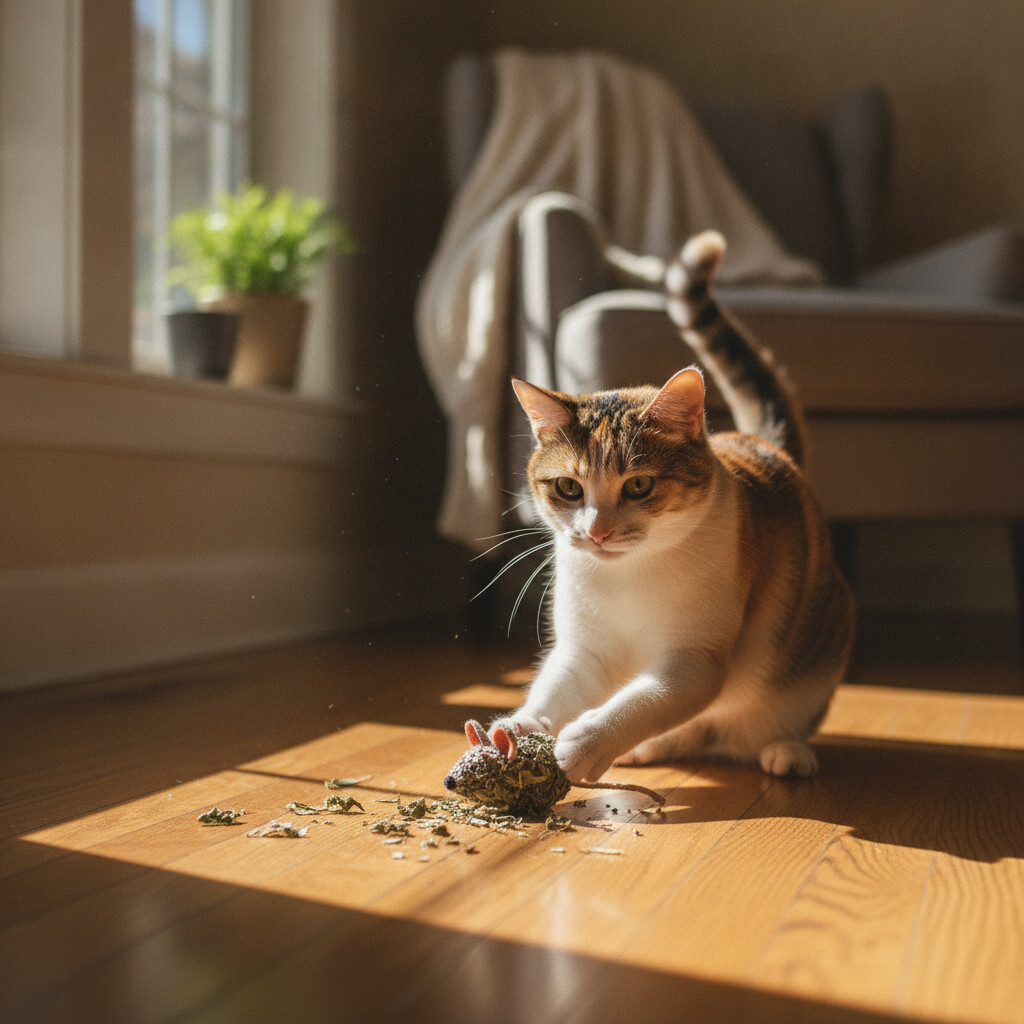
If your cat ignores catnip completely, they’re not broken — they’re probably just one of the roughly 30% of cats who lack the gene for it. The good news is catnip isn’t the only option. Silvervine and valerian root work through similar pathways and often reach cats who shrug off catnip entirely. Here’s how the three actually compare, and how to use them as real enrichment instead of a one-off novelty.
The Short Answer
Catnip, silvervine, and valerian all trigger a similar euphoric response in cats by binding to scent receptors linked to feline pheromone pathways, but they’re chemically different plants, and a cat’s sensitivity to each is genetically independent. Silvervine tends to work on the largest share of cats — including many that don’t respond to catnip at all — while valerian root has the least consistent, most individually variable effect. Rotating between the three, rather than relying on one, is the most reliable way to keep enrichment sessions actually working over time.
Catnip: The Familiar Baseline
Catnip (Nepeta cataria) triggers a response through a compound called nepetalactone, which binds to olfactory receptors and appears to mimic effects similar to cat pheromones. A 2017 study published in the Journal of Zoological Botanical Gardens and earlier genetic work going back decades estimate that sensitivity to catnip is an autosomal dominant trait, meaning roughly 50–75% of cats show a noticeable response and the rest show none — no amount of exposure will change that. Kittens under about three to six months typically don’t react yet, and reaction can fade slightly with extreme old age.
The response usually lasts 5–15 minutes, followed by a refractory period of an hour or two where the same cat won’t react again even with more exposure. This isn’t cats getting “immune” — it’s a normal reset period for the receptor pathway.
Silvervine: The Stronger, More Universal Option
Silvervine (Actinidia polygama) is a vine native to parts of Asia, and it’s gained popularity because it reaches cats that catnip doesn’t. A study published in BMC Veterinary Research (2021) found that around 75–80% of cats — including a meaningful share of catnip non-responders — reacted to silvervine, and reactions were often more intense and longer-lasting than catnip’s.
Silvervine’s active compounds — actinidine and related iridoids — work on an overlapping but not identical receptor pathway, which is the likely reason it succeeds where catnip fails. It comes in a few forms: dried fruit galls (small, hard, and typically ground into powder), powder, and sticks. The powder form tends to produce the strongest reaction because more surface area releases scent compounds faster.
Valerian Root: The Wildcard
Valerian (Valeriana officinalis) is the odd one out — it’s the same plant used in human herbal sleep aids, and its effect on cats is more variable and, for some cats, stimulating rather than sedating (the opposite of what it does in humans). The active compound, actinidine-related and also containing valerenic acid, appeals to a smaller and less predictable subset of cats than silvervine, and responses range from mild interest to intense rolling and vocalizing.
Because valerian’s effect is less consistent and slightly more likely to overstimulate certain cats, it’s worth introducing in a small amount first and watching the reaction before making it a regular fixture.
How to Rotate Them for Real Enrichment
A single catnip toy left in a bin for good just isn’t enrichment — it’s a discarded prop after novelty wears off. To get ongoing value:
- Rotate weekly, not daily. The refractory period means daily exposure to the same herb produces diminishing returns; giving a few days’ rest between sessions restores full potency of response.
- Try all three before assuming your cat “doesn’t like enrichment herbs.” A cat who ignores catnip may still respond strongly to silvervine — don’t rule out the category based on one plant.
- Combine with DIY puzzle feeders or scratching surfaces — rubbing silvervine powder into a scratching post or stuffing a small amount into a puzzle toy channels the resulting burst of energy into a physical activity rather than just aimless rolling.
- Watch for overstimulation. A small minority of cats become mildly irritable or even briefly aggressive during the response window. If that happens consistently, skip that herb and try another.
- Store dried herbs in an airtight container away from light — nepetalactone and the equivalent silvervine compounds degrade with air and UV exposure, which is why bargain catnip that’s been sitting on a shelf often underwhelms.
A Note on Safety
All three are considered non-toxic and non-addictive for cats in the amounts typically sold for pet use — there’s no evidence of dependency or harm from regular, moderate exposure, per veterinary toxicology consensus. That said, more isn’t better: excessive amounts, particularly of concentrated oils rather than dried plant material, can cause mild stomach upset. Stick to the small quantities in commercial cat products rather than human supplement forms of valerian, which are dosed for human bodies.
The Takeaway
If catnip does nothing for your cat, that’s genetics, not a lost cause — try silvervine next, since it works on a wider share of cats and often produces a stronger response. Keep a rotation going rather than relying on one herb indefinitely, and treat these as one tool in a broader indoor enrichment routine, not a replacement for physical play, climbing space, and mental stimulation.