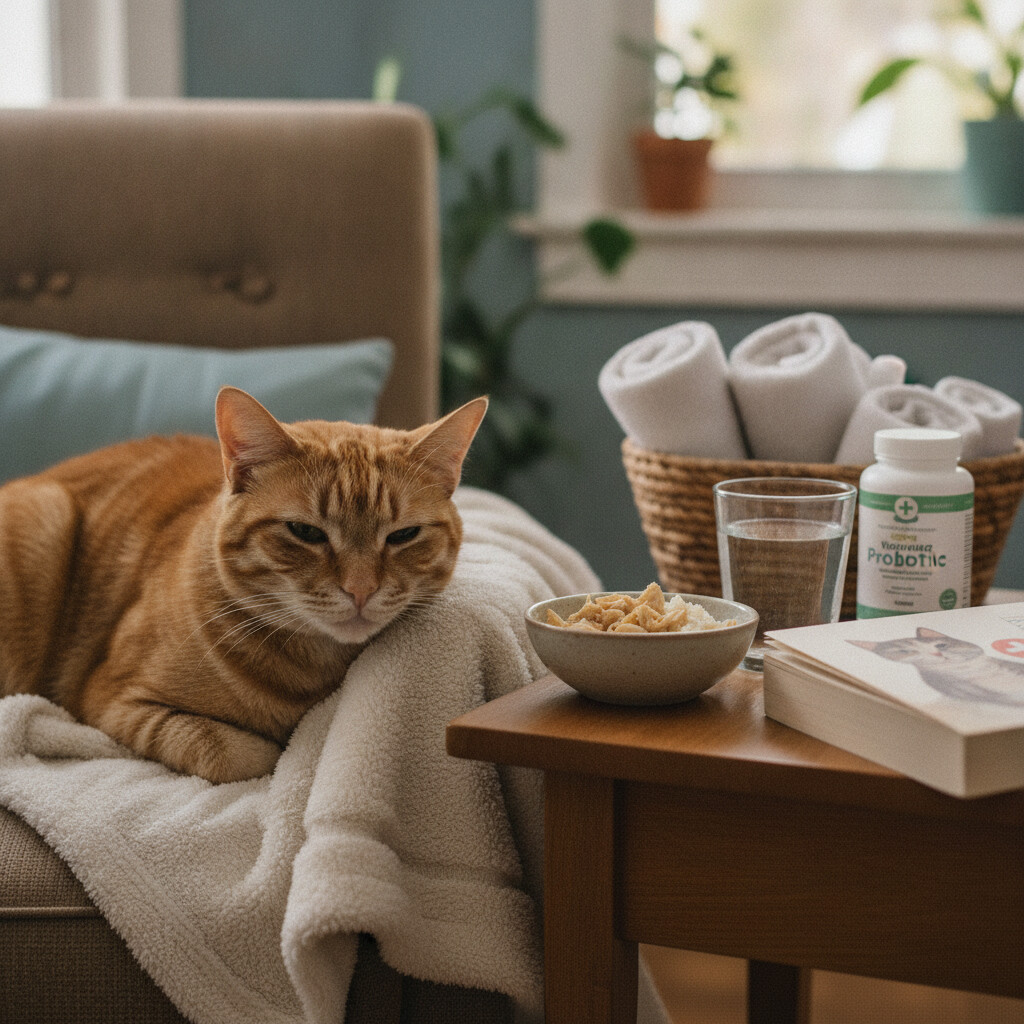
Most cases of cat diarrhea clear up on their own within a day or two and trace back to something simple — a food switch, a stolen bite of something they shouldn’t have had, or stress. The exceptions are what matter: diarrhea that lasts more than 48 hours, comes with vomiting or lethargy, or shows blood needs a vet, not a wait-and-see approach.
Diarrhea itself isn’t a disease — it’s a symptom, and the cause determines what you should actually do about it. Here’s how to sort out what’s happening and when to stop waiting.
What Usually Causes It
Dietary changes and indiscretion. Cats have sensitive GI systems, and an abrupt switch in food — even between two good-quality diets — is one of the most common triggers of soft stool. So is “dietary indiscretion”: table scraps, spoiled food, a housemate’s dropped pills, or anything raided from the trash. If your cat just started a new food, this is the first thing to rule out. (We cover the safest way to switch foods in our guide to transitioning your cat to a new food.)
Parasites. Roundworms, hookworms, and protozoal parasites like Giardia and Tritrichomonas foetus are common causes, especially in kittens, cats with outdoor access, and cats from shelters or multi-cat environments. Parasitic diarrhea often doesn’t resolve without targeted deworming or medication, which is one reason a vet visit — and a fecal test — matters more than it might seem for something that looks minor.
Infections. Bacterial infections (like Salmonella or Campylobacter) and viral infections (including feline panleukopenia in unvaccinated cats) can cause diarrhea, sometimes severe. Panleukopenia in particular is a medical emergency in young, unvaccinated kittens.
Stress. Cats are creatures of routine, and their gut often reflects that. A move, a new pet, boarding, or even rearranged furniture can trigger short-term diarrhea with no infectious cause at all. This tends to resolve as the cat settles back into normal life.
Chronic conditions. When diarrhea sticks around for weeks rather than days, inflammatory bowel disease (IBD), food sensitivities, hyperthyroidism, or — less commonly — intestinal cancer become more likely explanations. The American College of Veterinary Internal Medicine’s consensus guidance on chronic enteropathy in cats and dogs treats diarrhea lasting more than three weeks as a distinct clinical category that warrants full workup, not continued home management.
Home Care: What’s Reasonable to Try First
For a healthy adult cat with a single episode of soft stool, mild diarrhea, and no other symptoms, a short period of home monitoring is reasonable:
- Don’t withhold food entirely. Unlike the old advice for dogs, cats shouldn’t be fasted for more than 12–24 hours — prolonged fasting risks hepatic lipidosis (fatty liver disease), a serious and cat-specific complication. Feed smaller, more frequent meals of their regular diet instead.
- Stick with a bland, familiar diet rather than introducing anything new. If your vet has previously recommended a plain-chicken-and-rice approach or a specific GI-support food, this is when to use it — but check with them first rather than improvising, since cats need more protein than a bland carb-heavy diet typically provides.
- Make sure they’re drinking. Diarrhea causes fluid loss, and cats are notoriously prone to under-hydration already. A water fountain or a second water bowl in a different room can help.
- Track it. Frequency, consistency, color, and whether there’s blood or mucus. This detail is genuinely useful if you end up calling the vet — it speeds up triage significantly.
What you shouldn’t do: reach for human anti-diarrheal medication. Loperamide (Imodium) and similar drugs are not reliably safe for cats and can mask a problem that needs treatment rather than suppression. Don’t give anything without checking with a vet first.
When to See a Vet
Skip the wait-and-see approach and call your vet if you notice any of the following:
- Diarrhea lasting more than 48 hours
- Blood in the stool (bright red or black, tarry stool)
- Vomiting alongside diarrhea
- Lethargy, hiding, or noticeable appetite loss
- Diarrhea in a kitten, senior cat, or a cat with an existing health condition — these groups dehydrate faster and have less reserve
- Any diarrhea in an unvaccinated kitten — this warrants same-day attention given the risk of panleukopenia
- Repeated episodes over several weeks, even if each one seems mild on its own
Kittens and senior cats in particular can go from “a bit off” to dehydrated and in trouble much faster than a healthy adult cat, so the threshold for calling should be lower for them. If you’re ever unsure whether something warrants a same-day visit versus a scheduled appointment, most vet offices will triage that over the phone — use it.
How Vets Actually Work It Up
A vet visit for diarrhea usually starts with a fecal test to check for parasites, since that’s the most common fixable cause and the cheapest to rule out. Depending on what they find (or don’t), next steps might include bloodwork to check organ function and thyroid levels, a diet trial to test for food sensitivity, or imaging if something more structural is suspected. For diarrhea that’s dragged on for weeks despite basic treatment, referral to a veterinary internal medicine specialist for further workup — possibly including a biopsy — isn’t unusual.
The reason this matters: treating the symptom without knowing the cause often just delays the real fix. A cat with Giardia given a bland diet alone will keep having diarrhea. A cat with IBD given only dewormer won’t improve either.
The Takeaway
One bland, mild episode in an otherwise healthy adult cat is usually not an emergency — keep feeding, keep them hydrated, and watch for 24–48 hours. Anything beyond that window, any blood, any vomiting, or any diarrhea in a kitten or senior cat is your cue to stop guessing and get a professional opinion. If you don’t already have a vet you trust for calls like this, our guide on how to find a good vet covers what to look for before you need one urgently.