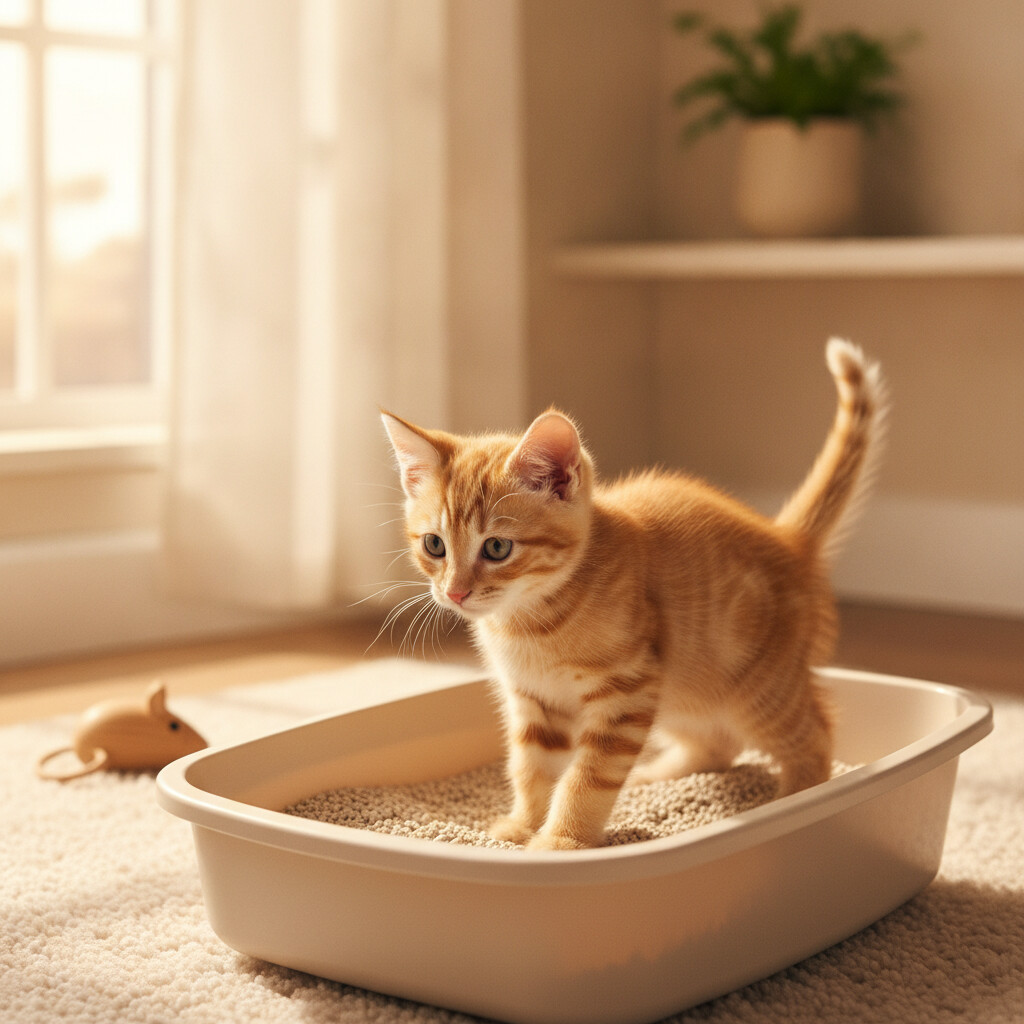
Most kittens barely need litter training. Instinct does most of the work: by about four weeks old, kittens start digging and covering in loose material, usually copying their mother. Your job is to give them a box they can actually use, put it where they’ll find it in time, and keep it clean. Here’s how to set that up, and what to do when accidents happen.
When do kittens start using a litter box?
Very young kittens can’t eliminate on their own. For roughly the first three weeks, the mother licks their belly and bottom to make them go, and orphaned kittens need a person to do the same with a warm, damp cloth. Our week-by-week guide to raising kittens covers that stage.
From about three to four weeks, kittens start eliminating on their own and begin pawing at loose material. That’s the time to give them a shallow box. Most kittens adopted at eight weeks or older already know what a litter box is. They may just not know where yours is yet, and many accidents come down to that.
Setting up the box
Getting the box right fixes more problems than any training technique.
Size and height. A tiny kitten needs low sides, roughly 2 to 3 inches, so they can climb in without effort. A baking tray or the lid of a storage tub works fine at first. As they grow, move to a full-size box. The AAFP and ISFM guidelines on house-soiling recommend boxes at least one and a half times the cat’s body length, nose to base of tail. Most commercial boxes are smaller than that for an adult cat, so plan to upgrade.
Litter type. Studies of litter preference, going back to research published in Applied Animal Behaviour Science in the early 1990s, have found that most cats favour fine, sandy, unscented litter. Strong fragrances appeal to people more than cats.
There’s one kitten-specific wrinkle. Some kittens taste or eat their litter while they’re figuring it out, and some vets suggest a non-clumping or paper-based litter for the first few weeks for that reason. The evidence on how risky clumping litter is for kittens is thin. A sensible middle ground: watch your kitten for the first few days. If they’re eating it, switch to something non-clumping until they grow out of it. Our litter comparison covers the main types.
Covered or open? Start open. Kittens find an open box more easily, and many cats prefer open boxes anyway. Our article on covered vs. open litter boxes goes into the research.
How many? The standard guidance from the AAFP and ISFM Feline Environmental Needs Guidelines (2013) is one box per cat, plus one extra. For a single kitten, two boxes is a good starting point, especially in a larger home.
Where to put the litter box
Location matters more than people expect, because a kitten’s bladder is small and the warning time is short.
- Close by. At first, keep the kitten in one room with the box, food, water and bed. A kitten can’t cross a large house in time. Our guide on how long to keep a new cat in one room explains how to widen their territory gradually.
- Away from food and water. Cats don’t like to eliminate near where they eat.
- Quiet but not trapped. Avoid next to a noisy washing machine, or a spot where another pet or a toddler can corner them.
- Same place every time. Moving the box around is confusing. If you need to move it, do it a step at a time.
How to litter train a kitten, step by step
- Show them the box on arrival. Put the kitten in the box gently and let them sniff and scratch. Don’t hold them there.
- Put them in at the key moments. Kittens usually need to go shortly after waking, after eating, and after a burst of play. Popping them in the box at those times catches most of it.
- Let them dig. Some kittens need a little demonstration. Gently scratching the litter with your finger often gets their attention.
- Reward quietly. A calm word or a treat after they use it is fine. Don’t make a fuss mid-business, which can startle them.
- Scoop at least once a day, ideally twice. Kittens, like adult cats, may avoid a dirty box. Leave a tiny bit of used litter in for the first few days if they seem unsure, so it smells like the right place.
- Expand the territory slowly. Once they’re reliable in one room for a week or so, open up more of the house, and add a second box nearer the new areas.
Most kittens get the idea within days, and many within hours.
What to do about accidents
Accidents are normal in the first few weeks. How you handle them decides whether they stick around.
- Never punish. Scolding, rubbing their nose in it or yelling doesn’t teach a kitten where to go. It teaches them to be afraid of you, and fear can make them hide to eliminate. The AAFP and ISFM house-soiling guidelines are explicit that punishment makes the problem worse.
- Clean with an enzymatic cleaner. Ordinary household cleaners, especially ammonia-based ones, can leave a smell that draws the kitten back to the same spot. Our guide to getting cat pee smell out of carpet and furniture explains what works.
- Look at the spot they chose. If they keep going in the same corner, try putting a box right there, then move it slowly towards where you want it.
- Make the old spot less attractive. Put a food bowl or a bed there, or block access for a while.
- Re-check the box. Too high, too small, too dirty, too scented, or too far away are the usual suspects.
If your kitten was reliable and then stops using the box, assume there’s a reason, and consider whether it might be medical.
When to see a vet
Litter box trouble in kittens is sometimes a health problem rather than a training one. Call your vet if your kitten:
- Has diarrhea lasting more than a day, or any diarrhea along with lethargy or not eating. Kittens dehydrate quickly. Intestinal parasites are very common in young kittens, which is why the Companion Animal Parasite Council recommends deworming starting in the first weeks of life.
- Strains in the box, cries while going, or goes often with little result.
- Has blood in their urine or stool.
- Hasn’t passed a stool in more than a day or two, or seems bloated or uncomfortable.
- Was using the box reliably and suddenly stopped.
Treat it as urgent and call straight away if a kitten is straining with nothing coming out, is weak or floppy, or has stopped eating. Our guide to cat diarrhea and when to see a vet has more detail.
The short version
Give your kitten a shallow box with unscented litter, close to where they spend their time. Put them in after sleeping, eating and playing. Scoop daily, clean accidents with an enzyme cleaner, and never punish. If something seems off physically, see your vet. For everything else a new kitten needs, our essential supplies checklist is a good next stop.
How long did it take your kitten to get the hang of the litter box?