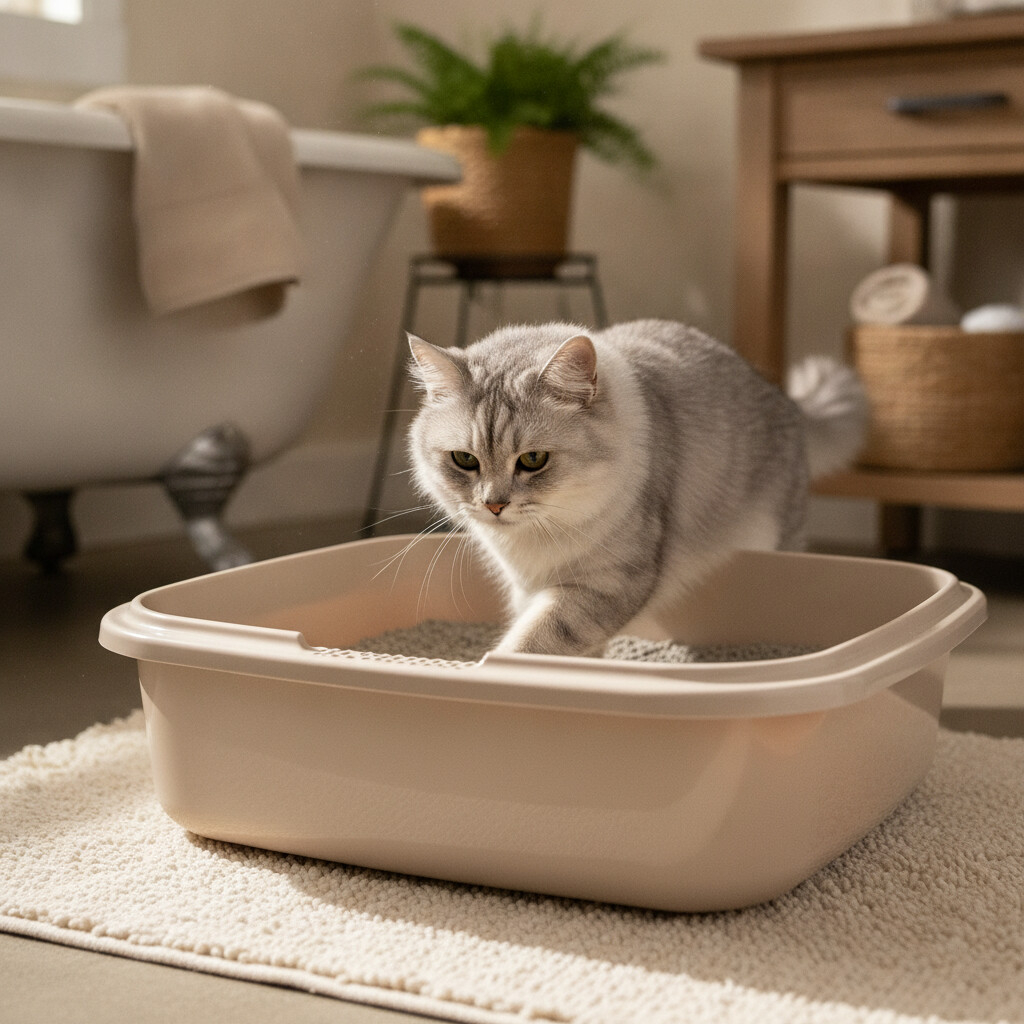
The right litter box for a senior cat has a low entry point — ideally under 4 inches — a wide, non-skid surface, and no lid. If your older cat has started missing the box, straining, or avoiding it altogether, the box itself is often the problem before anything else is. Here’s what actually matters and how to fix it without spending a fortune.
Why the Box That Worked for Years Suddenly Doesn’t
Degenerative joint disease is extremely common in older cats and badly underdiagnosed, because cats hide pain well and owners tend to read reduced mobility as “just slowing down.” A widely cited study published in the Journal of Feline Medicine and Surgery (Lascelles et al.) found radiographic evidence of degenerative joint changes in the vast majority of cats over 12 years old, and multiple veterinary sources since have echoed that arthritis is close to universal in senior cats, even when there’s no obvious limp.
A standard litter box with 6–8 inch walls, which is easy for a healthy adult cat to step over without thinking, becomes a genuine physical barrier for a cat with sore hips, knees, or spine. The result isn’t always an obvious injury — it’s often just avoidance, accidents just outside the box, or a cat that starts using a box on one floor but not another because stairs have become painful too.
For more on the joint disease driving this, see our guide to arthritis in senior cats, and if accidents have already started, why senior cats have litter box accidents covers the fuller picture beyond just the box itself.
What to Actually Look For
Entry height. This is the single biggest factor. Look for boxes with at least one low-cut side, ideally 3–4 inches or less. Many “senior” or “low-entry” boxes marketed for this purpose exist for exactly this reason; a large under-bed storage bin with one side cut down with a utility knife works just as well and costs far less.
No lid. Covered boxes trap odor inside, which is unpleasant for a cat with a sensitive nose, and the doorway flap or narrow opening is exactly the kind of obstacle a stiff cat will avoid. An open box is easier to enter from any angle and easier for you to check.
Size. Bigger than you think. A cat should be able to turn around and posture fully without touching the sides. For an arthritic cat, more usable floor space means fewer awkward twisting movements to get into position.
Non-skid footing. Smooth plastic can be genuinely difficult to get traction on for a cat with weak hindquarters. A textured mat underneath, or a box with a slightly textured base, reduces slipping — which matters both for comfort and for confidence about using the box at all.
Litter depth and texture. Very deep litter requires more digging effort than some senior cats can manage comfortably. A shallower layer (around 1–2 inches) of a soft, low-dust clumping litter is usually more comfortable on sore paws than coarse, sharp-edged crystal litter.
Budget and DIY Options
You don’t need to buy a specialty product to get this right:
- Storage bin conversion. A large, shallow plastic storage bin (18+ inches wide) with one long side cut down to 3–4 inches makes an oversized, low-entry box for a few dollars in materials.
- Baking or cookie sheet trick for ramps. If a cat can manage the entry height but struggles with a step up onto a raised surface (like a box on a platform to keep it from a dog), a short ramp or a couple of thick foam mats can bridge the gap.
- Skip the automatic self-cleaning boxes for cats with significant mobility issues unless the model specifically has a low, wide entry — many are built tall to house the mechanism, which defeats the purpose here.
Beyond the Box Itself
The box design solves part of the problem, but placement and quantity matter just as much for a cat whose mobility is declining:
- One litter box per floor, minimum, plus the usual “one per cat plus one extra” rule. A senior cat in pain will often go to the nearest acceptable spot rather than travel to a box on another level.
- Avoid tucking the box somewhere that requires navigating stairs, a tight laundry room turn, or stepping over a raised threshold. These small obstacles compound with joint pain in ways that aren’t always obvious to a healthy human moving through the same space.
- Keep a night light near the box if your cat’s vision is also declining, which is common alongside mobility changes in older cats.
- If mobility issues are more widespread than just the litter box, our guide on keeping an aging cat mobile and comfortable covers ramps, bedding, and home layout more broadly.
When to See a Vet
A box redesign is a reasonable first step, but litter box avoidance in a senior cat is also a common early sign of medical issues that have nothing to do with the box — including urinary tract infections, kidney disease, and diabetes, all of which increase thirst and urination frequency and can show up as “accidents” before anything else. See a vet if:
- Accidents started suddenly rather than gradually
- Your cat is straining, vocalizing, or spending unusually long in the box
- There’s blood in the urine or litter
- Drinking or urination volume has clearly increased
- The behavior doesn’t improve within a couple of weeks of fixing the box setup
Mobility-related litter box changes tend to develop gradually and respond to a better box. Sudden changes deserve a vet visit first, box redesign second.
The Takeaway
Most senior cats that stop using the litter box reliably aren’t being difficult — they’re telling you the box no longer fits their body. Start with entry height, ditch the lid, size up, and add non-skid footing before assuming the issue is behavioral. It’s one of the cheapest, fastest fixes available for an aging cat’s quality of life, and it’s worth doing before the harder work of ruling out medical causes.