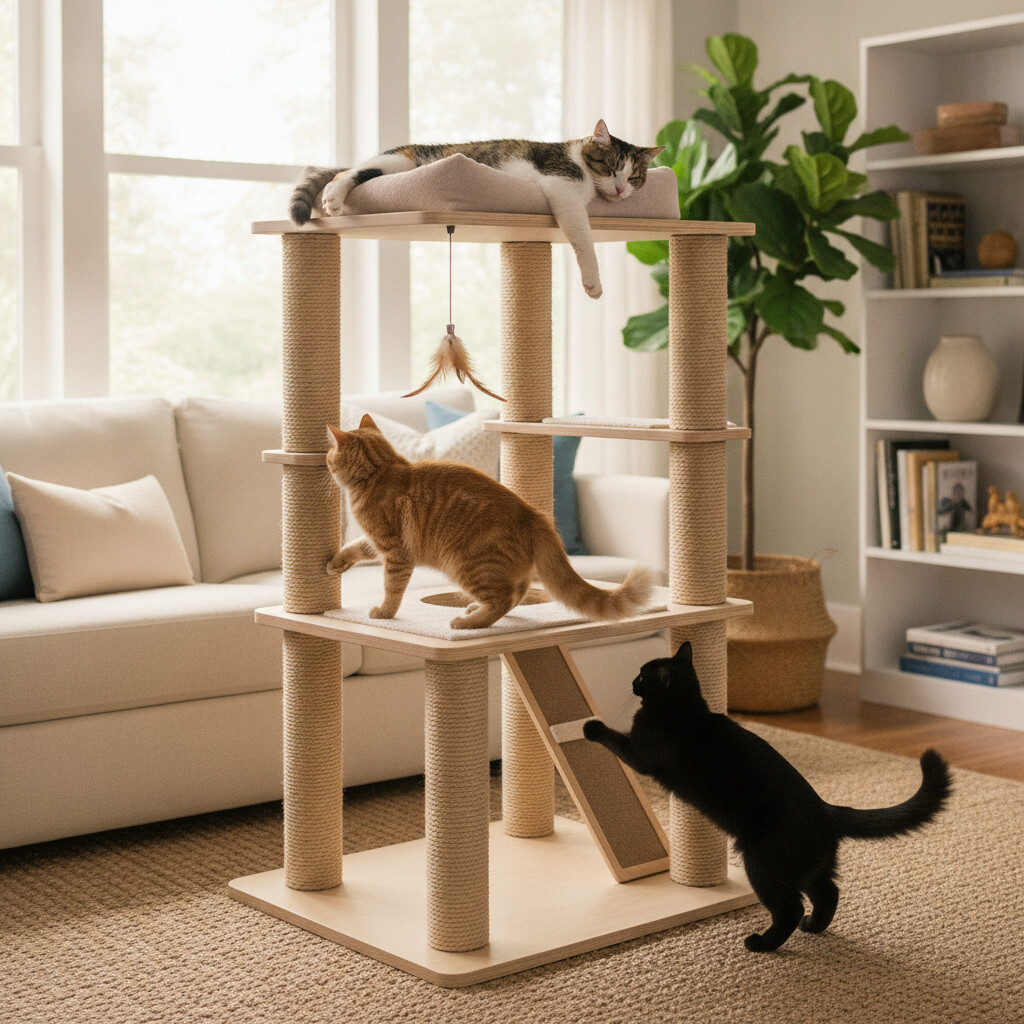
A good cat tree earns its floor space: sturdy base, real sisal (not carpet) for scratching, and platforms wide enough for an adult cat to turn around and stretch out on. A bad one wobbles, sheds fibers everywhere, and gets ignored within a month. Here’s what actually separates the two, and which features are worth paying for.
Why Cats Need Vertical Space in the First Place
Cats are natural climbers with a strong instinct to survey territory from height — it’s a security behaviour rooted in how they evolved as both predator and prey. Height gives a cat a vantage point to monitor the room, distance from other pets or noisy activity, and a sense of control over their environment. This isn’t a nice-to-have; in multi-cat households especially, vertical space is one of the main tools for reducing tension, since cats who can’t get away from each other on the ground will often resolve conflict by claiming different levels instead. If you want the fuller behavioural case for this, Why Cats Need Vertical Space goes deeper into the research.
What Actually Matters When Buying One
Stability first. A cat tree that wobbles when your cat jumps onto it will get avoided fast — cats are risk-averse about surfaces that feel unstable underfoot. Look for a wide base relative to height, and check weight distribution: taller trees (6 feet-plus) need a proportionally heavier or wider base than short ones.
Real sisal rope, not carpet. Carpet-wrapped posts look tidier in photos but shred into loose fiber loops within weeks of scratching, and cats tend to prefer the tighter grip of woven sisal rope anyway. If the post is the main scratching surface in your home, sisal rope holds up dramatically longer than carpet or sisal fabric.
Platform size. A perch that’s too shallow means your cat can perch but not actually stretch out and sleep, which is when a cat tree earns its keep. Look for at least one platform big enough for your cat to lie down fully — for most adult cats that’s roughly 16–20 inches across, larger for bigger breeds like Maine Coons.
Washable or replaceable components. Look for trees with removable, machine-washable perch covers or corner brackets built for a full sisal-post swap when it eventually wears down — a small design detail that adds years to the tree’s life instead of ending in the trash.
Where People Overspend (and Underspend)
The most expensive cat trees are often modular wall-mounted or wall-anchored systems, and they’re worth it mainly for small apartments where floor space is genuinely scarce — the vertical real estate lets you build up instead of out. If you have the floor space, a well-built freestanding tree in the $80–150 range typically performs just as well behaviourally as a $400 designer piece; the price difference is mostly aesthetic, not functional.
Where people tend to underspend is on base weight and platform count. A cheap, light tree with only two or three levels gets outgrown by an active cat’s routine within months — more levels means more options for your cat to rotate between sleeping, watching, and scratching spots, which matters more for daily engagement than the tree’s overall height.
DIY vs. Store-Bought
If you’re handy, a DIY wall-mounted shelf system can be more durable and better suited to an oddly-shaped room than anything off the shelf — sisal-wrapped posts and solid wood shelves outlast most commercial carpeted towers. We cover the build process in DIY Cat Shelves: How to Build a Wall-Mounted Cat Highway. For most owners, though, a solid freestanding tree is the faster, lower-effort option, and modern designs have closed a lot of the durability gap.
Multi-Cat Households: Buy More Space Than You Think You Need
In homes with more than one cat, the general behavioural guidance is to provide enough separate resting spots — including vertical ones — that no cat has to negotiate access with another. That doesn’t necessarily mean one tree per cat, but it does mean multiple perches at different heights and in different rooms, not one tower everyone has to share. A single tree in a multi-cat home tends to become contested territory rather than a shared resource, which can quietly increase tension between cats who otherwise get along fine.
Placement Matters as Much as the Tree Itself
Even a great cat tree gets ignored if it’s in the wrong spot. Cats gravitate toward trees placed near a window (natural light and outdoor visual stimulation), in a room they already spend time in, or somewhere that offers a sightline to the front door or a busy hallway. A tree stuck in an unused guest room, no matter how well-built, usually just becomes a shelf for laundry.
The Bottom Line
Prioritize a stable base, real sisal rope, and at least one platform your cat can fully stretch out on — those three things predict whether a tree gets used daily or ignored within a month, far more than price or brand does. Buy more vertical space than seems necessary, especially in multi-cat homes, and put it somewhere your cat already wants to be.