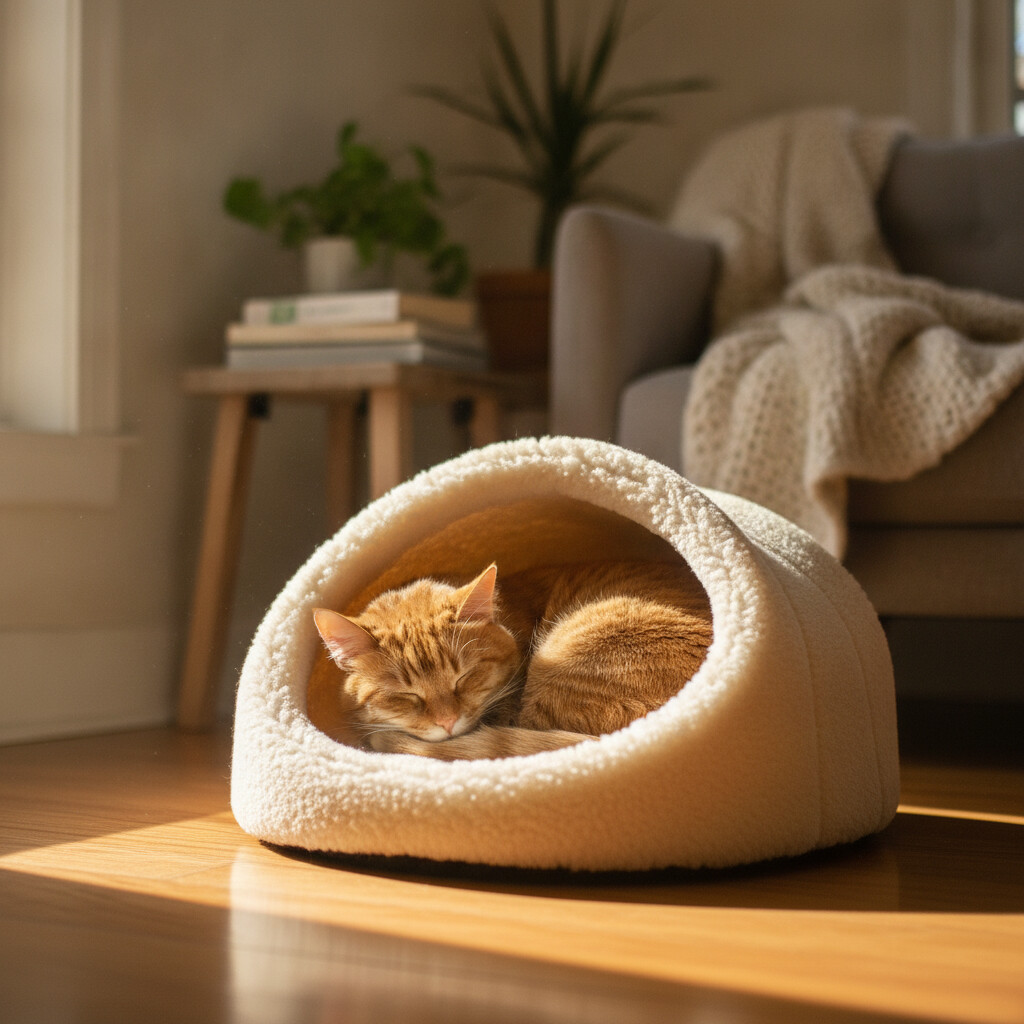
Most cats ignore the bed you bought them. That’s not a personality flaw — it’s a mismatch between what the bed offers and what a cat is actually looking for when it rests. Cats choose sleeping spots based on warmth, height, and enclosure, in roughly that order, and a $60 plush donut sitting on the living room floor often loses to a cardboard box or a sunny patch of carpet because it fails on all three counts.
Here’s the short version: the “best” cat bed isn’t a specific product, it’s a match to your cat’s resting preferences — and most owners buy for their own taste in home décor instead.
Why Most Cats Ignore the Bed You Bought Them
Cats aren’t being ungrateful. In the wild, resting-site selection is a survival behavior — a cat that sleeps somewhere warm, elevated, and enclosed is harder to ambush and burns less energy staying warm. Domestic cats still run on that wiring. Research on feline thermoregulation shows cats have a thermoneutral zone higher than humans (around 86–97°F), which is a big part of why they gravitate toward radiators, sunbeams, and laptop-warmed spots over a bed sitting at room temperature on the floor.
Height and enclosure matter almost as much as warmth. A bed placed in an open, high-traffic area — no matter how soft — competes with the instinct to rest somewhere a cat can see threats coming and not be seen itself. If your cat is choosing the closet shelf over the bed you bought, that’s the instinct talking, not a snub.
The Bed Types That Actually Get Used
Hooded or cave beds. For cats who prefer enclosure over open space (many rescue and anxious cats fall into this group), a covered bed with a single entry point mimics a den. These consistently outperform open beds for cats who spend a lot of time hiding.
Heated beds. Given the thermoneutral zone point above, a self-warming or low-wattage heated bed is one of the most reliable ways to get a cat to actually use a designated spot, especially in older cats who run cooler and appreciate the warmth on stiff joints. We’ve covered the safety side of this in detail in our guide to heated cat beds — the short version is that purpose-built pet heating pads with chew-resistant cords and low, constant temperatures are safe for the vast majority of cats.
Window perches. For cats who prioritize visual stimulation over enclosure, a padded perch at a sunny window often gets more use than any floor bed in the house.
Elevated hammocks and radiator beds. Cats that already gravitate to counters, cat trees, or the top of the fridge are telling you height matters more than softness. A hammock-style bed attached to a radiator or window frame, or a top perch on a cat tree built to actually hold up, tends to get claimed fast by cats with this preference.
Orthopedic and bolstered beds. For senior cats or anything with diagnosed joint issues, a low-entry orthopedic bed with supportive foam and a raised bolster (something to lean against) matters more than the fabric. Cats with arthritis are less likely to jump onto a high perch, so ground-level, easy-access options should be part of the lineup once a cat is past about age ten.
Match the Bed to the Cat, Not the Room
Before buying, watch where your cat already naps for a few days — window sill, top of the couch, a laundry basket, under the bed. That tells you more about what to buy than any product review. A cat that sleeps in laundry baskets is telling you it wants enclosure and texture, not a wide-open memory foam mat. A cat that suns itself on the windowsill every afternoon isn’t going to switch to a floor bed in a shaded corner, no matter how nice it is.
Multi-cat households often need more than one bed style, since preferences vary by individual cat the same way they do with humans — and having only one preferred resting spot can create low-grade tension between cats who both want it.
Placement Beats Product Every Time
Even the right bed type fails in the wrong location. A few placement rules that consistently improve adoption:
- Put it somewhere your cat already spends time, not somewhere you want them to spend time.
- Avoid loud, high-traffic zones — next to the washing machine or by the front door rarely works.
- Elevate it if your cat already prefers height; ground level if your cat is a hider or has mobility issues.
- Give it a few weeks. Cats are neophobic about new objects in their space, and a bed that’s ignored in week one is sometimes claimed by week three once it stops smelling and looking unfamiliar.
One Signal Worth Watching
If a cat that has always slept on a high perch or jumped onto furniture suddenly starts resting only on the floor, that’s worth paying attention to — it can be an early sign of joint pain or reduced mobility rather than a change in preference. It’s one of the more overlooked early indicators of arthritis in cats. If you notice a sudden shift like this, especially in a cat over seven or eight, it’s worth a vet visit rather than just buying a lower bed. Finding a vet you trust before you need one for an urgent reason makes this kind of check-in a lot easier.
The Practical Takeaway
Skip the bed that matches your living room and buy for your cat’s actual resting habits: warmth first, then height or enclosure depending on personality, and low-entry orthopedic support once a cat hits its senior years. Watch where your cat already sleeps before you buy anything — it’s the single best predictor of what they’ll actually use.