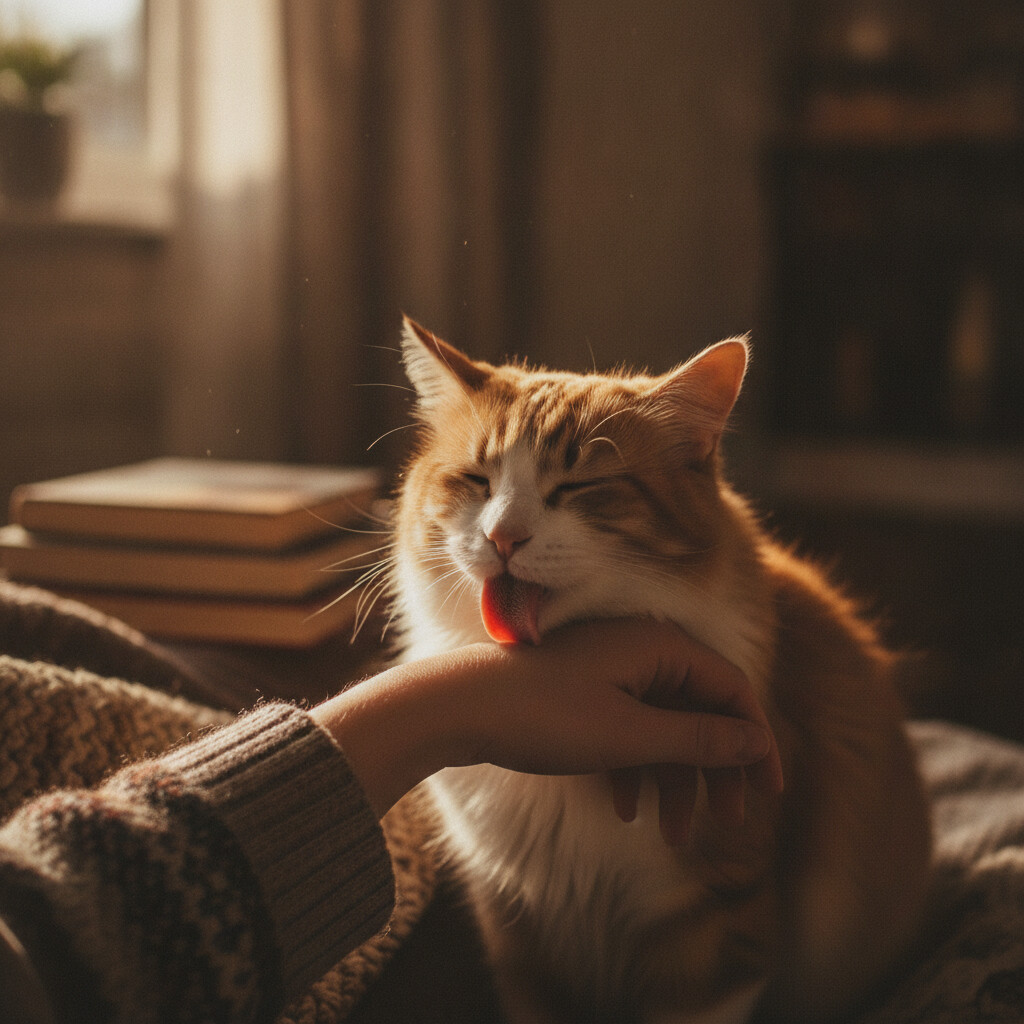
Your cat licks you for one of a handful of reasons: bonding (allogrooming), taste and scent, stress relief, or attention-seeking. Which one it is usually comes down to context — where they’re licking, how hard, and what happens right before and after. Here’s how to read it.
Allogrooming: The Bonding Explanation
In multi-cat households, cats groom each other as a normal part of social bonding — behaviourists call this allogrooming. It typically happens between cats who are already friendly, and it reinforces the relationship by mixing scent and building trust. When your cat licks you, researchers and veterinary behaviourists generally agree they’re extending the same social behaviour to you: you’re being treated as a member of the group, not a stranger or a threat.
This is why licking is more common in cats who are already affectionate in other ways — cats who headbutt, knead, or sleep near you are the same ones who tend to lick. It’s part of a cluster of bonding behaviours, not a standalone quirk. (If your cat also headbutts you constantly, the science behind bunting covers the related scent-marking side of that behaviour.)
Taste and Scent Are Doing More Than You Think
Cats have roughly 470 taste buds compared to a human’s 9,000, but their sense of smell is dramatically more sensitive than ours, and licking is partly a way of gathering information. Salt from sweat, lotion, food residue, or even the scent of another animal on your skin can all trigger licking — your cat is investigating you as much as bonding with you.
This is also why cats often lick you right after you’ve showered, applied lotion, or come home smelling like another animal. It’s not necessarily affection in that moment — it can be your cat re-establishing its scent on you, or simply being curious about an unfamiliar smell. Scent-swapping (bunting, rubbing, and licking) is a well-documented feline communication strategy, not just a human interpretation of “cuteness.”
When Licking Turns Into Overgrooming — On You or Themselves
Occasional licking is normal. But if your cat is licking excessively — to the point of leaving your skin raw, or licking themselves bald in patches — that’s a different issue entirely, and it’s worth taking seriously. Psychogenic (stress-related) overgrooming is a recognized behavioural condition in cats, often triggered by anxiety, boredom, or environmental change (a new pet, a move, a schedule disruption). It can also be a sign of an underlying medical issue like allergies, fleas, or pain, which is why vets always rule out physical causes before treating it as purely behavioural.
If your cat’s licking has escalated recently — more frequent, harder, or focused on one spot — it’s worth checking for the more general stress signals covered in 10 Signs Your Cat Is Stressed before assuming it’s just affection. Sudden increases in any repetitive behaviour are one of the more reliable early warning signs vets ask about.
Why the Licking Sometimes Turns Into a Bite
If your cat licks you a few times and then nips, that’s an extremely common — and normal — pattern. It’s sometimes called a “love bite,” and it likely happens because grooming is a low-level sensory experience that can tip into overstimulation. Your skin doesn’t have the same texture or feedback as fur, so what starts as an affectionate lick can cross a threshold your cat wasn’t quite tracking. The bite is usually a signal to stop, not aggression.
If this happens often during petting sessions (not just licking), it’s worth reading Why Does My Cat Bite Me When I Pet Them? — the overstimulation mechanism is the same one at play here, and the article covers how to spot the warning signs before the bite happens.
Is It Ever a Problem to Let Your Cat Lick You?
Generally, no — occasional licking is harmless. The one caveat: cat saliva can carry bacteria (including, rarely, Bartonella henselae, the organism behind cat scratch disease), so it’s sensible to avoid letting cats lick open cuts, healing wounds, or your face if you’re immunocompromised. This isn’t a reason to discourage normal affectionate licking — it’s a narrow, common-sense precaution, not a warning about your cat’s mouth being dangerous.
When to See a Vet
Most licking is normal social or investigative behaviour and needs no intervention. Talk to your vet if you notice:
- Bald patches, redness, or scabbing from self-grooming
- A sudden increase in how often or how intensely your cat licks (you or themselves)
- Licking that seems compulsive — your cat can’t easily be distracted from it
- Licking paired with other changes: appetite loss, hiding, or increased vocalization
These can point to allergies, parasites, pain, or an anxiety disorder that’s treatable once identified — but the first step is always ruling out a medical cause before assuming it’s purely behavioural.
The Takeaway
A cat licking you is almost always a good sign — it means you’ve been folded into their social world the same way another cat would be. Pay attention to changes, not the behaviour itself: more frequent, more intense, or paired with hair loss is when it’s worth a vet visit. Otherwise, it’s just your cat doing what cats do with things — and people — they’ve decided are theirs.