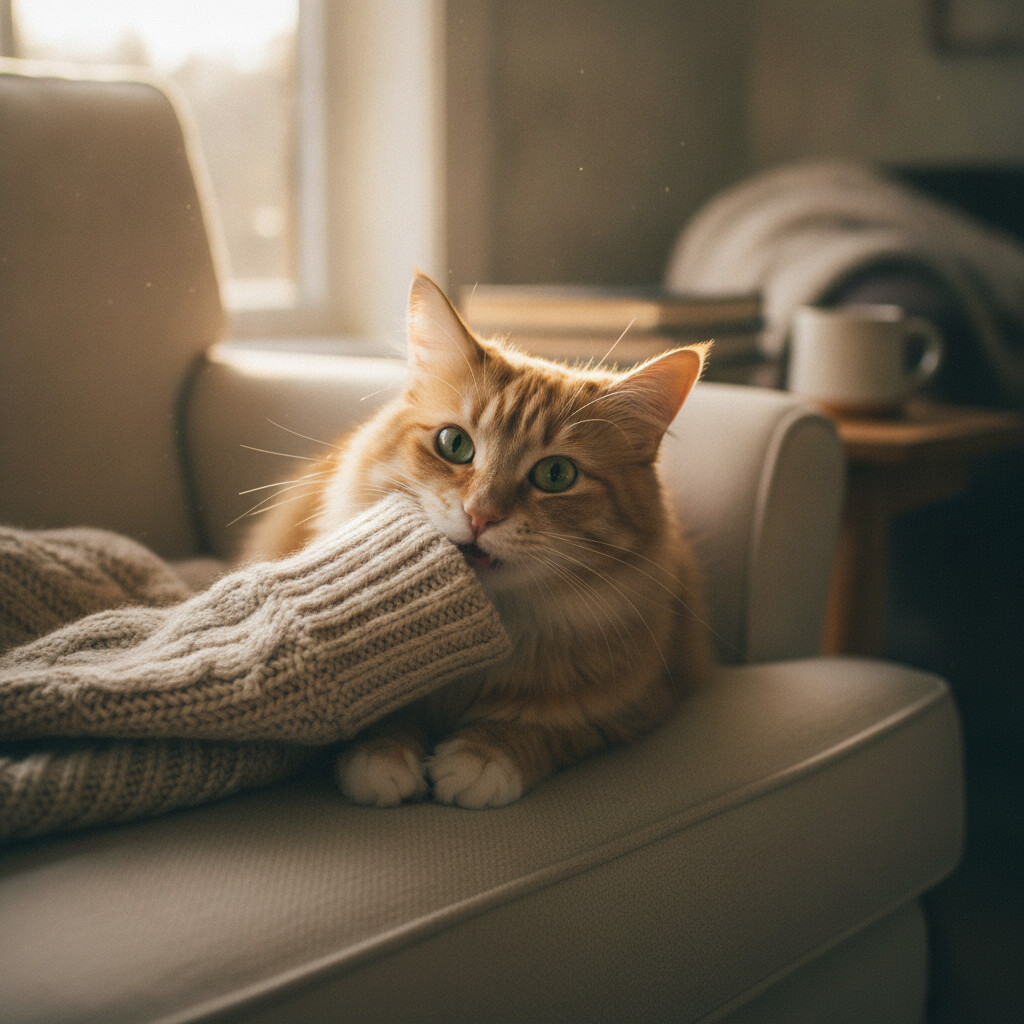
Some cats chew on things that aren’t food — plastic bags, shoelaces, wool sweaters, cardboard, even electrical cords. It’s called pica, and while an occasional nibble on a houseplant is normal cat curiosity, a cat who regularly seeks out and swallows non-food items has a behavior worth taking seriously. Here’s what’s actually going on, and when it stops being quirky and starts being dangerous.
What Pica Actually Is
Pica is the persistent eating or chewing of non-nutritive items. In cats it shows up in a few recognizable patterns: plastic (bags, packaging, twist ties), fabric (socks, blankets, especially wool), string-like objects (yarn, tinsel, dental floss), rubber bands, and cardboard. Some cats mouth and lick these items without swallowing; others actively ingest them, which is where the real risk starts.
Wool-sucking — chewing and sucking on wool or fabric, sometimes to the point of leaving holes in sweaters — is common enough in certain breeds that it’s been studied as its own subtype. Oriental breeds, especially Siamese and Birman cats, show it far more often than the general cat population, which points to a genetic or breed-linked component rather than pure boredom or bad habit.
Why Cats Develop Pica
There isn’t one single cause, and vets are honest that some cases don’t have a clean answer. The leading explanations, based on veterinary behavior research:
Early weaning or nursing disruption. Cats separated from their mother too early, or who missed out on a full nursing period, show higher rates of wool-sucking and fabric-chewing later in life. The behavior is thought to be a redirected sucking or suckling instinct that never fully resolved.
Breed and genetics. As mentioned, Siamese, Birman, and other Oriental breeds are overrepresented in pica cases, suggesting an inherited predisposition independent of upbringing.
Underlying medical issues. This is the one owners most often miss. Feline hyperthyroidism, diabetes, anemia, gastrointestinal disease, and nutritional deficiencies have all been linked to appetite and eating abnormalities that can look like pica. Dental pain or gum disease can also drive odd chewing behavior. Because of this, a vet visit to rule out a medical cause is the right first step — not a home fix.
Stress, boredom, or compulsive behavior. In cats without an underlying medical or breed-linked cause, pica can function similarly to other compulsive behaviors: a coping mechanism for an understimulated or anxious cat. This is more likely if the pica appeared alongside a stressful change — a move, a new pet, a schedule shift — or if the cat is otherwise under-enriched.
Genuine nutritional gaps. True dietary deficiency is rare in cats on a complete and balanced commercial diet, but it hasn’t been fully ruled out as a contributing factor in some individual cases, and vets sometimes review diet as part of the workup.
Why This Isn’t Just a Quirky Habit
The real concern with pica isn’t the chewing itself — it’s ingestion. Swallowed string, yarn, or ribbon can become what vets call a linear foreign body: one end gets caught (often under the tongue or in the stomach) while the rest of the intestine tries to pass it, bunching the intestine like a curtain on a rod. This is a surgical emergency, not a wait-and-see situation. Plastic and fabric pieces can cause a more standard intestinal blockage, which is equally serious.
If your cat has a habit of eating non-food items, don’t assume it will resolve on its own, and don’t leave tempting items (string, hair ties, plastic bags) within reach. This matters even more in homes without much vertical space and enrichment or DIY puzzle feeders to occupy an under-stimulated cat, since boredom-driven pica tends to improve once a cat has more to do.
What to Do About It
Cat-proof first, ask questions later. Get string, elastics, plastic bags, and small chewable items out of reach. This is the same logic behind a good kitten-proofing walkthrough — most households have more chewable hazards lying around than they realize, and it’s worth checking for the same things (cords, ties, plastic wrap) even with an adult cat.
Rule out medical causes. This is not optional. A vet visit with bloodwork can rule out thyroid disease, diabetes, anemia, and dental pain — all of which are far more treatable once identified than pica is to simply “train out.”
Redirect the behavior. If pica turns out to be compulsive or stress-related, increasing enrichment often helps — more play sessions, food puzzles, cat grass or safe chewable alternatives (some cats redirect well to cat-safe chew toys designed for the purpose), and more predictable daily structure.
Consider what changed. If the behavior started suddenly, think back to what shifted in the household in the weeks before — a move, a new pet, a change in your schedule. Addressing the underlying stressor is often more effective than addressing the chewing directly.
When to See a Vet
See a vet promptly if:
- Your cat has swallowed string, yarn, ribbon, or thread — this needs same-day veterinary attention even if your cat seems fine, because linear foreign bodies don’t always cause immediate symptoms
- You notice vomiting, lack of appetite, lethargy, or straining to defecate after a suspected ingestion
- Pica behavior is new or worsening, especially in a middle-aged or older cat, since this raises the odds of an underlying medical cause
- You can see part of an object protruding from your cat’s mouth or rear end — do not pull on it. Get to a vet immediately.
Pica is manageable in most cats once the cause is identified, whether that’s medical, breed-related, or environmental. What it isn’t is something to shrug off — a cat that eats non-food items is one accident away from a genuine emergency, and it’s worth treating it that way from the start.