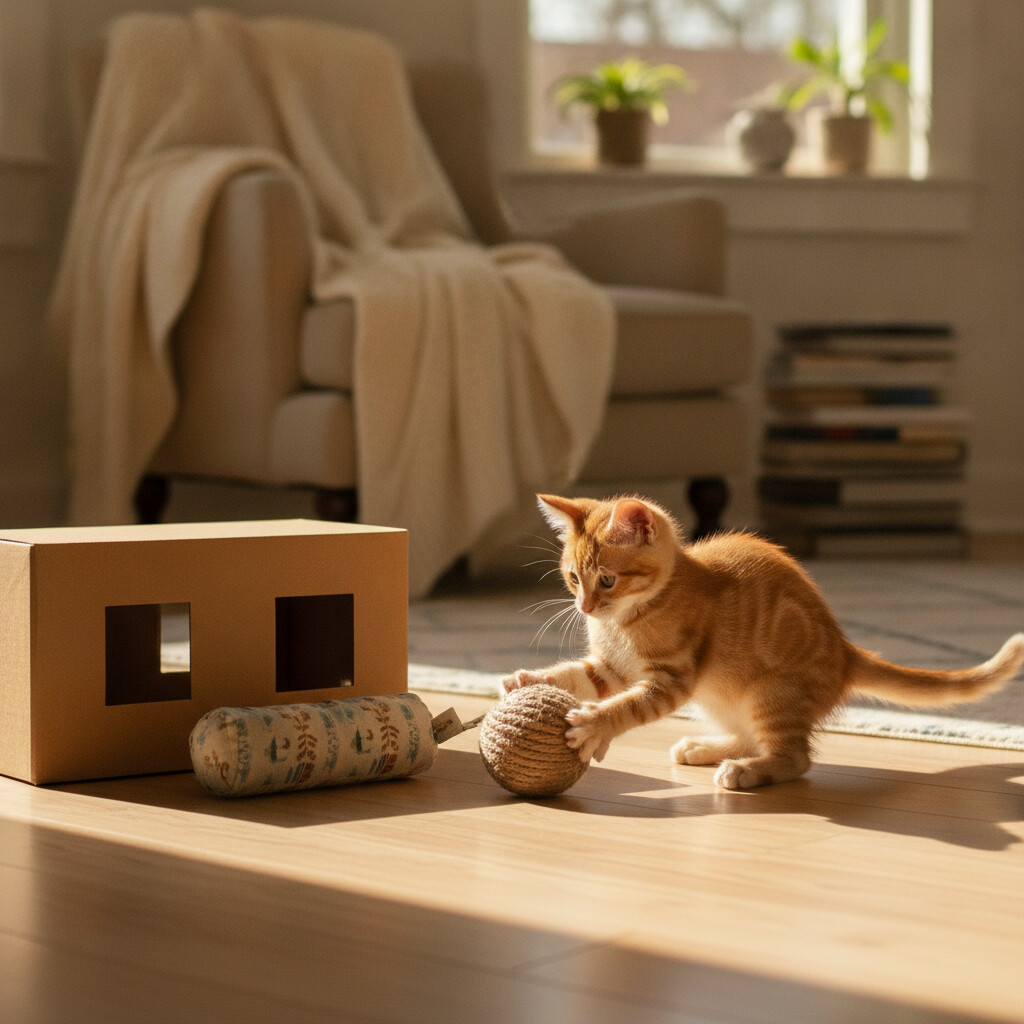
The cat toys that send the most cats to the vet are the ones that look harmless: string, ribbon, hair ties, wand toys left lying around, and anything small enough to swallow. Here’s what to avoid, what to supervise, and what to buy instead.
Most toys are fine most of the time. The problems come from a short list of shapes and materials, and from toys left out when nobody is watching. Once you know that list, choosing safe toys gets a lot easier.
The short answer
Avoid anything long and thin your cat could swallow (string, yarn, ribbon, tinsel, elastic bands and hair ties), small loose parts (bells, plastic eyes, glued-on feathers), small magnets, and toys that are cracked or fraying. Wand toys and feather teasers are great for play, but they should be put away in a closed cupboard when you’re done. Laser pointers are fine in moderation, as long as each session ends with something your cat can actually catch.
Why string-like toys are the biggest risk
Cats’ tongues are covered in backward-facing barbs called papillae. They’re great for grooming and stripping meat from bone, but they make it hard for a cat to spit something out once it’s in their mouth. A piece of string that starts as a chew often ends up swallowed.
Vets call what happens next a linear foreign body. One end of the string gets caught, often around the base of the tongue or in the stomach, while the rest is carried along by the gut. The intestine bunches up along the string like fabric on a drawstring, and the string can cut through the gut wall. This usually needs surgery.
Veterinary surgical studies consistently find that cats are more likely than dogs to have linear foreign bodies. A retrospective study of 208 cases of dogs and cats with gastrointestinal foreign bodies (Hayes, Journal of Small Animal Practice, 2009) is one of several showing that linear foreign bodies are a particular problem in cats. If you’ve read our story about the hair tie that nearly cost us our cat, you’ll know how quickly this goes from “playing” to “emergency.”
High-risk items to keep out of reach:
- String, yarn, thread (especially with a needle attached), dental floss
- Ribbon, gift wrap curling ribbon, tinsel
- Hair ties, elastic bands and rubber bands
- Shoelaces and drawstrings
- The cord or string on a wand toy
Toys that should only come out with supervision
These are good toys. They just shouldn’t be left lying around.
Wand and feather teasers. These are probably the best interactive toys you can buy, because they let your cat stalk, chase and pounce like a hunter. The risk is the string and the feathers. After play, put the wand in a cupboard or drawer your cat can’t open. Leaning it in a corner doesn’t count. If you prefer to make your own, our guide to DIY cat wand toys includes safer designs.
Laser pointers. Plenty of cats love them. The concern is frustration: the cat chases and chases but never catches anything. A 2021 owner survey by Kogan and Grigg (Applied Animal Behaviour Science) found an association between laser pointer use and repetitive behaviours like fixating on lights or shadows. The link was modest and the study can’t prove cause, but the fix is easy: finish every laser session by landing the dot on a toy your cat can grab, or follow it with a treat. Never shine it in their eyes.
Toys with feathers, fur or fabric tails. Many are fine, but cats love to pull these apart and swallow bits. Check them after each use and throw them out when they start shedding.
Toys to skip altogether
- Toys with small glued or sewn-on parts: plastic eyes, noses, sequins and small bells that come loose. If a part is smaller than your cat’s mouth and can be pulled off, assume it will be.
- Toys containing small magnets. If a cat swallows more than one magnet, they can attract each other through the gut walls and cause serious damage. This is a well-documented hazard in children, and the same physics applies to cats.
- Thin, brittle plastic that cracks into sharp pieces.
- Toys sized for small dogs or children with stuffing your cat can get at.
- Anything treated with essential oils or strong fragrances. Cats lack some of the liver enzymes that break these compounds down, which is why several oils are toxic to them.
Some cats chew and swallow non-food items far more than others. If yours regularly eats fabric, plastic or rubber, that’s a behaviour called pica, and our guide on why cats eat plastic and fabric covers what causes it and how to manage it.
What to buy instead
Safe doesn’t mean boring. These are good choices for most cats:
- Large, sturdy balls too big to swallow, including ping-pong balls and solid plastic balls with a bell sealed inside.
- Kicker toys: long, firm pillow-shaped toys cats can hug and bunny-kick. Choose ones with tightly stitched seams.
- Crinkle balls and crinkle tunnels, checked regularly for tears.
- Puzzle feeders and treat balls, which feed the hunting instinct and slow down fast eaters.
- Catnip or silvervine toys with tight stitching and no loose parts. (About two-thirds of cats respond to catnip. Silvervine works for many of the rest.)
- Wand toys that are put away after play.
- Cardboard, in the form of boxes, scratchers and tubes, which is cheap, safe and endlessly popular.
For specific product types and how cats use them, see our roundup of interactive cat toys for bored indoor cats.
A quick toy safety routine
- Inspect toys weekly. Bin anything fraying, cracked or losing parts.
- Rotate toys. Keep a few out and the rest in a closed box, and swap them every few days. Cats lose interest in toys that are always there, and rotating means you check each one as it comes back out.
- Put away anything with string whenever you leave the house or go to bed.
- Tidy up after crafts, gift wrapping and sewing. Ribbon and thread on the floor are a classic cause of emergency surgery during the holidays.
- Match the toy to the cat. Kittens and young cats chew more, so pick sturdier toys for them.
When to see a vet
Call your vet straight away if you saw your cat swallow string, ribbon, a hair tie, a magnet or part of a toy. Don’t wait for symptoms, because surgery is much simpler before the gut is damaged.
Never pull on string you can see coming from your cat’s mouth or bottom. If it’s anchored inside, pulling can cut the intestine. Leave it, keep your cat calm and get to a vet.
Also see a vet promptly if your cat has:
- Repeated vomiting or retching, especially with no hairball
- Loss of appetite for more than a day
- A painful or tense belly, hiding, or unusual quietness
- Straining in the litter box or no stool
- Drooling or pawing at the mouth (check under the tongue, where string often loops around)
These signs can come from many problems, not only toys, so let your vet do the diagnosing.
The bottom line
The safest toy is one that’s too big to swallow, has nothing that pulls off, and gets put away when it involves string. Use wand toys and lasers together with your cat, keep sturdy solo toys out the rest of the time, and check them often.
What’s the one toy your cat goes back to every single time?