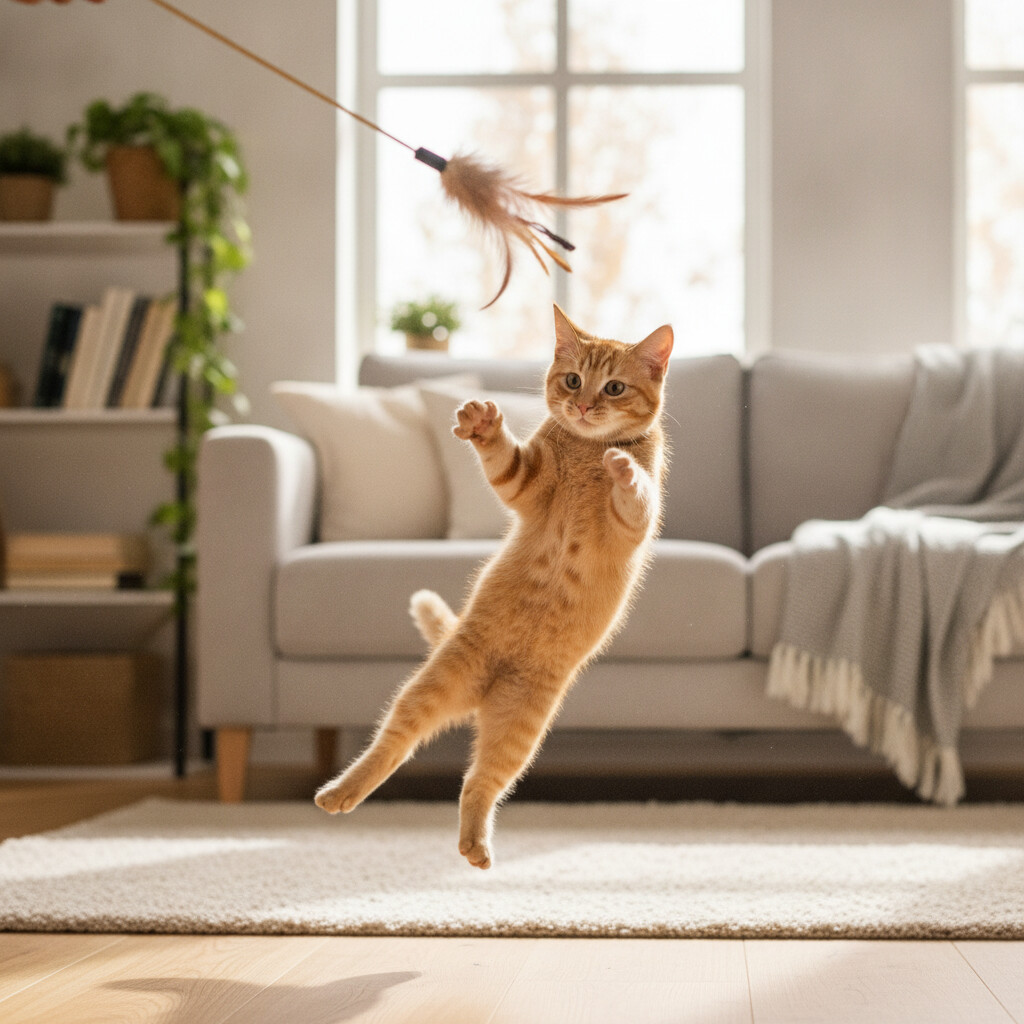
The best way to play with a cat is to copy a hunt: let the toy hide, move like prey, get caught, and finish the session with food. Two or three short sessions of 5 to 15 minutes a day, built this way, will tire out most indoor cats better than an hour of dangling a feather while you scroll. Here’s the routine, why it works, and how to adjust it for your cat.
Why “hunt, catch, eat” works
Cats are predators, and play is how an indoor cat uses its hunting behaviour. The sequence is stalk, chase, pounce, catch, and then eat. The AAFP and ISFM Feline Environmental Needs Guidelines (2013) list the chance to play and act out predatory behaviour as one of the five core needs of every cat, alongside safe spaces, separate resources, positive human contact, and a world that respects their sense of smell.
When play skips the catch or the meal, many cats stay keyed up. They stare at the spot where the toy disappeared, go hunting for your ankles, or start the 3am zoomies. A session that ends with a catch and a snack gives that hunting drive a proper ending.
There’s research behind this. A 2021 University of Exeter study in Current Biology (Cecchetti and colleagues) asked owners to play with their cats for 5 to 10 minutes a day using a feather wand, and to finish each session by giving the cat a toy mouse to “catch.” Those cats brought home about 25% fewer wild animals than the control group. That’s an outdoor-cat result, but it supports the idea that structured, prey-like play satisfies a real drive.
The 10-minute play routine, step by step
1. Pick the right toy. A wand toy (a stick with a line and a lure on the end) is the most useful toy you can own, because you control the movement and your hands stay out of reach. A feather, a fabric “mouse” or a strip of fleece all work. You can make your own wand toys from household bits.
2. Start slow and hidden (1–2 minutes). Prey doesn’t run toward a cat. Drag the lure slowly along the floor, behind a chair leg, under a blanket edge, around a door frame. Let it twitch and stop. You’re looking for the stalk: low body, wide pupils, tail flicking, the butt wiggle.
3. Build the chase (3–5 minutes). Move the toy away from your cat, never at them. Mix short bursts with pauses. Bird-style toys can flutter and land; mouse-style toys should zigzag along the floor and dart behind cover. Use vertical space if your cat likes to leap, but keep jumps reasonable for their age and joints.
4. Let them win, often. Let your cat catch the toy every few attempts and hold it for a few seconds before it “escapes.” A cat that never catches anything usually gets frustrated and gives up.
5. Wind down (1–2 minutes). Slow the toy down as if the prey is tired. Shorter movements, longer pauses, an easy catch.
6. The final catch, then food. Let your cat make one last catch and keep the toy, or swap the wand lure for a small toy they can “kill” and carry off. Then give a meal or a small treat straight away. Many people time the evening session just before dinner for this reason. A puzzle feeder works well here too.
7. Put the wand away. Wand toys and anything with string go in a closed drawer after play. Cats can swallow string, and linear foreign bodies are a real surgical emergency (see our guide to unsafe cat toys).
How often and how long should you play with your cat?
There’s no official minimum, but most vets and behaviourists suggest two or three sessions a day of roughly 5 to 15 minutes each. Several short sessions usually work better than one long one. A 1998 study by Hall and Bradshaw in Applied Animal Behaviour Science found that cats lose interest in the same toy within minutes, and follow-up work by the same group in 2002 found that switching to a different toy brought play back to full intensity. If your cat stops after five minutes, swap the lure before deciding they’re done. Rotating toys over the week helps for the same reason.
Timing matters. Cats are naturally most active around dawn and dusk, so a session before breakfast and another in the evening fits their rhythm. An evening session followed by food is the classic fix for a cat who runs laps at night.
How do you know they’ve had enough? A tired cat lies down while still watching the toy, bats at it lazily, or starts grooming and wanders off. Panting is a stop signal: cats aren’t built for long sprints, and open-mouth breathing in a cat usually means it’s time to stop and let them recover. If it happens often, or after very little exercise, mention it to your vet.
What about laser pointers?
Use them sparingly, if at all. A 2021 survey of more than 600 cat owners by Kogan and Grigg, published in Animals, found an association between laser pointer use and owner-reported repetitive behaviours such as chasing light or shadows and staring fixedly at the floor. A survey can’t prove the laser caused those behaviours, but the concern makes sense: a cat can never catch a laser dot.
If your cat loves the laser, use it to start a chase, then land the dot on a physical toy or treat they can actually grab, and end the session that way.
Common play mistakes
- Using your hands or feet as the toy. It’s cute with an 8-week-old kitten and less fun with a 12-pound adult. Cats who learn hands are prey tend to keep treating them that way. Our article on what’s normal and what’s too rough in cat play covers how to redirect it.
- Dangling the toy in their face. Prey moving toward a predator isn’t believable, and many cats will just watch.
- Never letting them catch it. Frustration, not fatigue, is the usual result.
- Leaving it all to the self-play toys. Battery mice and ball tracks are fine extras, but most cats engage far more when a person is moving the toy.
- Playing with multiple cats at once. The confident cat gets every catch and the shy one gives up. Use one wand per cat, or play with them separately, ideally in different rooms.
Adjusting the routine for your cat
Kittens have endless energy and short attention spans. Several short sessions a day, with lots of catches. Start teaching them now that hands are off limits.
Senior cats still want to hunt, but lower down. Keep the lure on the floor, skip the high jumps, and keep sessions short. Our guide to how much play a senior cat needs goes further.
Overweight or lazy cats often respond better to slow, sneaky movements than fast ones. Start with a minute or two, and build up over a few weeks.
Shy or fearful cats may only watch at first, and that counts. Keep the toy small and slow and at a distance, and let them come to it.
Cats who “don’t play” often just haven’t found their prey type. Try a bird-style toy one day, a mouse-style toy the next, then something that crinkles or a toy with a little catnip or silvervine. Many cats who seem uninterested will play once the toy moves the right way. Some even learn to play fetch.
A word on behaviour problems
Not enough play is a common reason behind night activity, ankle attacks and household destruction. A 2014 owner survey by Strickler and Shull in the Journal of Veterinary Behavior found that owners who played with their cats for shorter periods reported more behaviour problems. It’s not a cure-all, though. A sudden change in energy, appetite, vocalising or aggression can have a medical cause, so if regular play doesn’t settle things, check with your vet before assuming it’s boredom.
What toy does your cat go wild for, and what has never caught their interest?