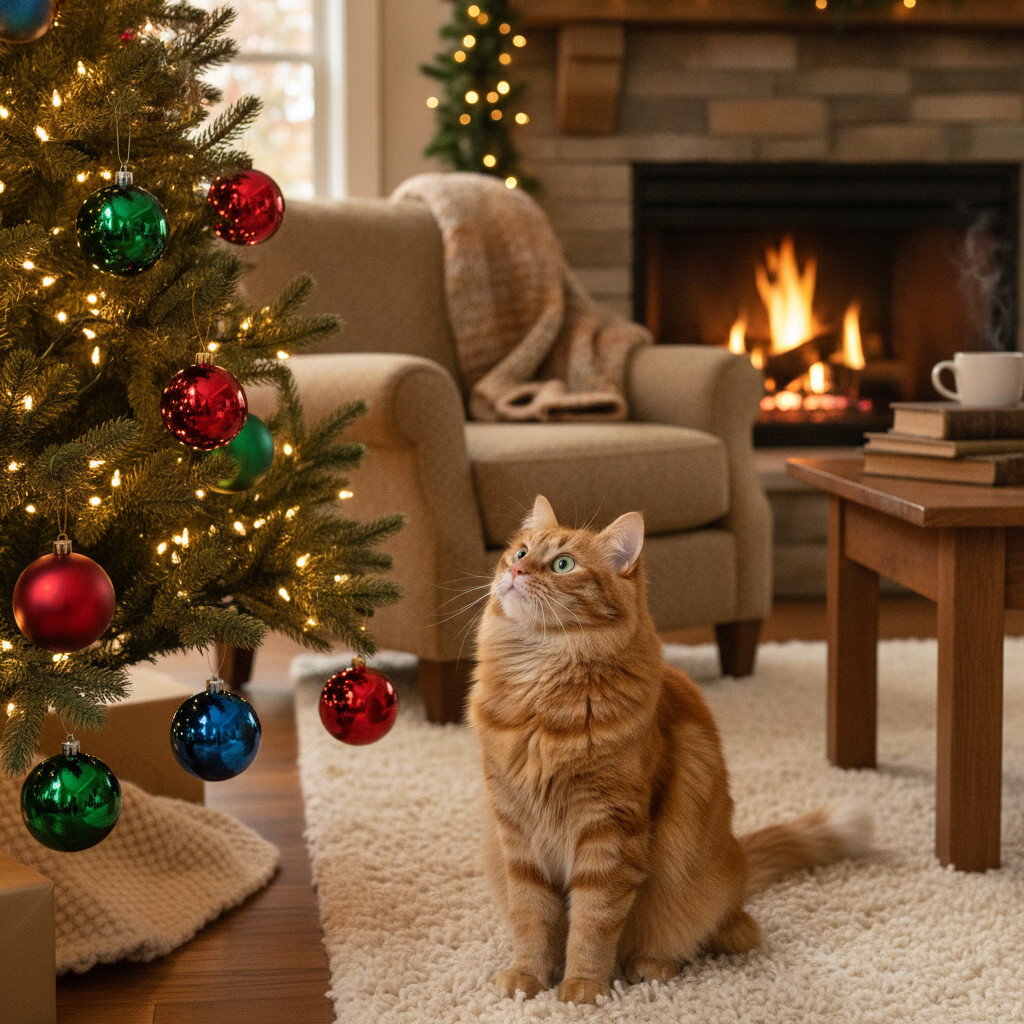
You can have a Christmas tree and a cat in the same house. The trick is to anchor the tree so it can’t fall, skip tinsel completely, keep breakable ornaments and light cords out of reach, and cover the water reservoir. Most cats lose interest in a well-set-up tree within a week or so. It’s the first few days that need the most care.
Here’s how to set it up, what’s actually dangerous, and what to do if something goes wrong.
Why cats are drawn to Christmas trees
From a cat’s point of view, someone just put a climbing frame in the living room, hung shiny prey on it and filled the base with a water bowl. Cats are natural climbers and hunters, and dangling, moving objects trigger the same instincts as a wand toy. Add new smells (especially with a real tree) and a change to their territory, and investigation is almost guaranteed.
That’s not bad behaviour. It’s just a cat being a cat, and it means the setup matters more than training.
The real hazards
Tinsel, ribbon and string
This is the most serious one. When a cat swallows a long, thin object like tinsel, ribbon, curling ribbon or the thread used to hang ornaments, it can cause what vets call a linear foreign body. The string anchors in one place while the gut keeps contracting around it, which can bunch up and cut the intestine. It often needs surgery. Cats’ backward-facing tongue barbs make it hard for them to spit string out once they’ve started chewing it.
The simplest fix is not to use tinsel at all while you have a cat. Use wire hooks instead of thread for ornaments, and tie ribbons on gifts only once you’ve moved the gifts out of reach. Our unsafe cat toys guide covers why string-type objects are such a problem.
The tree falling
A cat climbing a tree, or leaping at it from the couch, can tip it over. The risk is injury to the cat, broken glass, and pulled light cords.
Light cords
Kittens and young cats in particular may chew electrical cords, which can cause burns to the mouth and, in more serious cases, fluid build-up in the lungs. The Merck Veterinary Manual lists electrical cord bites as a recognised cause of injury in young pets.
Tree water
The water in the stand of a real tree can contain fertilisers, preservatives, or bacteria and mould that build up over time. The ASPCA advises keeping cats from drinking it. A cat lapping a little is unlikely to be poisoned, but stagnant tree water can upset the stomach, and some commercial tree preservatives are best kept away from pets altogether.
Pine needles and tree oils
The ASPCA notes that fir tree oils can be mildly irritating to the mouth and stomach, causing drooling or vomiting. Needles aren’t easily digested either. This is a nuisance-level risk rather than a severe poisoning risk, but it’s another reason to discourage chewing.
Breakable ornaments
Glass baubles shatter into sharp pieces that cut paws and mouths. Small ornaments or ones with hooks can also be swallowed.
Holiday plants
Lilies are the plant to really worry about. All parts of the lily plant, including the pollen and the vase water, can cause kidney failure in cats. Our story about the bouquet that nearly killed our cat shows how fast that can happen. Holly and mistletoe can cause vomiting and diarrhea. Poinsettias have a scarier reputation than they deserve: the ASPCA describes them as only mildly irritating. Our toxic houseplants guide has the full list.
How to cat-proof your Christmas tree
1. Choose the location and size carefully
Put the tree in a corner, away from furniture your cat can launch from. If your cat is a determined climber, a smaller tree on a sturdy table, or a tree in a room you can close off when you’re out, is a perfectly reasonable compromise.
2. Anchor it
Use a heavy, wide base. Then secure the top of the tree to the wall or ceiling with clear fishing line and a small hook, or to a window frame. This one step removes most of the fall risk.
3. Let your cat meet the bare tree first
Put the tree up and leave it undecorated for a few days. A lot of the novelty wears off before there’s anything shiny to bat at. If your cat starts climbing, interrupt calmly and redirect to a cat tree or toy rather than shouting.
4. Decorate smart
- No tinsel or string hangers. Wire hooks, crimped closed, are safer.
- Shatterproof ornaments on the bottom third. Keep glass, heirlooms and anything with small parts near the top, or skip them this year.
- Avoid edible decorations. Popcorn strings, chocolate ornaments and candy canes are tempting to pets and some (chocolate especially) are toxic.
- Skip artificial snow (flocking) on lower branches if your cat is a chewer, since it’s not meant to be eaten.
5. Deal with the cords
Run cords along the back of the tree and use cord covers or protectors for anything near the floor. Unplug the lights when you’re not home or asleep. Battery-operated lights can reduce the number of cords running across the floor.
6. Cover the water
Use a tree stand with a covered reservoir, or cover the top with a tree skirt, foil or a piece of cardboard cut to fit around the trunk. Leave a fresh water bowl elsewhere so your cat isn’t looking for an alternative.
7. Make the area less appealing
Some cats dislike the feel of aluminium foil or double-sided tape on the floor around the tree base. Don’t spray the tree itself with deterrents or essential oils, since many essential oils are risky for cats.
8. Give them a better option
A cat tree, window perch or a short play session near the Christmas tree gives your cat something they are allowed to climb and chase. A bored cat is a tree-climbing cat. Our indoor enrichment guide has ideas.
Real tree or artificial: which is safer?
Neither is risk-free. Real trees add needles, oils and the water reservoir. Artificial trees can shed plastic needles, may be flocked, and tend to be lighter and easier to tip. If you’re choosing, an artificial tree with a heavy, wide base is usually the easier one to cat-proof, but anchoring and decoration choices matter far more than the tree type.
When to see a vet
Call your vet or an emergency clinic straight away if your cat:
- May have swallowed tinsel, ribbon, string or thread. Never pull string out of a cat’s mouth or bottom; it can cause serious internal damage. Leave it and get to a vet.
- Has chewed an electrical cord and has mouth burns, drooling, coughing or any breathing difficulty.
- Has eaten any part of a lily, or drunk vase water from lilies.
- Is vomiting repeatedly, not eating, or straining in the litter box after the holidays.
- Has a cut paw or mouth from a broken ornament that won’t stop bleeding.
You can also call the ASPCA Animal Poison Control Center on (888) 426-4435 (a consultation fee may apply). Our holiday hazards guide covers the wider season, from table scraps to decorations.
The bottom line
Anchor the tree, lose the tinsel, protect the cords, cover the water, and give your cat a few days to get bored of it before you decorate. Most cats settle down quickly. If yours is the exception, a smaller tree or a closed door when you’re out is a perfectly good answer.
Has your cat ever taken on the Christmas tree, and who won?