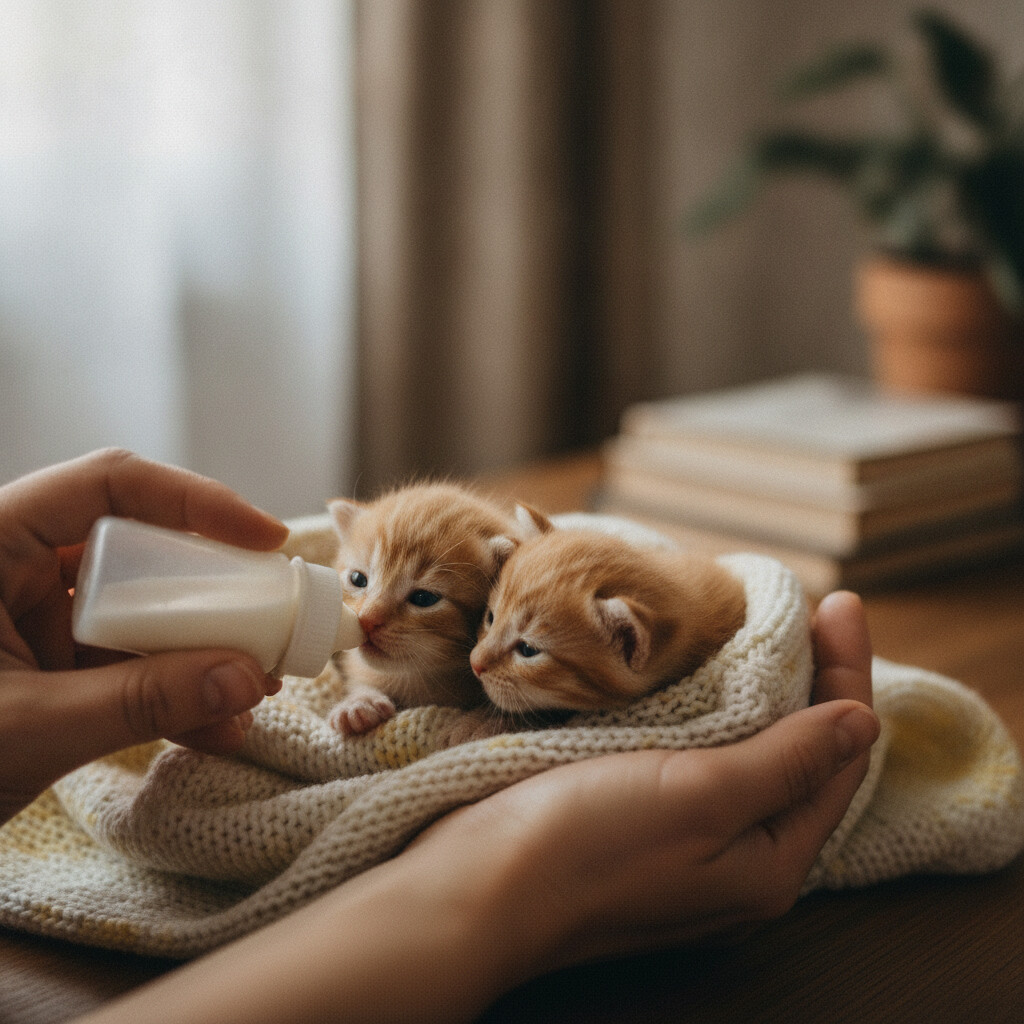
Two of them fit in one cupped hand. Eyes still sealed shut, barely bigger than mice, found in a cardboard box behind an auto parts store with no mother in sight. That’s how Waffle and Pretzel came into our lives — and how we ended up setting an alarm for every two hours, all night, for almost three weeks straight.
If you’ve never bottle-fed a neonatal kitten, here’s the short version: it is exhausting, it is not always going to work out, and it is one of the most viscerally rewarding things we’ve ever done as cat people. This is what those three weeks actually looked like.
How We Found Them
A neighbor heard crying near a dumpster and, thankfully, knew enough not to just leave them or scoop them up and drive off. She waited almost two hours to see if a mother cat would come back to retrieve them, which is exactly what vets recommend — kittens found alone aren’t always abandoned, and a mother may be off hunting or moving the litter one at a time. No mother came. No other kittens turned up. She called us because we’d fostered before.
Estimating age matters more than people think, because it determines everything from feeding volume to whether a kitten can regulate its own body temperature yet. Eyes still shut, ears flattened against the head, umbilical cord barely healed — these two were roughly a week old, maybe ten days. Too young for solid food, too young to potty on their own, and too young to keep themselves warm without help.
The First 48 Hours Were the Hardest
Our vet’s advice, echoed by guidance from the Cornell Feline Health Center, was blunt: kittens this young are fragile, and the two biggest killers are hypothermia and aspiration during feeding. So the setup came before anything else — a heating pad on low, covered with a towel, half the carrier left unheated so they could move away from the heat if they got too warm.
Feeding was kitten milk replacer (KMR), never cow’s milk, which cats can’t digest properly and which can cause diarrhea severe enough to kill a kitten this small. We used a proper kitten nursing bottle, kept them belly-down (never on their backs, which risks the formula going into the lungs instead of the stomach), and fed roughly every two to three hours around the clock based on their weight, weighing them daily on a kitchen scale to track that they were gaining rather than guessing.
The exhausting part wasn’t the feeding itself — it was everything around it. Newborn kittens can’t urinate or defecate on their own; a mother cat would stimulate this by licking them, so we did the job with a warm, damp cotton ball after every feed. Skip it and a kitten can develop a dangerously distended bladder within a day.
By hour 30 we were both running on fumes and mild panic every time one of them squeaked oddly in their sleep.
When It Started to Feel Less Terrifying
Around day four, Pretzel’s eyes started to open — first a thin blue slit, then fully within another two days, the milky newborn blue that all kittens are born with regardless of what color their eyes will end up. Waffle was a day behind him, which tracks with how uneven littermate development can be even between kittens found together.
By the end of week one, weight gain had become steady and predictable rather than something we were white-knuckling over. That’s the marker vets look for over almost anything else — kittens should gain roughly half an ounce to an ounce per day once past the first rocky days. Once that curve is consistent, the odds of the kitten thriving go up enormously.
We also started weaning conversations with our vet earlier than we expected, because kitten development moves fast: by three to four weeks old, most kittens are ready to start experimenting with a gruel made from KMR mixed with wet kitten food, gradually thickened over the following weeks as they figure out how to eat rather than nurse.
What We’d Do Differently
Honestly, not much — but a few things we learned the hard way are worth passing on to anyone who finds themselves with an unexpected box of kittens:
- Don’t wing the schedule. We used a written feeding log, because at 3 a.m. neither of us could reliably remember whether the last feed was 90 minutes ago or three hours ago, and both matter.
- Get a vet on the phone before day one is over, even for a “just in case” check. Orphaned kittens are one of the situations where waiting to see if something resolves on its own can go badly fast.
- Litter training happens sooner than you’d think. Once they were stimulating and eliminating more independently around four to five weeks, a shallow tray with a small amount of litter and copying an older, litter-trained cat’s behavior got both kittens using it within days.
- Socialization matters as much as calories. Kittens raised without littermates or a mother can miss out on bite inhibition and social cues, so we made a point of handling them gently and often, and eventually introduced them to our resident cat, Biscuit, under close supervision once they’d had their first vet visit.
Where They Are Now
Waffle and Pretzel are a year and a half old now, thoroughly unbothered by the drama of their first few weeks, and doing the extremely normal cat things of knocking objects off counters and monopolizing the good sunbeam. You would never guess, watching them now, how close it came to going differently.
If you find kittens in a similar situation, the single most useful thing to know is that timing and temperature control matter more than almost anything else in those first days — and that a vet or a local kitten rescue’s bottle-baby program can walk you through it even if, like us, you’re doing it for the first time at midnight with a search engine open in one hand. For more on setting a young cat up for success once they’re past the newborn stage, our guide on the first 30 days with a new cat and on kitten nutrition through the first year cover what comes next.