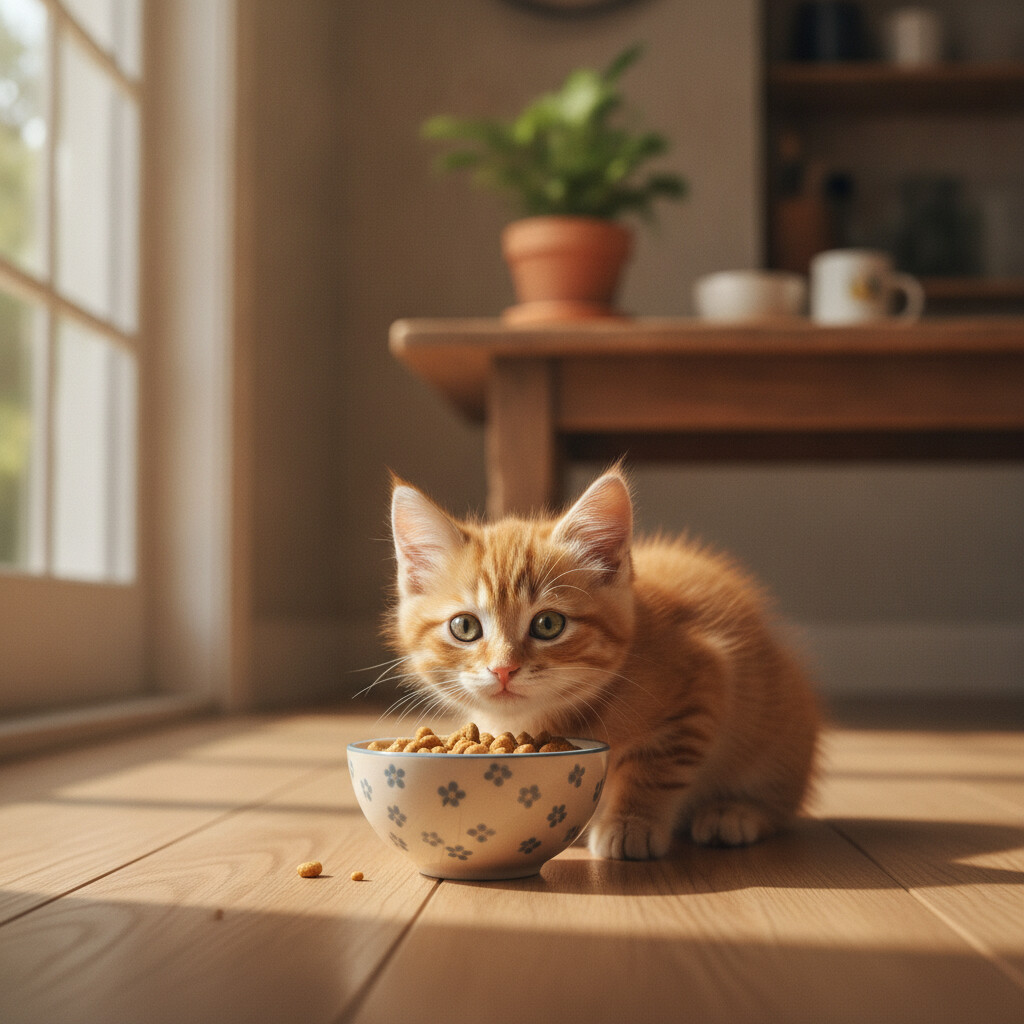
Kittens need roughly double the calories per pound of body weight that adult cats do. That’s not a rounding difference — it’s a fundamentally different nutritional profile for a body doubling in size over months. Get the feeding wrong in the first year and you risk setting a cat up for lifelong weight problems, developmental gaps, or deficiencies that show up years later.
The good news is that feeding a kitten correctly isn’t complicated. Here’s what you actually need to know.
Why Kitten Food Isn’t Just Small Adult Food
Kitten formulas are genuinely different from adult maintenance food in composition, not just kibble size. Compared to adult food, kitten food typically provides:
- Higher protein — to support rapid muscle development
- Higher fat — for energy density and brain development (DHA, an omega-3 fatty acid, is especially critical in the first months of life)
- More calcium and phosphorus — for bone and tooth development, in a ratio optimized for growth
- More calories per cup — because kittens burn energy fast
AAFCO (the Association of American Feed Control Officials) requires any food labeled “for kittens” or “for all life stages” to meet specific nutritional minimums for growth. Foods labeled “adult maintenance” don’t meet those minimums. The label distinction matters more than most owners realize.
If you buy food labeled “All Life Stages,” that meets AAFCO’s growth requirements — it counts as kitten food. If it says “adult maintenance only,” it doesn’t.
Wet Food vs. Dry Food for Kittens
Both work for kittens, but the wet-versus-dry question has a particularly strong case for wet food in younger cats. Kittens have an immature thirst drive and don’t compensate well for dry food by drinking more water. Wet food provides hydration alongside nutrition, which matters a lot in a stage where organ development is still underway.
Most veterinary nutritionists recommend at least 50% wet food during kittenhood if your budget allows. That said, plenty of kittens grow up fine on high-quality dry food — just make sure fresh water is always available, ideally from a fountain, which encourages more drinking than a static bowl.
How Much to Feed and When
Kittens need to be fed generously in the early months — their growing bodies regulate intake reasonably well before 6 months, and restricting food at this stage is a mistake.
General approach by age:
- 8–16 weeks: Feed kitten food freely (or 4+ small meals per day). This is the highest-growth window. Don’t restrict portions.
- 4–6 months: 3–4 meals per day. Still kitten formula. Roughly 150–250 calories total per day depending on size and activity, but follow your food’s packaging guide for specifics.
- 6–12 months: 2–3 measured meals per day. This is when appetite starts to outpace growth rate, and when obesity risk begins — especially after spaying or neutering, which reduces caloric needs by roughly 25–30%.
Your kitten’s food packaging will include a feeding guide based on weight. Use it as a starting point, then adjust based on body condition. Ribs should be easily felt but not visible; you should see a slight waist taper from above.
After Spaying or Neutering: Adjust Immediately
Many owners don’t realize that the metabolic shift after desexing is significant and fast. Caloric needs drop noticeably within weeks of the procedure. Kittens who were being fed freely before desexing often start gaining excess weight rapidly afterward if nothing changes.
Adjust to scheduled, measured meals within 2–4 weeks of the procedure. Your vet can advise on target amounts based on your kitten’s weight and breed.
When to Switch to Adult Food
Most cats can transition to adult food between 12 and 18 months. Large breeds — Maine Coon, Ragdoll, Norwegian Forest Cat — continue growing until 18–24 months and benefit from staying on kitten or all-life-stages food longer.
Don’t switch based on a calendar alone. Transition when your cat has clearly reached its adult weight and the growth curve has leveled off. Your vet can confirm this at the 12-month checkup.
When you do switch, do it gradually. Abrupt food changes cause GI upset in many cats, and a bad experience during food transition can make a cat suspicious of future food changes for months. The full transition protocol is worth reading before you start — the 10-day ramp approach is standard for good reason.
What Not to Feed Kittens
Cow’s milk: The cultural image of a kitten and a saucer of milk is wrong. Most cats are lactose intolerant after weaning. Cow’s milk causes diarrhea and isn’t nutritionally appropriate.
Raw eggs: Raw egg whites block biotin absorption over time. Raw eggs also carry Salmonella risk. Small amounts of cooked egg are fine and are a reasonable protein treat.
Adult food as the main diet: Not catastrophic short-term, but it doesn’t meet growth requirements. If you ran out of kitten food and used adult food for a day or two, your kitten will be fine. Just don’t make it a long-term habit under 12 months.
Grain-free diets as a default: Veterinary cardiologists have flagged a possible association between grain-free diets and dilated cardiomyopathy (DCM) in cats and dogs. The research is ongoing and not conclusive, but most veterinary nutritionists don’t recommend grain-free as the default approach — especially for kittens, whose developing hearts don’t need any additional risk factor. More on the grain-free evidence if you’re weighing this.
What to Ask Your Vet
Most kittens thrive on quality commercial kitten food without special intervention. But bring up nutrition at your kitten’s first vet visit if:
- You want to feed a raw or home-cooked diet. Get veterinary nutritionist input first — deficiencies in kittens develop fast and cause lasting damage
- Your kitten is losing weight or not gaining despite eating well
- You’re adopting a kitten under 8 weeks. These kittens may need bottle-feeding with kitten milk replacer (KMR), not solid food, and the protocol is more involved than standard feeding
The first year is the window where nutrition has its biggest impact on long-term health. Quality kitten food, the right amount, and a thoughtful transition to adult food at the right age — that’s genuinely all most kittens need.
When to See a Vet
Contact your vet about nutrition if:
- Your kitten shows signs of food intolerance: persistent diarrhea, vomiting after meals, skin issues
- Weight gain or loss that doesn’t track with expected growth curves
- You’re considering a home-cooked or raw diet (please consult a veterinary nutritionist before starting)
- You’re unsure whether your kitten’s current food meets AAFCO growth standards — your vet can confirm
Otherwise, a well-chosen kitten food and consistent feeding schedule will carry you through the first year with minimal drama.