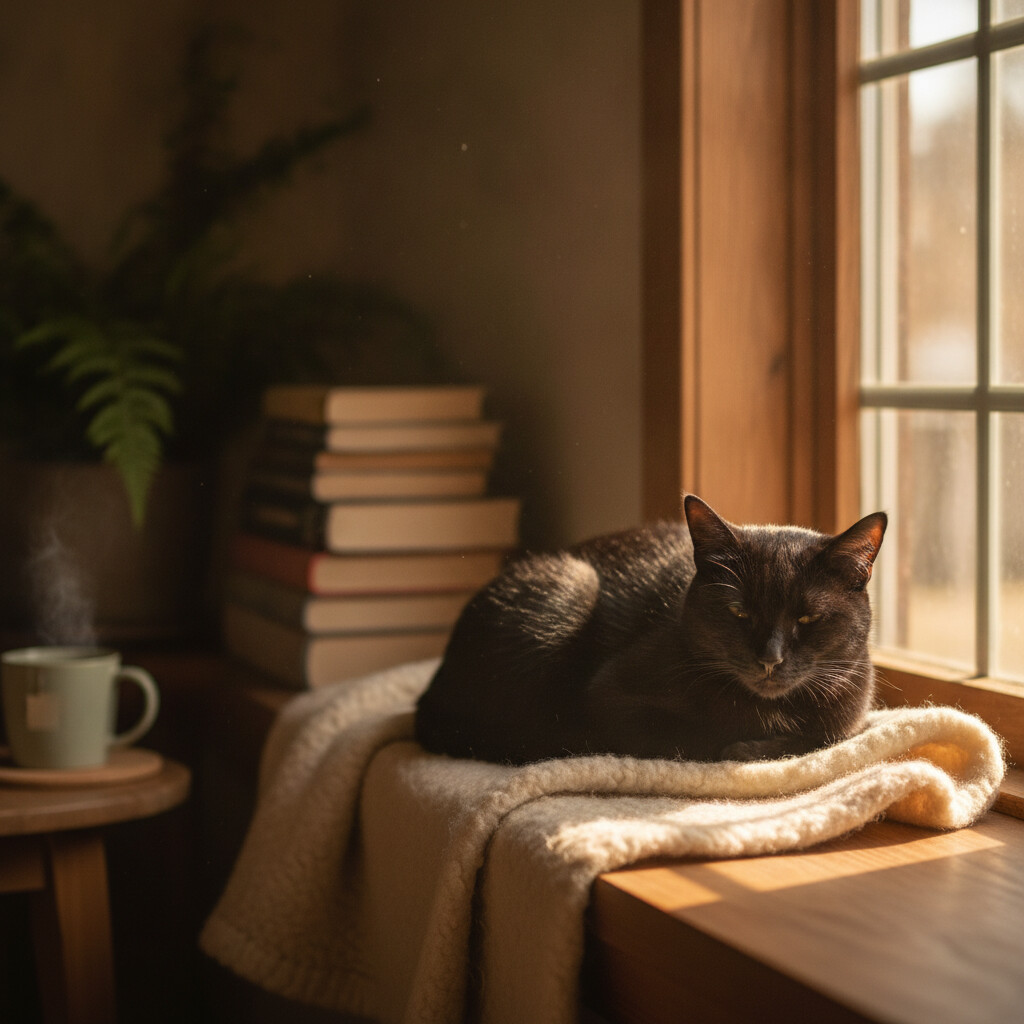
For almost three months we thought our cat Pepper had a hairball problem. She’d crouch low, stretch her neck out flat, and hack for twenty seconds at a time. Nothing ever came up. It turned out to be feline asthma, and the “hairball” was a cough.
If your cat retches like this and never produces anything, take a short video and show it to your vet. Here’s how we worked out what was really going on, and what living with an asthmatic cat looks like now.
The hairball that never appeared
Pepper was four, a sleek black shorthair with very little fur to swallow. That should have been our first clue, but hairballs are what everyone assumes when a cat makes that noise, so that’s what we assumed too.
The episodes started in late spring. Once a week, then twice. She’d stop whatever she was doing, drop into a crouch with her elbows out and her chin almost touching the floor, and make a dry, hacking sound. Then she’d shake it off and go back to sleep in the sun.
We bought a hairball paste. We brushed her more. We switched to a hairball-control food. None of it changed anything, and we still never found a single hairball on the carpet.
What finally pushed us to the vet was a Sunday morning when she had three episodes in an hour and was breathing with her mouth slightly open afterwards. A healthy cat almost never breathes through its mouth at rest, and seeing it scared us.
Coughing or retching? The difference we didn’t know
Our vet asked one question that changed everything: “Does anything come up?”
Cats bringing up a hairball usually retch and heave from the belly, and the episode ends with something on the floor: a hairball, foam or food. A cat that’s coughing looks different, and the posture is the giveaway:
- crouched low, often with the elbows slightly out
- neck stretched straight forward, head close to the ground
- a dry, hacking or wheezing sound
- nothing produced at the end, or at most a swallow
Our hairball guide covers what normal hairballs look like. Pepper’s episodes didn’t match any of it. Our vet asked us to film the next one on our phones, and that video ended up doing more for the diagnosis than our descriptions ever did.
How the vet worked it out
There’s no single test for feline asthma. Vets diagnose it partly by ruling out everything else that makes cats cough, which in Pepper’s case meant:
- Chest X-rays. These showed a pattern in her airways that’s typical of inflammation, which our vet pointed out on the screen.
- Blood tests, including a check for raised eosinophils, a type of white blood cell linked to allergic inflammation.
- A heartworm test and a faecal test for lungworm, because both parasites can cause coughing that looks like asthma.
- An airway wash was offered (a sample of fluid from the airways, taken under anaesthesia). We started treatment first and kept that in reserve.
Feline asthma is a chronic inflammatory disease of the lower airways. Veterinary references such as the Merck Veterinary Manual estimate it affects roughly 1 to 5% of cats. The airways become inflamed and over-reactive, then narrow when something triggers them. It can’t be cured, but in most cats it can be well controlled. We covered the medical side in more depth in Feline Asthma: Symptoms, Triggers, and Treatment.
Learning to use an inhaler on a cat
When the vet said “inhaler,” I laughed. I couldn’t imagine Pepper holding still for anything near her face.
Pepper started on a short course of oral steroids to calm the inflammation quickly, then moved to an inhaled steroid given through a cat-sized spacer: a tube with a soft face mask on one end and the inhaler on the other. She also has a rescue inhaler (a bronchodilator) for bad days. Doses and timing came from our vet and were adjusted over several rechecks, so I won’t list them here. Every cat’s plan is different.
The training took about three weeks, and it went like this:
- The spacer just sat on the floor near her food bowl for a few days.
- Treats came off the mask. I’d smear a lick of her favourite paste on the rim.
- The mask touched her face for one second, then she got a treat. We built up slowly.
- We added the puff only once she’d sit calmly with the mask on for several breaths.
These days she gets her morning puff on the kitchen bench and hops down expecting breakfast. It’s honestly less fuss than trimming her nails.
The triggers we found at home
Asthma flares are often set off by things in the air. Our vet suggested we look hard at our house, and we found more than we expected:
- Dusty litter. We switched to a low-dust, unscented litter. Her episodes dropped noticeably within a couple of weeks, though we changed several things at once, so I can’t credit any single change.
- Scented candles and plug-in air fresheners. Gone.
- Aerosol sprays, including hairspray and furniture polish, now used in another room with the door closed.
- Smoke of any kind. Nobody in our house smokes, but the research on secondhand smoke and cats made us strict about guests and fireplaces.
- Pollen season. Her worst weeks are still late spring, so we keep windows closed on high-pollen days.
Counting breaths: the habit that keeps her safe
The most useful thing our vet taught us cost nothing: counting Pepper’s breathing rate while she sleeps. Count each rise of the chest for 30 seconds and double it. Most healthy cats breathe somewhere under about 30 breaths a minute when they’re sleeping. Our vet gave us a personal number for Pepper and told us to call if she was consistently above it.
We log it in a phone note a few times a week. When her count creeps up, we know before she has a bad episode, and we can call the vet early. If you want to learn how, our guide to fast breathing in cats explains normal rates and how to count.
When to see a vet
Book an appointment if your cat:
- coughs, wheezes or “retches” without bringing up a hairball, food or foam
- has coughing episodes that are becoming more frequent
- breathes faster than usual while sleeping, or seems to work harder to breathe
Treat it as an emergency and go straight to a vet or emergency clinic if your cat:
- is breathing with their mouth open, or panting, while at rest
- has blue, grey or very pale gums or tongue
- is crouched and struggling to breathe, or the episode doesn’t settle within a few minutes
- collapses or seems unable to get comfortable
Breathing trouble in cats can get serious fast. If in doubt, call.
Where Pepper is now
Two years on, Pepper has one mild episode every month or two, mostly in spring. She’s on the lowest dose that keeps her steady, we recheck with our vet twice a year, and she still believes the inhaler is a treat dispenser.
Has your cat ever had a “hairball” that turned out to be something else?
A note on this story: it’s a composite, built from situations owners commonly describe and checked against published veterinary guidance. Names and personal details are illustrative. The medical information is not, so please talk to your vet about your own cat.