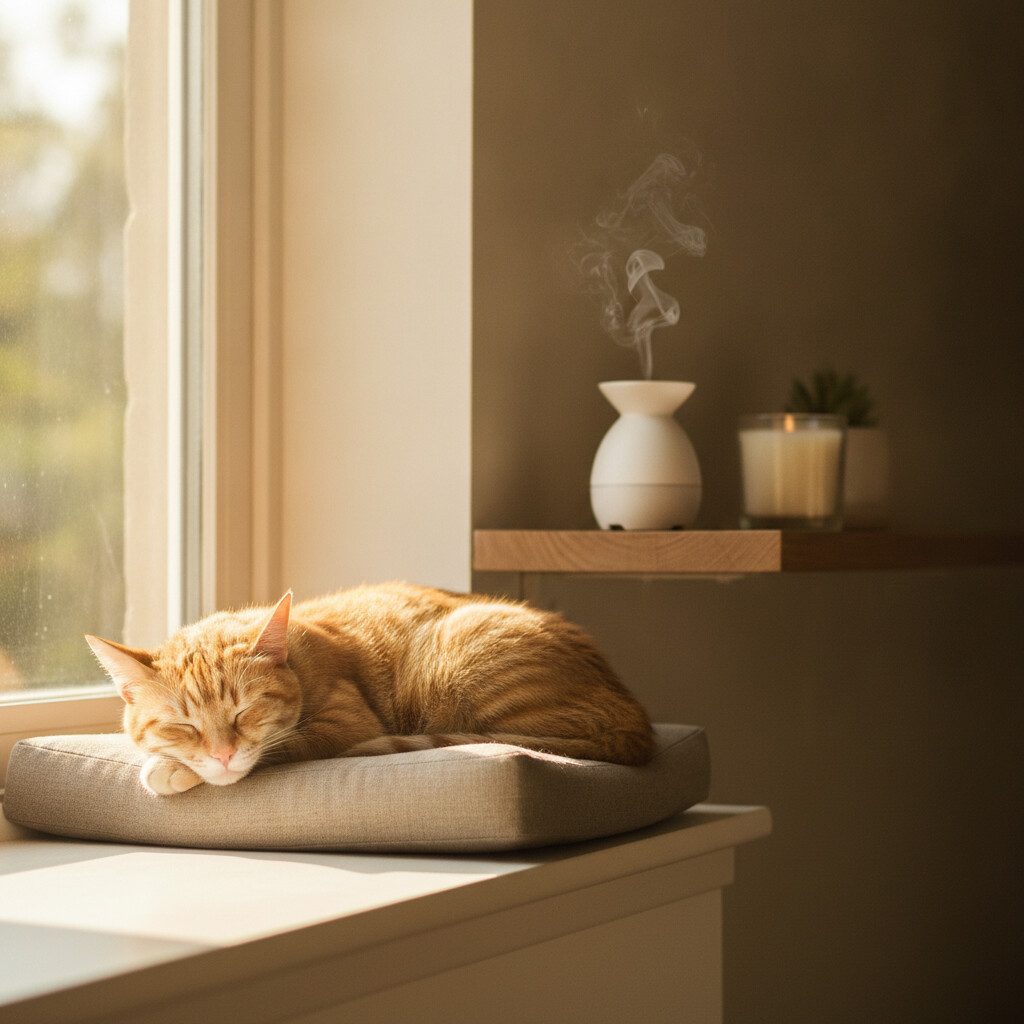
Many essential oils are unsafe for cats, and the risk climbs fast with concentration. A drop of undiluted tea tree oil on the skin can poison a cat. A diffuser running in a room the cat can’t leave is a smaller but real risk, especially for cats with asthma. Here’s what makes cats so vulnerable, which oils are the worst, and how to use scent at home without gambling.
Why are essential oils more dangerous for cats than for people or dogs?
It comes down to the liver. Most animals clear compounds like phenols and terpenes (the active chemicals in many essential oils) through a process called glucuronidation. Cats are unusually bad at it. Genetic research on the feline UGT1A6 gene (Court and Greenblatt, Pharmacogenetics, 2000; Shrestha and colleagues, PLoS One, 2011) shows that cats lack a working version of one of the key enzymes involved. That’s the same reason paracetamol (acetaminophen) is so toxic to them.
The result: compounds that a person or a dog breaks down and excretes can build up in a cat’s body. On top of that, oils are absorbed through the skin, and cats groom constantly. Anything that lands on their fur ends up in their mouth.
Dose still matters. “Essential oils are toxic to cats” is true for concentrated products and some specific oils. Whether occasional, low-level diffusing causes harm is much less clear, and there is very little controlled research on it. So the honest answer is: some uses are clearly dangerous, others are a “probably low risk, but why take it” situation.
Which essential oils are toxic to cats?
The oils most often named by the ASPCA Animal Poison Control Center and the Pet Poison Helpline include:
- Tea tree (melaleuca) — the best documented. A study of 443 cases in dogs and cats published in JAVMA (Khan and colleagues, 2014) found that 100% tea tree oil applied to the skin caused wobbliness, weakness, tremors and low body temperature, sometimes within hours. Many owners had used it on purpose, to treat fleas or skin problems.
- Pennyroyal — linked to liver failure.
- Wintergreen and sweet birch — contain methyl salicylate, a relative of aspirin, which cats also handle poorly.
- Eucalyptus, peppermint, cinnamon, clove, pine and ylang ylang
- Citrus oils (d-limonene), common in cleaners and air fresheners
That list isn’t complete, and “not on the list” doesn’t mean “safe.” Lavender, often marketed as calming, is frequently listed as a concern too. If you’re not sure about an oil, assume it’s a risk until your vet says otherwise.
Are diffusers safe to use around cats?
It depends on the type and how you use it.
Passive diffusers (reed diffusers, plug-in oil warmers, scent pads) release fragrance without spraying droplets. The bigger risk with these is a cat knocking one over, then walking through or licking the spill. Reed diffusers on a low shelf are an accident waiting to happen.
Active diffusers (ultrasonic and nebulizing types) push tiny droplets of oil into the air. Those droplets can settle on fur, and the cat then grooms them off. Inhaled oils can also irritate the airways. That’s a particular concern for cats with asthma or other breathing problems, because airway irritants can trigger flare-ups. If your cat coughs, wheezes or breathes with an open mouth, keep diffusers out of the house entirely. Our story The Cough We Thought Was a Hairball covers what feline asthma actually looks like.
If you do diffuse:
- Use it in a room the cat can leave, with the door open
- Run it for short periods, not all day
- Keep it well out of reach and on a stable surface
- Never diffuse in a small closed room with a cat inside
- Stop immediately if you see drooling, watery eyes, sneezing, coughing or pawing at the face
What about scented candles, wax melts and sprays?
Scented candles carry two separate risks. The first is fire and burns: cats walk along shelves and tails swish over flames. The second is the smoke and fragrance, which can bother sensitive airways in the same way other indoor air pollutants do (our article on secondhand smoke and cats covers why cats are so exposed to what’s in the air at floor and furniture level).
Wax melts are a burn risk when hot and a chewing risk when cold. Room sprays and “natural” cleaners often contain citrus or pine oils, and the residue sits on the floors and counters your cat walks across. Our room-by-room guide to household chemicals that are toxic to cats goes through the usual suspects.
A simple rule: if a product leaves anything on surfaces, or produces a mist, keep the cat out until it’s dry and the air has cleared.
Never put essential oils directly on your cat
This is the one that sends cats to emergency clinics. Home remedies for fleas, ear mites and itchy skin often call for tea tree or other oils. Even diluted, there’s no safe dose established for cats, and the 2014 JAVMA case series shows how quickly undiluted oil can cause serious illness.
The same applies to “natural” flea products. Some pet shampoos and sprays rely on plant oils, and the label “natural” tells you nothing about whether it’s safe for cats. For fleas, use a product your vet recommends that is labelled specifically for cats. Dog flea treatments containing permethrin are a separate and very serious danger to cats.
Signs of essential oil poisoning in cats
Watch for:
- Drooling or foaming at the mouth
- Vomiting
- Wobbly walking, weakness or trembling
- Pawing at the mouth or face
- Watery eyes, redness or irritated skin
- Coughing, wheezing or fast or labored breathing
- An oily smell on the fur or breath
- Low body temperature, a slow heart rate or collapse in severe cases
Signs can show up within minutes of skin contact or swallowing, or take a few hours. Liver damage from some oils can take longer to appear.
When to see a vet
Call your vet or an emergency clinic straight away if:
- Oil was put on your cat’s skin, or your cat licked up a spill
- Your cat has any of the signs above after being near an oil, candle or diffuser
- Your cat has breathing difficulty of any kind (this is always urgent)
While you’re getting help:
- Don’t make your cat vomit unless a vet tells you to.
- Move your cat to fresh air and turn off any diffuser.
- Bring the bottle or product so the vet knows exactly what was involved.
- If oil is on the fur, your vet may tell you to wash it off with a mild dish soap. Ask first, and don’t try other home remedies.
You can also call the ASPCA Animal Poison Control Center (888-426-4435) or the Pet Poison Helpline (855-764-7661). Both are staffed by veterinary toxicology professionals around the clock. A consultation fee usually applies, and it’s often worth it.
The practical takeaway
You don’t have to give up scent entirely. Keep concentrated oils sealed and stored like medicine. Never apply oils to your cat. If you diffuse, do it briefly, in a room your cat can walk out of, and skip it altogether if your cat has breathing issues. Keep candles where tails can’t reach. And if your cat seems unwell after contact with any scented product, call a vet rather than waiting it out.
Do you use diffusers or scented candles at home, and has your cat ever reacted to one?