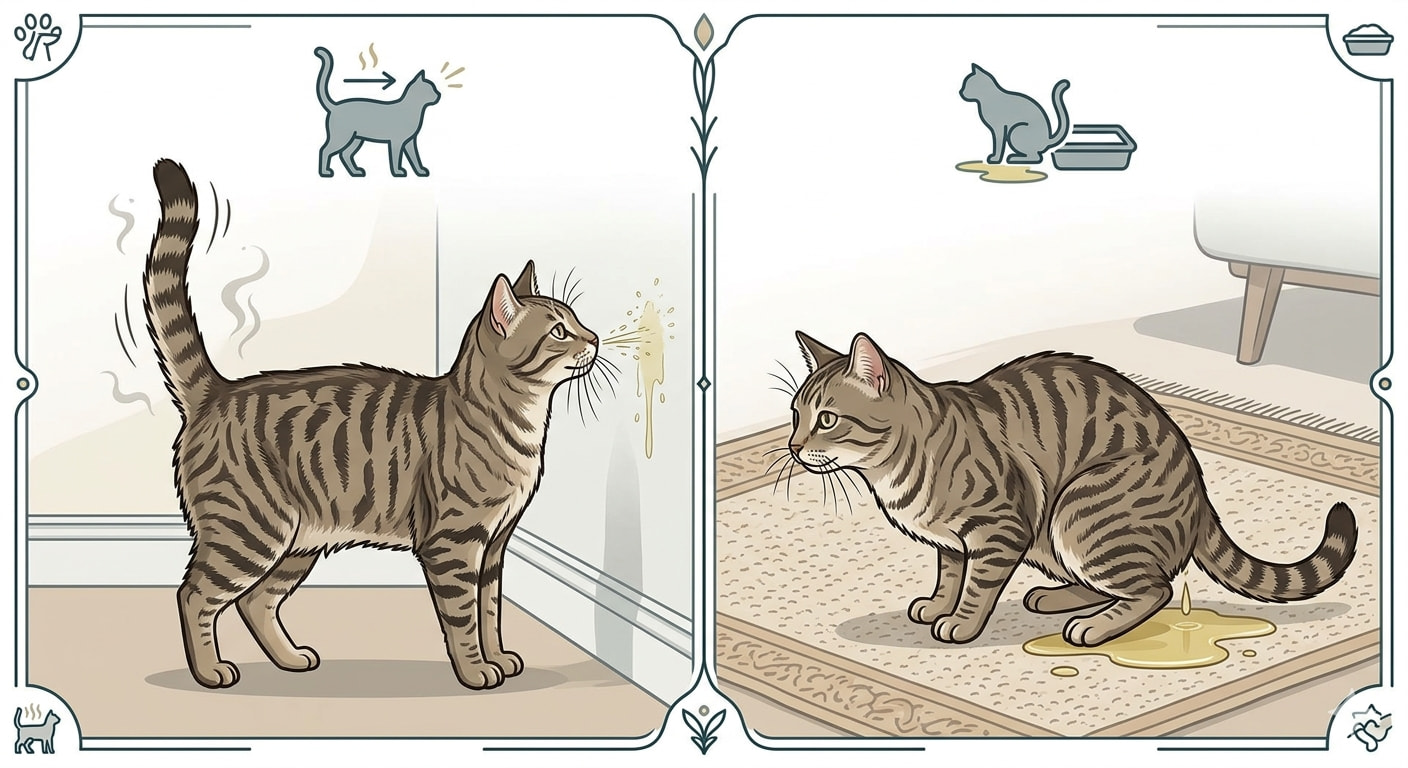
Your cat is depositing urine somewhere other than the litter box. Before anything else, you need to figure out whether this is spraying or inappropriate urination — because the causes are completely different, and doing the wrong fix will waste weeks of your time.
Here’s the short version: spraying is territorial marking behavior; inappropriate urination is a litter box rejection. Both result in urine in unwanted places, but they look different, happen for different reasons, and need different responses.
What Spraying Looks Like
Spraying is a marking behavior, not a toileting failure. A cat that sprays:
- Backs up to a vertical surface — walls, door frames, furniture legs, curtains
- Holds the tail upright and may quiver it slightly while depositing a small amount of urine
- Leaves a thin streak rather than a puddle — typically a few inches high on the target surface
- Continues using the litter box normally for urination and defecation
The position is the giveaway. Spraying cats stand, back up, and mark vertically. If you’ve seen your cat standing with tail raised against a couch leg and then walked away from the litter box without issue, that’s marking.
The urine also smells stronger than normal. Spraying cats deposit pheromone-rich urine deliberately intended to send a chemical signal — you’ll usually notice a sharper, more pungent odor than you’d smell from regular elimination.
What Inappropriate Urination Looks Like
Inappropriate urination (also called periuria by vets) is when a cat squats and empties their bladder somewhere other than the litter box. Key differences:
- Happens on horizontal surfaces: beds, carpet, laundry piles, couch cushions, floor
- Produces a proper puddle, not a streak — the cat is fully voiding, not marking
- The cat may be using the litter box inconsistently, or avoiding it entirely
- May be accompanied by signs of discomfort: crying, licking at the genitals, going in and out of the box without producing anything
If your cat is squatting and leaving a wet patch on your duvet, that’s inappropriate urination. The problem isn’t territorial — it’s that something has made normal litter box use unattractive or painful.
Why Cats Spray
Spraying is almost always either territorial or stress-driven. Common triggers:
Territorial causes:
- A new cat in the household (or even a cat visible through a window)
- Moving to a new home
- Rearranged furniture that disrupts the cat’s mapped territory
- A new pet or person in the home
Hormonal causes:
- Intact (unneutered) males spray significantly more than neutered males — the AVMA notes that neutering reduces spraying in approximately 90% of male cats. Intact females can also spray, especially during estrus.
Stress causes:
- Changes to routine (new work schedule, household disruption)
- Inter-cat conflict in a multi-cat home — even subtle social tension between cats that live together can trigger marking behavior
- Perceived threats from outdoor cats coming into view
The key pattern with spraying: it tends to cluster around specific locations that carry territorial significance — doorways, windows, corners of rooms, and anywhere a new person or animal has recently spent time.
Why Cats Urinate Outside the Litter Box
The reasons vary widely and include both medical and behavioral causes. This is important: inappropriate urination always warrants a vet check first, because medical issues frequently look identical to behavioral ones.
Medical causes (rule these out before assuming behavioral):
- Feline lower urinary tract disease (FLUTD) — inflammation that makes urination painful; cats associate the litter box with pain and seek alternatives
- Urinary tract infection — less common in cats than dogs, but real
- Bladder stones or crystals
- Kidney disease or diabetes (both increase urination frequency)
- Arthritis — older cats may find it painful to climb into a hooded box or one with high sides
Behavioral/environmental causes (after ruling out medical):
- Litter box too dirty — cats are clean animals and many will refuse a dirty box before humans even notice the smell
- Wrong litter type — a sudden switch in litter can cause rejection; unscented, fine-textured clumping litter is preferred by most cats per AAFP guidelines
- Box location: too noisy, too exposed, near food or water, or only accessible through territory controlled by another cat
- Box type: some cats refuse covered boxes because the enclosed space traps odor
- Insufficient number of boxes — the AAFP guideline is one box per cat plus one; in multi-cat homes this is often the problem
How to Fix Spraying
If your cat is neutered or spayed and still spraying, address the trigger:
For territory-driven spraying:
- Block visual access to outdoor cats if that’s the trigger (window film, repositioned furniture)
- Use synthetic feline pheromone diffusers (Feliway Classic or Comfort Zone) — multiple studies show pheromone diffusers reduce stress-related spraying, though results vary by individual cat
- Clean marked areas with an enzyme-based cleaner (not ammonia-based, which smells like urine and can encourage re-marking)
For multi-cat household spraying:
- Identify which cat is spraying (a vet can prescribe fluorescent dye added to food if it’s not obvious)
- Ensure adequate resources — each cat needs their own food station, water source, litter box, and sleeping area without having to pass through another cat’s territory. The guide to stopping cats from fighting covers multi-cat setup in detail.
- Increase vertical space — cats coexist more easily when they can occupy different height levels
If your cat is intact: spaying or neutering is the most effective single intervention for hormonally-driven spraying.
How to Fix Inappropriate Urination
Step 1: See the vet. Don’t start with behavioral fixes. A cat suddenly avoiding the litter box is displaying pain until proven otherwise. A urinalysis and basic blood panel will rule out FLUTD, infection, and metabolic causes. If your cat is straining and producing no urine, treat it as an emergency — urinary blockage in male cats is life-threatening. See the urinary tract infections in cats article for a closer look at medical causes.
Step 2: Reassess the litter setup.
- Clean boxes daily; empty and scrub weekly with unscented soap
- Ensure you have enough boxes — one per cat plus one
- Place boxes in quiet, low-traffic locations the cat can access without crossing another cat’s path
- Offer an uncovered box if you currently use covered ones
- Try unscented, fine-grain clumping litter if you use scented or crystal varieties
Step 3: Remove the opportunity to re-offend.
Cats that have urinated somewhere tend to return to that spot. Clean soiled areas thoroughly with an enzyme cleaner. Temporarily restrict access to problem areas while you address the root cause.
Step 4: Make the litter box more attractive by placing it near a location the cat has chosen. If they’re consistently using a corner of the bedroom, a box temporarily placed there while you work on the underlying problem often helps break the habit.
When to See a Vet
Go immediately if:
- Your cat is straining to urinate and producing little or nothing — potential blockage emergency
- Blood in the urine
- Any sign of distress around urination (crying, excessive licking, restlessness)
Book an appointment soon if:
- Inappropriate urination started suddenly with no obvious environmental trigger
- Your cat is urinating more frequently than normal
- The problem continues despite cleaning and litter box adjustments
- Your cat is older than 7 (rule out kidney disease, diabetes, and arthritis-related litter box avoidance)
Spraying and inappropriate urination look similar from the outside but require different responses. Get the diagnosis right first — is it marking or avoidance? — and you’ve solved half the problem before doing anything else.