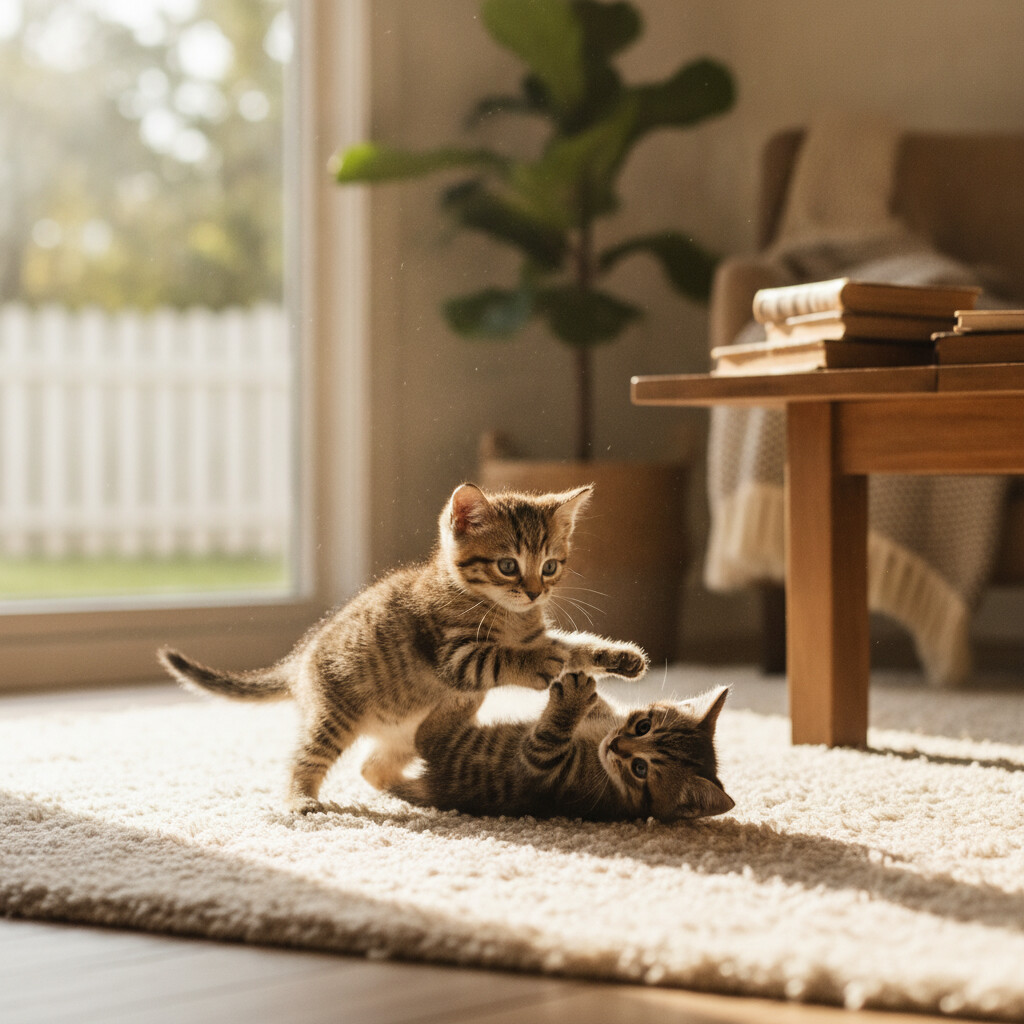
Yes, in most cases — if you have the time, space, and budget for two, adopting a pair of kittens together is usually easier than adopting one now and adding a second cat later. Kittens raised together from a young age tend to bond faster, play with each other instead of relentlessly pestering you, and adjust to a new home with less stress than a solo kitten does. That said, “usually easier” isn’t “always the right call,” and there are real trade-offs worth thinking through first.
Why Shelters and Vets Often Recommend Pairs
Kittens are wired to play — hard, constantly, and often at 3am. A single kitten with no feline playmate directs all of that energy at you: your hands, your ankles, your sleeping face. Two kittens burn off that energy on each other instead, which tends to mean fewer overstimulation bites and a calmer household overall.
The American Association of Feline Practitioners (AAFP) and most shelter behaviorists note that the socialization window for kittens — roughly 2 to 9 weeks of age — is when they learn bite inhibition, appropriate play, and social skills primarily from littermates and their mother. A kitten adopted solo after this window has already missed some of that peer learning, and a second, similarly-aged kitten can help fill the gap by continuing that rough-and-tumble social education at home.
Kittens introduced to each other before they’re fully weaned or shortly after also tend to skip the drawn-out introduction process that adult cats usually need — no scent-swapping, no separate rooms for weeks, no growling through a door.
The Real Costs of Two
This is where “should I” and “can I” diverge. Two kittens means:
- Double the vet bills. Two rounds of vaccines, two spay/neuter surgeries, two sets of any unexpected illness costs. Kittens are prone to parasites, upper respiratory infections, and other early-life vet visits — budget for two of everything.
- Double the food, litter, and supplies — though not necessarily double the space needs, since kittens raised together often share resources more easily than unrelated adult cats.
- More chaos during the kitten phase. Two kittens knocking things over, scaling curtains, and getting into things is genuinely more work than one, even if it’s also funnier.
- A harder time housetraining and crate-adjusting them separately if you ever need to (illness, travel, a vet stay) — pairs that have never been apart can struggle with brief separations.
If your budget or bandwidth is already tight with one kitten, a single kitten is the more honest choice — a stressed, overextended owner isn’t better for either cat than a well-resourced single-kitten household.
What Actually Matters: Age-Matching and Timing
If you do go with two, the biggest factor in long-term success isn’t personality-matching (kittens are adaptable) — it’s age and timing:
- Similar ages work best. A 10-week-old and a 4-month-old kitten have very different energy levels and play styles; the age gap can create frustration on both sides rather than companionship.
- Adopting together beats adopting sequentially. Bringing home kitten #1, waiting six months, then adding kitten #2 means kitten #1 has to adjust to a newcomer in what’s now “their” territory — a genuinely different (and often harder) process than two kittens meeting each other in a brand-new space at the same time. For more on managing that staggered scenario, see our guide on how to introduce two cats for the first time.
- Littermates aren’t required. Two unrelated kittens of similar age, introduced at the same time in a new home, typically bond just as well as biological littermates do.
Setting Up for Two From Day One
A few adjustments make the early weeks smoother:
- Multiple resources, even for a bonded pair. The general rule is one litter box per cat plus one extra, and at least two separate food and water stations, so competition and resource-guarding don’t take root early. Our guide to setting up a multi-cat household covers the space and resource math in more detail.
- Expect a rough first few weeks either way. Even two kittens who get along well will have spats — hissing, brief chasing, the occasional overly hard bite. This is normal social learning, not a sign the pairing failed.
- Handle them individually too. It’s easy to let two kittens become “a unit” and only interact with them as a pair. Make time for one-on-one handling, vet-visit practice, and solo attention with each kitten so they’re comfortable being separated when life requires it (a vet stay, one getting sick, eventual differences in daily routine).
The Bottom Line
Two kittens is the easier path for the kittens — they’ll socialize each other, play together instead of exclusively on you, and adjust to a new home with a built-in companion. It’s the harder path for your wallet and your patience in the short term. If you can genuinely afford double the vet care and tolerate double the kitten chaos for a few months, adopting a pair is a reasonable default. If either of those is a stretch, one well-loved kitten — with plenty of play from you — is a completely sound choice too.