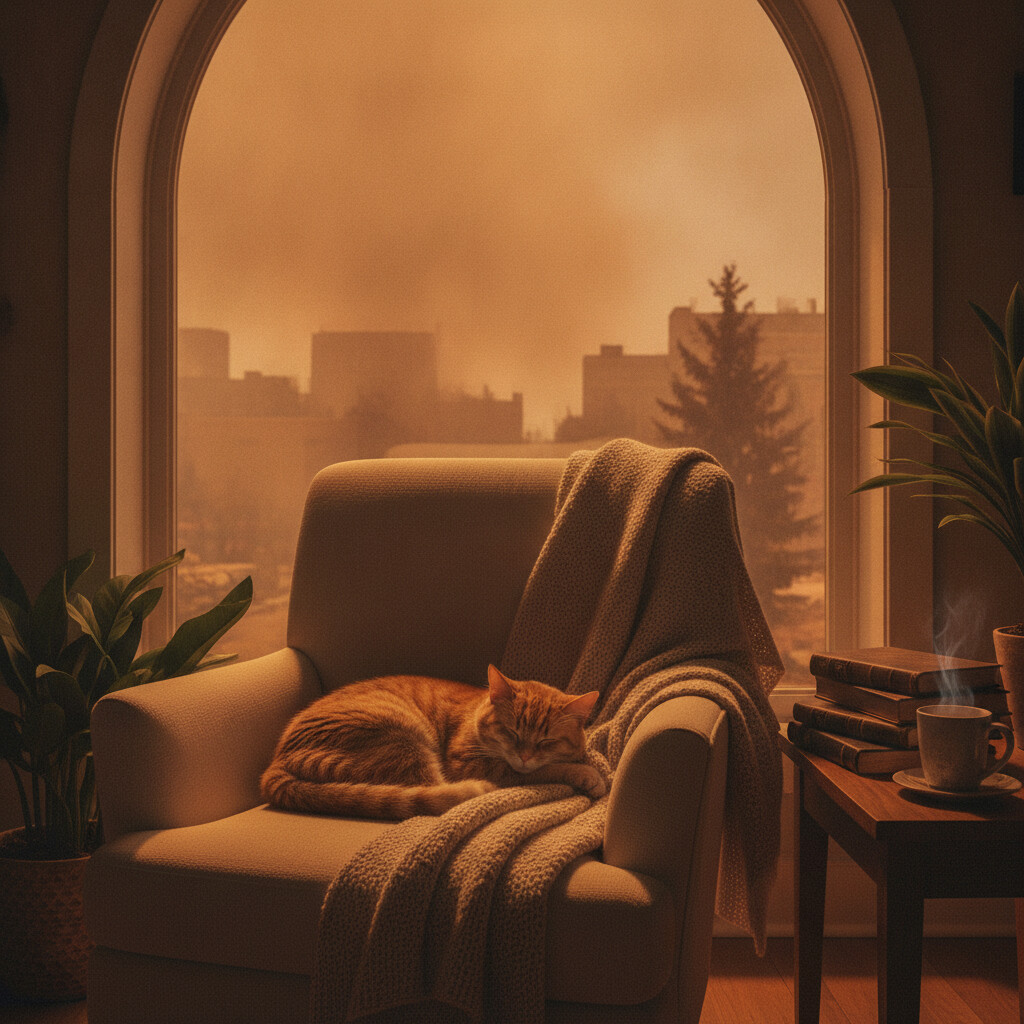
Wildfire smoke is bad for cats in exactly the way it’s bad for you — the fine particles in smoke (PM2.5) get deep into the lungs and irritate airways, and cats can’t step inside and shut a window on their own. If you’re anywhere near a wildfire-smoke advisory this summer, the short version is: keep your cat indoors, run a real air purifier, and watch for coughing, wheezing, or lethargy.
Here’s what’s actually happening in a cat’s respiratory system during a smoke event, and what to do about it.
How Wildfire Smoke Affects a Cat’s Lungs
Wildfire smoke is a mix of gases and fine particulate matter, most notably PM2.5 — particles small enough to bypass the upper airway’s natural filtering and lodge deep in lung tissue. Cats have smaller airways relative to their body size than humans do, and their respiratory rate is higher, which means they’re moving more smoke-laden air through those airways per minute during a bad air day.
The U.S. EPA’s Air Quality Index (AQI) guidance for sensitive groups — originally written with human asthmatics and the elderly in mind — is a reasonable proxy for pets too, according to veterinary toxicologists who’ve studied wildfire exposure in companion animals. Once AQI crosses into the “unhealthy for sensitive groups” range (101+), it’s worth changing your cat’s routine for the day, not just yours.
Signs Your Cat Is Reacting to Smoke
Cats are good at hiding discomfort, so the signs are often subtler than you’d expect:
- Coughing or wheezing — a cat cough can sound like a dry hack or be mistaken for a hairball attempt
- Open-mouth breathing or breathing that looks labored even at rest
- Reduced appetite or unusual lethargy
- Red, watery eyes or squinting
- Increased hiding — smoke and haze changes light and smell in ways cats notice before we do
None of these are exclusive to smoke exposure, but if they show up during or right after a smoke event, treat smoke as the likely trigger and act accordingly.
Cats With Asthma or Existing Respiratory Conditions Are at Higher Risk
If your cat has feline asthma or a history of upper respiratory infections, wildfire smoke is a genuine trigger, not just a general irritant. Asthmatic cats can go into a flare with airway inflammation and bronchoconstriction from smoke exposure the same way a human asthmatic would from wildfire haze. If you know your cat has a respiratory history, smoke days are the days to have rescue medication on hand and a lower threshold for calling your vet.
How to Protect Your Cat During a Smoke Event
Keep them inside, fully. This is the single biggest thing you can do. No supervised yard time, no cracked windows for “fresh air” — outdoor air during a smoke event is worse than indoor air, even in an untreated home.
Run a HEPA air purifier in the room your cat spends the most time in. Look for one sized appropriately for the square footage — undersized units running on low don’t do much. Change filters on schedule; a clogged filter stops filtering.
Close windows and doors, and switch HVAC to recirculate if your system has that option, so you’re not actively pulling smoky outside air in.
Skip strenuous play on bad air days. Heavy breathing during exercise pulls more particulate matter deeper into the lungs — same logic as advising human asthmatics to avoid outdoor exercise on red-flag air days.
Keep the litter box away from any drafty exterior door or window during smoke events, so litter dust isn’t adding to airway irritation on top of smoke particles already in the air.
When to See a Vet
Call your vet the same day if your cat is:
- Breathing with an open mouth, or breathing looks effortful (visible chest/belly movement, flared nostrils)
- Coughing repeatedly or wheezing
- Refusing food for more than 24 hours
- Unusually lethargic or unresponsive to normal interaction
- A known asthmatic showing any change from baseline
None of these are things to wait out over a weekend. Feline respiratory distress can escalate quickly, and a same-day vet visit is the appropriate level of urgency, not overreaction.
The Practical Takeaway
Wildfire smoke isn’t just an outdoor-cat problem — indoor cats are exposed too, through open windows, HVAC intake, and residual particulate that settles indoors during multi-day smoke events. Treat bad air days the way you’d treat extreme heat: check the AQI before you plan the day, keep your cat inside with filtered air, and watch for the early signs rather than waiting for obvious distress. If you’re already tracking AQI for your own asthma or allergies, you’re most of the way to protecting your cat too — the thresholds aren’t that different.
For more on keeping cats comfortable during difficult weather stretches, see our guide on keeping your cat cool in summer heat.