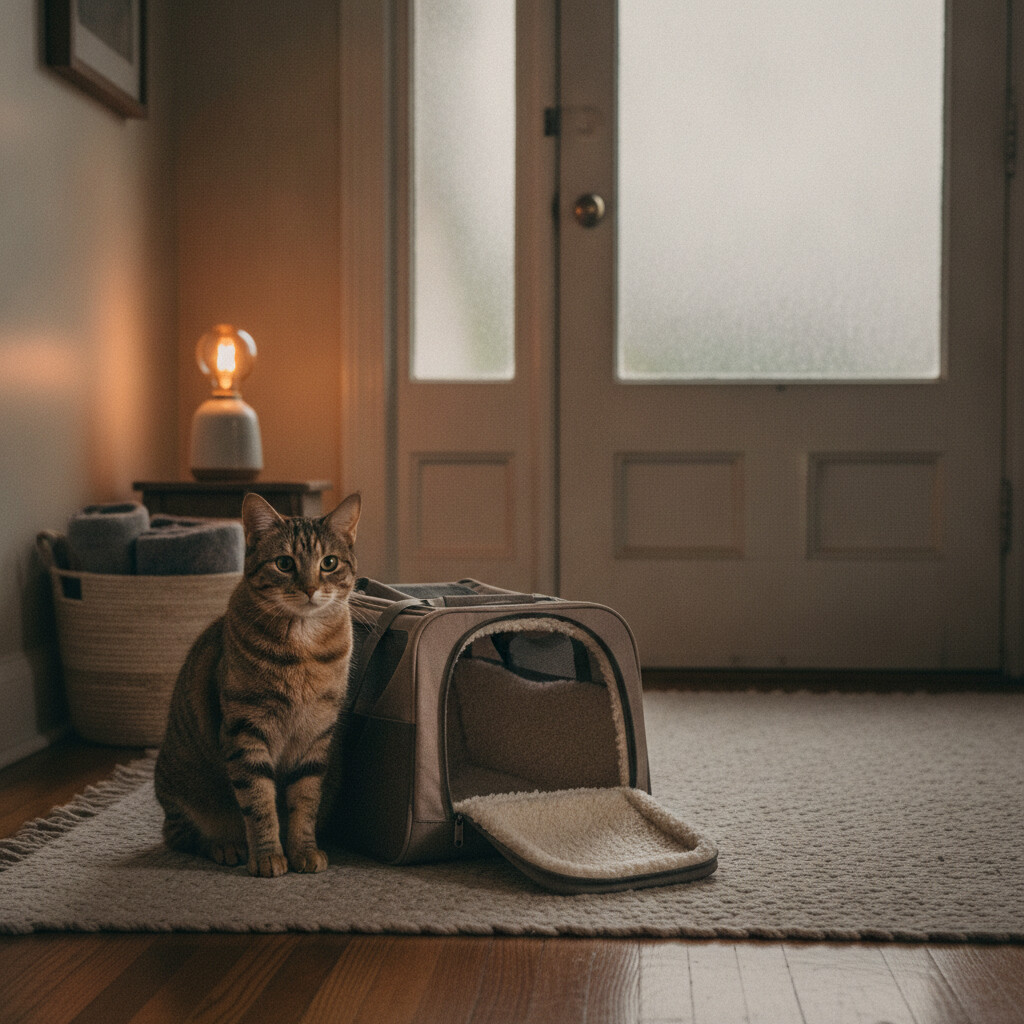
We had eleven minutes. That’s what the reverse-911 call said when it woke us up at 2 a.m. in August: mandatory evacuation, fire moving fast, leave now. My husband grabbed the go-bag we’d never actually packed. I ran for the cat.
Loretta wasn’t in her bed. She wasn’t under the couch. For almost four of our eleven minutes, we couldn’t find her — and I learned something that night that no wildfire-smoke article had prepared me for: a scared cat doesn’t act like herself, and finding her fast means knowing where she goes when she’s terrified, not where she usually sleeps.
The Search
Loretta is not a hider. Nine years old, mellow, the kind of cat who greets the mail carrier through the window. But the second the smoke alarm’s low-battery chirp mixed with actual sirens outside, she vanished — and “vanished” for a cat usually means one of three places: up, under, or behind something heavy.
We’d already lost two minutes checking her normal spots before my husband thought to check behind the water heater in the laundry closet, wedged into a gap she’d never used before that night. She was flattened against the wall, pupils blown wide, breathing fast. He had to physically pry her loose — she wasn’t going to walk out on her own.
That’s the part I want other cat owners to hear: in a genuine emergency, don’t expect your cat to come when called, even a cat who always comes when called. Fear rewires behavior. Go straight to the tightest, darkest gaps in the house.
The Carrier Problem
We own a carrier. It lives in the garage, which — in an evacuation where the garage is the last place you’re grabbing things from on your way to the car — is a design flaw I hadn’t thought about until 2 a.m. with a fire glowing orange on the ridge behind our house.
We ended up putting Loretta in a soft-sided duffel bag with the zipper cracked for air, because that’s what was closest to the laundry closet. It worked, but it was not a plan — it was luck. She could have bolted the second the zipper opened wider than an inch.
Since that night, our carrier lives by the front door, always, no exceptions. If you take one thing from this story, take that: the carrier has to be somewhere you’ll actually grab it in under a minute, in the dark, with your hands shaking. A step-by-step guide for what to do if your cat gets out is worth reading before you’re in this situation, not during it — we read one at 3 a.m. in a Target parking lot and it would have helped a lot more at 1:45 a.m.
What the Smoke Actually Did
We got out. The house was fine — the fire turned two ridges over. But Loretta coughed for three days afterward, and our vet later told us that even brief, heavy smoke exposure can irritate a cat’s airways the same way it does a human’s, sometimes worse, because cats groom the particulates off their fur and ingest them too. We’d already read what wildfire smoke does to cats months earlier — that article was the reason we didn’t panic when the coughing started and knew what “wait it out” versus “call the vet” actually looked like.
She also didn’t eat for almost two full days after we got to my sister’s place. The vet wasn’t worried yet at that point — cats commonly go off food for a day or two after acute stress — but she was clear that if it stretched past 48 hours, that’s a same-day call, not a wait-and-see, because cats can develop serious liver problems from prolonged fasting.
What We’d Do Differently
A few things changed permanently in our house after that night:
- The carrier stays by the front door. Not the garage, not the closet upstairs. By the door we’d actually run out of.
- Loretta has a hiding-spot list now, not a sleeping-spot list — we know the three places she goes when she’s scared, and we check those first if we ever need to find her in a hurry again.
- Her microchip info got updated the week after, because in the chaos of that night, if she’d bolted from the duffel bag before we got in the car, a wrong phone number on file would have meant losing her for good.
- We keep a printed, physical list of her vet’s info and a photo of her in the same folder as our insurance documents — because your phone can die, and evacuation shelters ask for this stuff.
None of this required buying anything expensive. It required thinking through the two-minutes-of-panic scenario once, calmly, in daylight, instead of improvising it for the first time at 2 a.m.
The Takeaway
If you live anywhere near wildfire risk — and in the western half of the country now, that’s a lot more homes than it used to be — do the version of this exercise before you need it: know your cat’s actual hiding spots when scared, keep the carrier somewhere grab-and-go, and have a plan for what “acute stress, give it 48 hours” looks like versus “this needs a vet now.”
Loretta’s fine. She’s back to greeting the mail carrier. But I think about that four minutes behind the water heater more than I expected to, and I’d rather every cat owner reading this have a plan already than learn it the way we did.