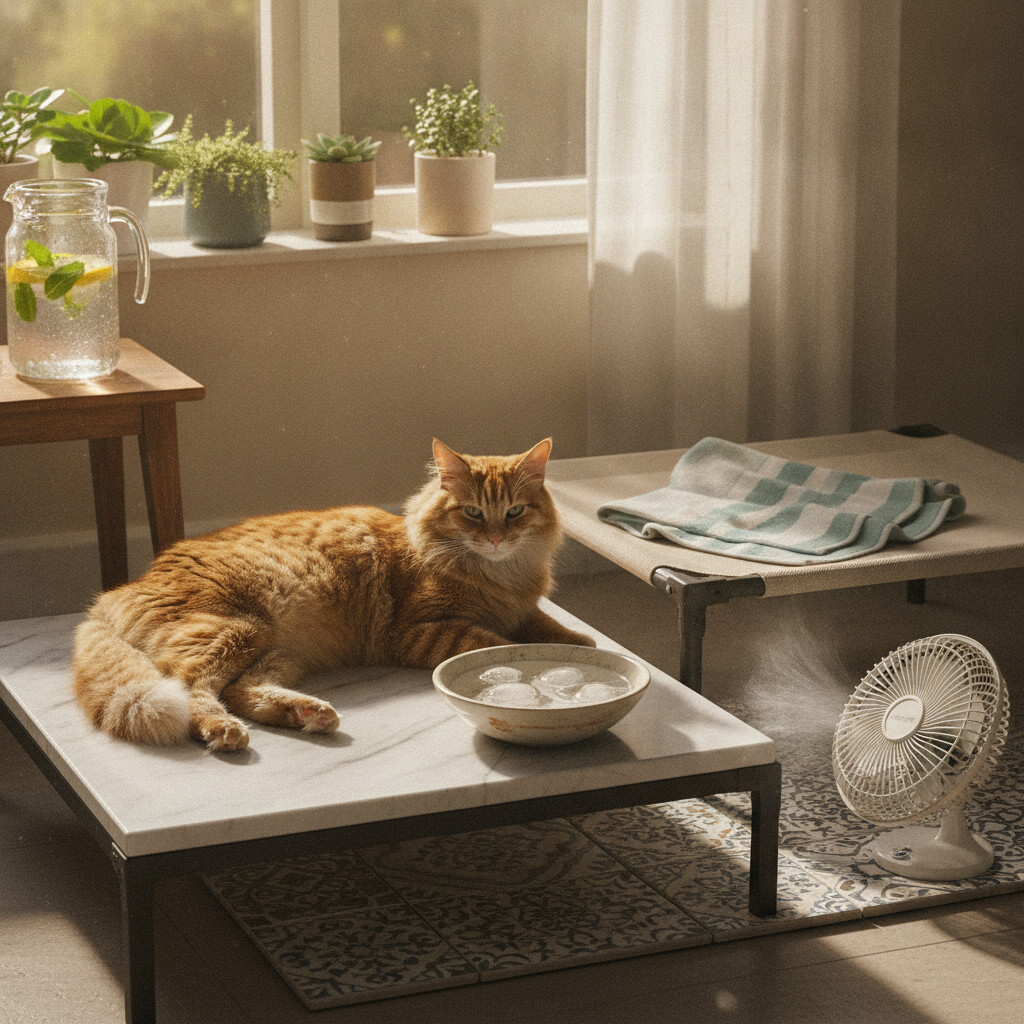
Cats regulate heat far less efficiently than most owners assume. They don’t sweat except through their paw pads, panting is a late-stage sign rather than an early cooling strategy, and a dense coat that insulates against cold in winter works against them in July. The short version: keep water constantly available, keep peak-sun hours off-limits, and learn to tell the difference between a cat napping in a sunbeam and a cat in real trouble.
Why Cats Overheat Faster Than You’d Expect
Cats’ normal body temperature runs higher than ours to begin with — roughly 100.5°F to 102.5°F. That leaves a much smaller buffer before things go wrong. Most cats can’t cool down the way dogs or humans do. They have almost no functional sweat glands outside their paw pads, so their main defenses against heat are behavioral: seeking shade, stretching out to increase surface area, and reducing activity. When the environment doesn’t give them those options — a hot apartment with the blinds open all day, a car, a carrier left in direct sun — their body has very few backup systems.
Certain cats are at higher risk than others. Flat-faced breeds like Persians and Himalayans struggle more because their airway shape limits the small amount of panting-based cooling they can do. Overweight cats, senior cats, kittens, and cats with heart or respiratory conditions also have a much narrower safety margin. The Cornell Feline Health Center flags obesity and brachycephalic anatomy specifically as heat-risk multipliers, not just general health concerns.
Signs of Heat Stress vs. Heatstroke
A cat sprawled in a warm patch of floor, breathing normally, ears relaxed, is just a cat enjoying the sun — that’s not a problem. Heat stress looks different: restlessness, seeking out cool surfaces like tile or a bathtub, and drinking more water than usual. That’s your cue to intervene before it escalates.
Heatstroke is a veterinary emergency, and the signs are distinct from normal warm-weather behavior:
- Open-mouth panting (genuinely unusual for cats — this alone is a red flag)
- Excessive drooling
- Bright red gums or tongue
- Rapid heartbeat
- Vomiting or diarrhea
- Wobbliness, disorientation, or collapse
- Body temperature above 105.8°F
The American Veterinary Medical Association notes that heat-related illness in cats often gets missed early because owners are watching for panting the way they would with a dog — by the time a cat is panting heavily, the situation has usually already progressed past the easy-fix stage.
Practical Ways to Keep an Indoor Cat Cool
Most heat-related problems in cats happen indoors, not outdoors, simply because that’s where most cats spend their time. A few things make a real difference:
- Water access everywhere, not just one bowl. Cats often won’t walk across a hot room for water. Put bowls or a fountain in two or three rooms your cat actually uses. If you’re unsure whether your cat is drinking enough even outside of hot weather, How Much Water Should a Cat Drink Per Day? breaks down the numbers.
- Block direct sun during peak hours, roughly 11am to 4pm, rather than relying on the whole house staying cool. Closed blinds on south- and west-facing windows do more than a fan pointed at an already-warm room.
- Give them a cool surface to lie on. Tile floors, a bathtub with a towel in it, or a cooling mat all work — cats will find these on their own if they’re accessible.
- Keep them mentally occupied instead of just physically confined. A bored cat in a hot house is a stressed cat in a hot house, and stress raises body temperature too. If you’re working from home and your cat’s usual routine is disrupted by heat keeping you both indoors more, Indoor Cat Enrichment: How to Keep an Indoor Cat Mentally Stimulated has ideas that don’t require running around.
- Never rely on a fan alone. Fans help humans evaporate sweat; they do much less for a cat, since evaporative cooling isn’t how cats regulate heat in the first place.
Cars, Carriers, and Outdoor Time
The car-related warnings you’ve heard about dogs apply just as much, and arguably faster, to cats — a parked car’s interior can climb past 120°F within 30 minutes even with the windows cracked, regardless of outside temperature. Never leave a cat in a parked car, even for a “quick errand.”
If your cat has supervised outdoor access, hot pavement and decking are an underappreciated risk — surfaces that feel warm to your bare foot can be significantly hotter at paw level, and burned pads are a real and painful injury. A simple rule: if you can’t hold the back of your hand on the pavement for five seconds, it’s too hot for paws. Shaded, elevated surfaces (a catio platform, a shelf under a tree) let a cat stay outside without direct ground contact.
When to See a Vet
Heat stress that resolves once you move the cat somewhere cool and offer water usually doesn’t need a vet visit. Heatstroke does — and it needs one immediately, not “if it doesn’t improve in an hour.” Call your vet or the nearest emergency clinic right away if you see open-mouth panting, drooling, vomiting, wobbliness, or collapse. Don’t submerge a cat in ice water on the way — cool them gradually with room-temperature wet towels or a fan while you’re getting them to care, since rapid overcooling can cause its own problems. Heatstroke damages organs quickly, and outcomes depend heavily on how fast treatment starts.
The practical takeaway: most summer heat problems in cats are preventable with water access, shade, and paying attention to behavior changes rather than waiting for panting. Know your cat’s normal warm-weather habits so you can spot the moment something’s actually wrong.