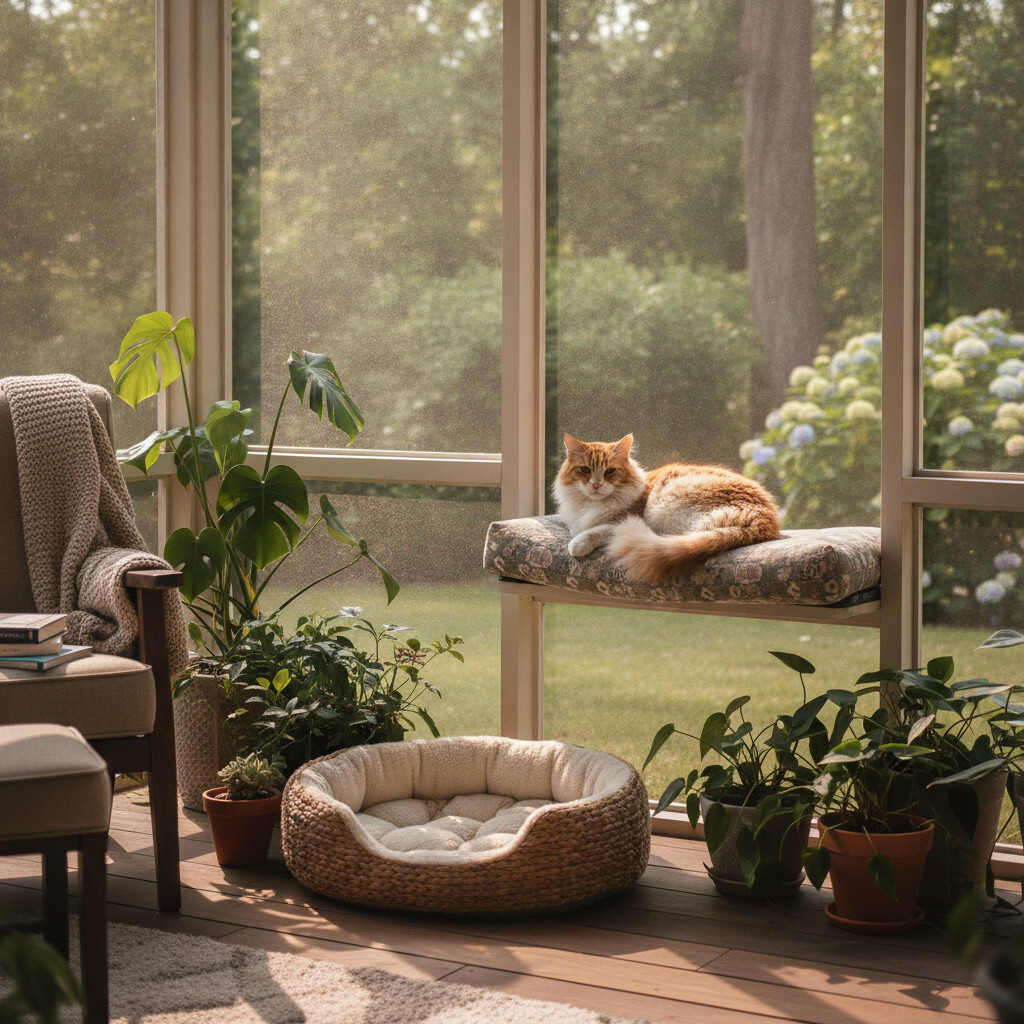
A screened porch or sunroom can give an indoor cat something a window sill never will: real outdoor air, real sun, real smells, with none of the risks of free-roaming. Done right, it’s one of the best enrichment upgrades you can make. Done wrong, it’s an expensive way to lose a cat through a gap in the screen.
Here’s how to actually make one safe, not just “outdoor-adjacent.”
What Actually Makes a Porch Cat-Safe
A porch is cat-safe when a determined cat cannot get out, get hurt, or get poisoned while they’re in it. That’s the whole bar, and most DIY conversions fail on the first one — standard window screening and screen doors are built to keep bugs out, not to hold a 10-pound animal with claws.
The AAFP and ISFM’s Feline Environmental Needs Guidelines (Journal of Feline Medicine and Surgery, 2013) are blunt about why this matters: cats have a strong need to express normal behavior — climbing, scratching, stalking, sunbathing — and a lack of outlet for those instincts is linked to stress-related problems like overgrooming and inappropriate elimination. A secure porch gives cats a legitimate outlet without the predation, traffic, and disease risks that come with unsupervised outdoor access.
Screening: What to Use, What to Avoid
Standard fiberglass window screen is not an option — cats shred it in minutes and it won’t hold weight if they climb it. Use:
- Heavy-gauge pet screen (vinyl-coated polyester, sometimes sold as “pet-resistant screen”) — far more tear- and claw-resistant than fiberglass, though still not indestructible.
- Welded wire mesh or hardware cloth (1/2-inch to 1-inch grid) for high-stress areas — bottom panels, anywhere a cat is likely to climb or push.
- Framed panels, not stapled sheets. Screen should be stretched over a wood or aluminum frame and screwed or bolted in, not just stapled to the porch structure. Staples pull loose under repeated pressure.
Check every seam, corner, and gap where the screen meets the frame — these are the failure points, not the middle of the panel. A cat doesn’t need a big hole, just a paw-width gap to start working at it.
Flooring, Furniture, and Escape-Proofing
Give the space a self-closing door — a simple screen door closer or spring hinge — so it can’t be left ajar by a distracted human. Airlock-style entry (a small buffer area with two doors) is worth the extra effort if the porch connects directly to your yard rather than your house interior, since it means one open door doesn’t mean one open route outside.
Furniture matters more than people expect. A cat tree or shelf positioned near a screen wall gives a cat leverage to test that screen with their full body weight. Keep climbing structures toward the center of the space, away from perimeter walls, so any testing happens against something sturdy, not the screen itself.
Weather, Temperature, and What to Watch For
A porch isn’t climate-controlled like the rest of your house, so treat it as supervised or limited-access space during extremes rather than a 24/7 room. Cats can overheat faster than people assume, especially flat-faced breeds, senior cats, and anything over roughly 90°F (32°C) with poor airflow. In freezing temperatures, an unheated porch isn’t a safe place for extended stays either.
Check for the usual outdoor-adjacent toxins that people forget about indoors-outdoors transition spaces: mosquito coils, citronella candles, certain potted plants (the ASPCA and Cornell Feline Health Center both maintain toxic plant lists worth checking against anything you bring in), and any pest control products used near the porch structure.
What to Actually Put in There
The enrichment payoff is the whole point, so don’t waste the space on an empty bench. A well-used cat porch usually has:
- A perch at window height, positioned for a clear sightline to birds, foot traffic, or a yard
- A scratching surface (vertical or horizontal — cats have preferences, so offer one of each if you can)
- A shaded spot and a sun spot, since cats thermoregulate by moving between them
- Water, refreshed regularly — outdoor-adjacent spaces get warmer and cats drink less when water sits too long
If you already have an indoor cat tree or window perch that’s underused, this is often the place to relocate it. See our guide on why cats need vertical space for what height and placement actually get used versus ignored.
When a Porch Isn’t Enough
For some cats and some households, a porch scratches the itch completely. For others — especially cats who were previously used to full outdoor access — it’s a good start but not the whole answer. If what your cat really wants is the yard itself rather than a screened room, fence-mounted containment systems like Oscillot are worth knowing about as an alternative: they let a cat use the full yard while a rotating paddle mechanism along the fence top stops them from climbing over. It’s a different tool for a different problem than a porch conversion, and worth considering separately rather than as an add-on to the same project.
Whichever direction you go, the failure mode is the same: people underestimate what a bored, athletic animal can do to a barrier over time. Build for the cat that tests everything, not the cat you hope you have. Our guide to cat-proofing a balcony covers the same “assume they’ll test it” principle for a different kind of space, if you’re weighing multiple options for your home.
Get the screening right, keep climbing structures away from the perimeter, and check the seams more than the middle — and a porch or sunroom becomes one of the highest-value spaces in the house, for you and your cat both.