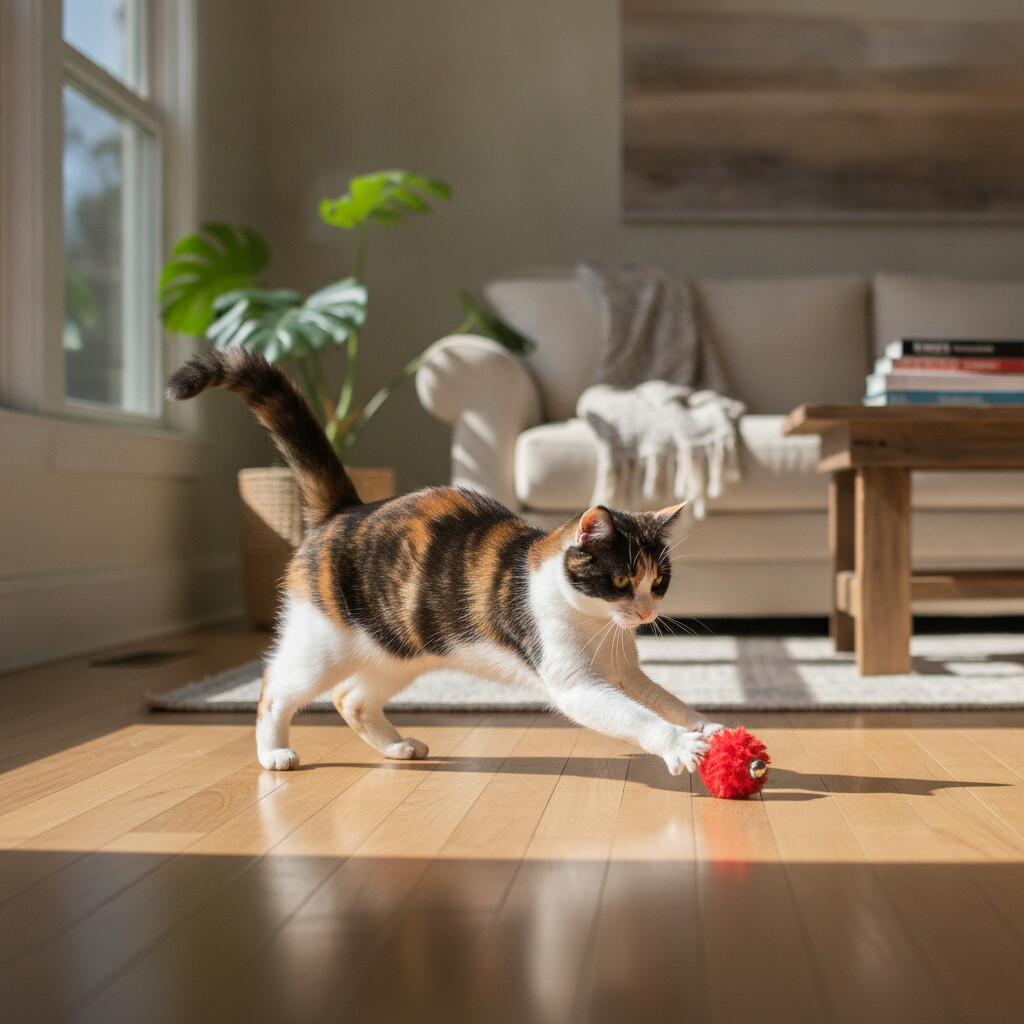
Yes — a genuine number of cats can learn to fetch, and you don’t need a special breed to teach it. It works because fetch borrows directly from a cat’s natural predatory sequence: stalk, chase, catch, carry. You’re not fighting instinct to teach this trick. You’re redirecting one that’s already there.
Why Some Cats “Just Do It” Naturally
Cat behaviorists describe feline predatory behavior as a fixed sequence — stalk, chase, pounce, bite, and (often) carry the “prey” somewhere before releasing it. A thrown toy triggers the same sequence a moving prey animal would. Some individual cats — regardless of breed, though anecdotal reports skew toward Siamese and other vocal, high-drive breeds — happen to complete that last step by bringing the toy back toward a person, usually because they’ve learned that’s when the throwing (and the fun) resumes. Once a cat discovers that returning the toy restarts the game, you’ve essentially got fetch on your hands without training at all.
For cats who don’t do it spontaneously, you can build the behavior in stages using the same shaping principles used in clicker training.
What You Need Before You Start
- A small, light toy your cat already likes carrying — a crinkle ball, a pom-pom, a small stuffed mouse. Avoid anything with small detachable parts (bells, feathers glued rather than sewn on) that could become a swallowing hazard once a cat starts carrying it in their mouth repeatedly.
- High-value treats, cut small enough to give several in a five-minute session without overfeeding.
- A hallway or enclosed room — fewer distractions and a natural boundary that nudges the cat back toward you after a catch.
- Sessions under five minutes. Cats habituate fast; a shorter session that ends on success beats a longer one that ends in disinterest.
Step-by-Step: Shaping the Behavior
- Reward the chase and catch first. Toss the toy a short distance and give a treat the moment your cat catches or pins it — even before worrying about the “return” part.
- Reward proximity next. Once catching is reliable, only treat when your cat is holding the toy and has taken a step toward you. Cats are quick to notice that closer earns more.
- Reward the drop. When your cat gets close, wait for them to drop or loosen their grip on the toy before treating — don’t grab it out of their mouth, which teaches them to guard it instead of release it.
- Fade the treats gradually once the sequence is consistent, moving to intermittent rewards and praise so the game itself becomes the reinforcement.
Keep every session upbeat and end it while your cat is still interested — stopping a beat early does more for long-term engagement than pushing for one more throw.
Troubleshooting the Common Snags
My cat catches it but won’t bring it back. Very common, and not a training failure. The workaround most owners land on: keep two identical toys. Instead of coaxing the first one back, simply toss the second. Many cats will drop the one they’re holding to chase the new throw, and over several repetitions the “drop and re-chase” loop starts to look a lot like fetch even without a true retrieve.
My cat loses interest after two throws. Shorten sessions further and raise the stakes on the reward — a lick of tuna or a favorite freeze-dried treat works better than kibble for building initial motivation. Play right before a meal, when hunting drive is naturally higher.
My cat only fetches at 3 a.m. That’s not a fetch problem, it’s a scheduling one — cats that don’t get enough daytime activity often generate their own at night. Moving your fetch sessions to early evening, closer to when night-time zoomies tend to start, can redirect that energy before it turns into 3 a.m. chaos.
Why This Is Worth Teaching (Beyond the Party Trick)
Structured play with a clear start and stop gives a cat’s hunting drive somewhere to go, which matters for cats who otherwise redirect that energy onto ankles, hands, or 4 a.m. zoomies. It’s also one of the few forms of enrichment that actively involves you rather than running in the background like a toy rotation or a window perch — useful if your cat’s biggest source of boredom is a lack of interaction, not a lack of stuff. If your cat seems chronically under-stimulated regardless of how many toys are on the floor, it’s worth reading through the signs in Do Cats Get Bored? Signs of Understimulation before assuming more toys is the answer — sometimes what’s missing is exactly this kind of interactive session. Pairing a fetch session with your existing toy rotation routine — one interactive game a day plus rotated solo toys — covers both the social and independent sides of play.
The Takeaway
Fetch isn’t a novelty confined to a handful of unusually smart cats — it’s an extension of instincts every cat already has, shaped through short, treat-driven sessions. Start with the chase and catch, build toward the return in small steps, keep sessions brief, and don’t be surprised if your “retrieve” ends up looking more like “drop and re-chase” with a second toy. Either version gets you the same result: a cat who’s using natural drive productively instead of looking for somewhere else to put it.