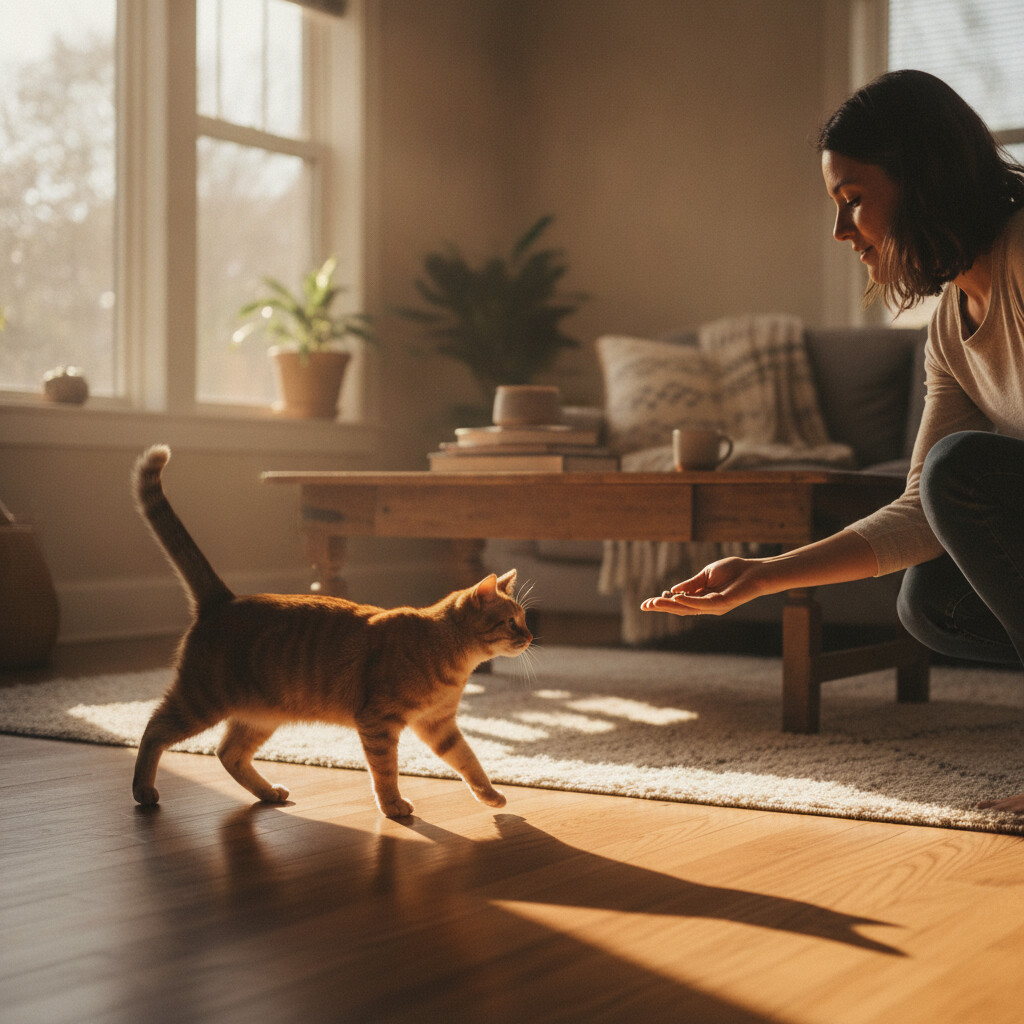
Yes, you can train a cat to come when called, and most cats learn it faster than their owners expect. The method is simple: pair one specific sound with a treat your cat loves, practise in short sessions, and slowly add distance and distraction. A few minutes a day for two to three weeks is enough for many cats to come running reliably at home.
This guide walks through the full process step by step, plus the mistakes that quietly undo it.
Why bother teaching a cat to come?
A reliable recall isn’t a party trick. It’s one of the most useful safety skills a cat can have.
- Emergencies. If you ever have to leave the house in a hurry, a cat who comes to a sound is a cat you can find and get into a carrier. Our cat emergency kit guide is worth pairing with this.
- Escapes. If an indoor cat slips out the door, a trained recall gives you a much better chance of getting them back quickly. A 2018 study in Animals (Huang and colleagues) on missing cats found that most indoor cats who got out were found close to home, often within a few houses, so a cat who responds to a familiar sound has a real advantage. See our step-by-step guide on what to do if your cat gets out.
- Everyday life. Calling your cat in for dinner, out from under the bed before a vet trip, or away from the open dishwasher is much easier when they actually come.
If you’ve already read why cats tend to ignore their names, the short version is this: cats can recognise their names (a 2019 Scientific Reports study by Saito and colleagues showed this), but recognising a word isn’t the same as having a reason to respond. Training gives them the reason.
What you need before you start
- A unique recall cue. Don’t use your cat’s name, because you say it all day in contexts that mean nothing. Pick a sound you’ll only use for recall: a specific whistle, a short phrase like “treat time!”, a squeaky toy, or tapping a spoon on a can. Consistency matters more than the sound itself.
- High-value treats. Not their regular kibble. Think lickable treats, tiny pieces of cooked chicken, or freeze-dried meat. Break them into pea-sized bits so you can reward many times without overfeeding.
- A slightly hungry cat. Train before a meal, not after. A full cat has little reason to get up.
- Optional: a clicker. If your cat is already clicker trained, you can mark the moment they arrive. If not, our beginner’s guide to clicker training cats covers the basics, though you don’t need one for recall.
Research supports this reward-based approach. A 2017 study in Animals (Kogan, Kolus and Schoenfeld-Tacher) found that shelter cats given short clicker-and-treat sessions learned new behaviours within a few days, which is a useful reminder that cats are very trainable when the reward is right.
Step-by-step: how to train your cat to come when called
Step 1: Charge the cue (days 1–3)
Sit near your cat. Make your recall sound, then immediately give a treat. Don’t ask for anything yet. Repeat five to ten times, then stop.
You’re teaching one thing: this sound means something great is about to happen. Do two or three of these sessions a day.
Step 2: Add a little distance (days 3–7)
Move a few feet away. Make the sound once. When your cat walks over, reward them the moment they reach you. Gradually increase the distance in the same room.
If your cat doesn’t move, you’ve gone too far too fast. Step closer and make it easier.
Step 3: Call from another room (week 2)
Once they’re reliably coming across the room, step around a corner or into the next room and make the sound. Reward generously when they find you. This is where most cats start to really get it, because they learn the sound works even when they can’t see you.
Step 4: Add distractions (weeks 2–3)
Practise when something mildly interesting is happening: a toy on the floor, another person in the room, a bird at the window. Distractions make the job harder, so use your best treats here.
Step 5: Practise at random times
Call your cat at unexpected moments throughout the day and reward every response. Short, frequent, and unpredictable beats long sessions. Two or three minutes at a time is plenty.
Step 6: Keep it going for life
Once your cat is reliable, keep rewarding most responses. You can mix in a play session or a chin scratch for some of them, but a recall that stops paying off will fade. Practising a couple of times a week is enough to keep it sharp.
Common mistakes that break a recall
- Calling for bad things. If the recall sound sometimes means “get in the carrier” or “time for a pill”, your cat will stop coming. For unpleasant tasks, go and get the cat instead.
- Repeating the cue. Say it once. If you say it five times, you teach the cat that the first four don’t count.
- Calling when they won’t come. In early training, only use the cue when you’re fairly sure your cat will respond. Every failure weakens it.
- Weak rewards. A piece of everyday kibble rarely beats whatever they’re doing. Use something they’ll actually get up for.
- Overfeeding. Count training treats in your cat’s daily food. Treats should stay under roughly 10% of daily calories, a commonly cited veterinary guideline. Smaller pieces solve most of this.
Does this work for every cat?
Most cats can learn a recall, but speed varies. Food-motivated, confident cats often pick it up in days. Shy cats, older cats, or cats with little interest in food may take longer.
For less food-driven cats, try play as the reward instead, such as a few seconds with a favourite wand toy when they arrive. A 2017 study in Behavioural Processes (Vitale Shreve, Mehrkam and Udell) found that many cats, when given the choice, preferred social interaction with people over food, so attention can be a genuine reward for some cats. If your cat already enjoys games like playing fetch, that can make a great reward.
If your cat used to respond to you and has suddenly stopped, or seems not to hear you at all, mention it to your vet. Hearing loss and cognitive changes become more common in older cats.
Recall is a backup, not a barrier
A trained recall is a safety net, but it’s not a guarantee. A frightened cat outdoors may bolt or hide rather than come, however well they’re trained. For cats who go outside, recall works best alongside other precautions: a microchip with up-to-date details, supervised time on a harness and leash, or a secure outdoor space. If you’re thinking about letting your cat use the whole yard, fence-mounted containment systems are one option, and oscillotamerica.com explains how they work.
The takeaway
Pick a unique sound, pair it with a treat your cat loves, and build it up in tiny steps from close range to the next room to busy moments. Never use it for anything your cat dislikes, and keep rewarding it for life. Ten minutes a day spread across a few short sessions is enough for most cats to learn a recall that could one day bring them home.