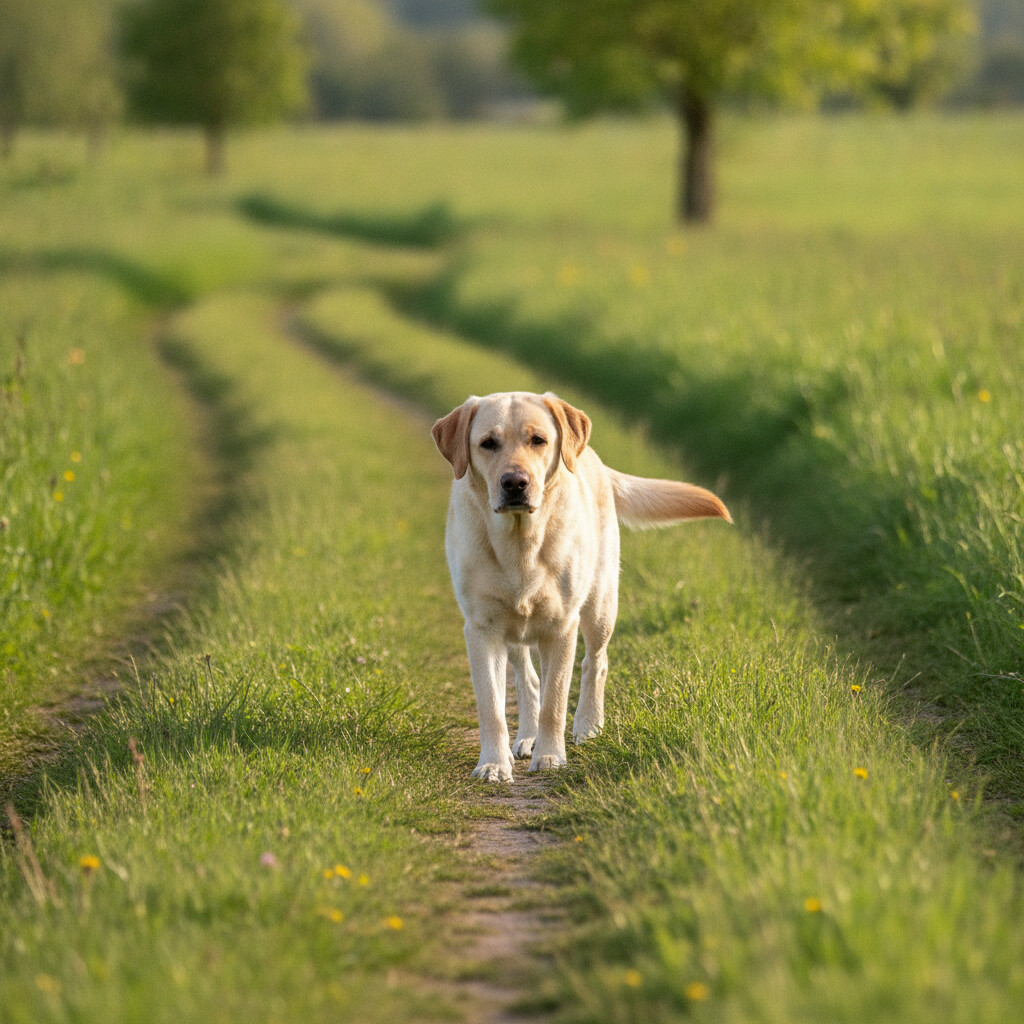
Hip dysplasia is a malformation of the hip joint — the ball and socket don’t fit together the way they should, so the joint grinds and wears instead of gliding. It’s one of the most common orthopedic conditions in dogs, especially large and giant breeds, and it can start causing damage well before you notice a limp. Here’s what actually causes it, how to spot it early, and what treatment really involves.
What Hip Dysplasia Actually Is
A healthy hip is a snug ball-and-socket joint: the head of the femur sits deep inside the pelvis’s socket (the acetabulum), cushioned by cartilage and held in place by ligaments and muscle. In a dysplastic hip, the socket is too shallow, too loose, or shaped wrong, so the joint has extra play in it. Every step lets the ball shift slightly instead of rotating cleanly.
That instability wears down cartilage over time. The body responds to the damage by laying down new bone around the joint — a process called osteoarthritis — which is what ultimately causes the pain and stiffness owners notice. This is why a dog can be born with the skeletal predisposition for dysplasia and not show clinical signs for months or years: the arthritis, not the malformation itself, is usually what hurts.
The Orthopedic Foundation for Animals (OFA), which maintains the largest hip-screening database in North America, estimates dysplasia rates above 15–20% in several large breeds, and it’s been documented in essentially every breed, including smaller dogs, though it’s far more common and more severe in large, fast-growing ones.
Why It Happens
Hip dysplasia is polygenic — caused by multiple genes interacting, not a single mutation — which is part of why it’s so hard to eliminate through breeding alone even with careful screening. Genetics set the baseline risk, but several environmental factors during a puppy’s growth window strongly influence whether and how severely it develops:
- Growth rate. Puppies that grow very quickly, often from overfeeding or calorie-dense diets, are at higher risk. Fast bone growth can outpace the soft tissue and muscle development that stabilizes the joint.
- Body weight. Excess weight — at any age — increases mechanical stress on the hips. This is one of the few risk factors owners can directly control, at every life stage, not just puppyhood.
- Breed and size. Large and giant breeds (German Shepherds, Labradors, Golden Retrievers, Rottweilers, Saint Bernards) are disproportionately affected, largely because of their size and growth trajectory.
- Exercise during growth. High-impact activity — repeated jumping, running on hard surfaces, forced long-distance exercise — before growth plates close can aggravate a joint that’s already predisposed to instability. This doesn’t mean puppies shouldn’t move; it means controlled, low-impact activity is safer than repetitive high-impact stress during the growth window.
None of these factors cause dysplasia in a dog with no genetic predisposition, but in a predisposed dog they can meaningfully affect how early and how severely it shows up.
Signs to Watch For
Hip dysplasia can look different depending on the dog’s age. In young dogs (5 months to 18 months), signs tend to reflect joint laxity itself:
- Reluctance to jump, run, or climb stairs
- A “bunny hop” gait, where both back legs move together instead of alternating
- Difficulty rising after rest
- Looser build through the hindquarters, or a hind end that seems to sway when walking
In older dogs, the picture usually shifts toward arthritis symptoms:
- Stiffness that’s worse after rest and improves somewhat with gentle movement
- Reduced activity or reluctance to go on walks they used to enjoy
- Muscle loss in the hind legs (thigh muscles noticeably thinner than the front)
- Audible clicking or grinding from the hip
- Sitting with one or both legs splayed out to the side rather than tucked normally
It’s worth noting that severity of symptoms doesn’t always match severity on X-ray. Some dogs with significant joint laxity on imaging show almost no outward signs, while others with milder structural changes are clearly uncomfortable. This is one reason dysplasia can be difficult to distinguish from other causes of limping without a proper exam.
How It’s Diagnosed
Diagnosis starts with a physical exam — a vet checking for pain on hip extension, reduced range of motion, and a specific finding called the Ortolani sign, which tests for looseness in the joint. From there, X-rays under sedation are the standard next step, since dogs need to be relaxed enough for accurate positioning. The OFA and PennHIP are the two main formal hip-screening programs in the US; PennHIP in particular can assess joint laxity in dogs as young as 16 weeks, which is useful for early detection in high-risk breeds even before symptoms appear.
Treatment Options
There’s no single “right” treatment — it depends on the dog’s age, severity, activity level, and overall health. Vets generally sort options into two categories.
Conservative (non-surgical) management is the starting point for most dogs, especially those with mild to moderate disease:
- Weight management. This is consistently identified as one of the single most effective interventions — a 2000 study published in the Journal of the American Veterinary Medical Association found that dogs kept lean throughout life had significantly delayed onset and reduced severity of hip osteoarthritis compared to littermates fed to maintain a higher body condition.
- Controlled exercise. Low-impact activity like swimming or leash walking maintains muscle mass (which supports the joint) without the jarring impact of running or jumping.
- Joint supplements and prescription diets. Glucosamine/chondroitin and omega-3 fatty acids have modest evidence for symptom relief, though they won’t reverse structural changes.
- Pain management and anti-inflammatories, typically NSAIDs prescribed and monitored by a vet — never over-the-counter human medications, which can be toxic to dogs.
- Physical therapy, including hydrotherapy, which is increasingly used to build hind-end strength without joint stress.
Surgical options are considered for dogs with significant pain, dysfunction, or progressive arthritis that isn’t responding to conservative management:
- Triple pelvic osteotomy (TPO), used in young dogs before arthritis has set in, which repositions the socket for better coverage of the femoral head.
- Total hip replacement, the most reliable long-term fix for severe disease in mature dogs, with success rates generally reported above 90% for pain relief and function.
- Femoral head and neck excision (FHO), which removes the ball of the joint and lets scar tissue form a “false joint.” It’s typically reserved for smaller dogs or cases where hip replacement isn’t an option, since larger dogs tend to have less predictable functional outcomes.
When to See a Vet
Book an exam if you notice any combination of: reluctance to jump or climb stairs, a hopping gait, stiffness after rest that doesn’t fully resolve, or visible muscle loss in the hindquarters. Early evaluation matters — even if surgery isn’t ultimately needed, catching dysplasia before significant arthritis develops gives you more options and generally better long-term outcomes. If your dog suddenly can’t bear weight on a leg, seems to be in acute pain, or the change in gait is sudden rather than gradual, that’s an urgent visit, not a wait-and-see situation — sudden changes are more consistent with an acute injury than chronic joint disease and need to be ruled out.
If you’re already managing a dog at a higher-than-ideal weight, our guide on telling whether your dog is overweight and what to do about it is a good place to start — weight is the one major risk factor you have real control over, at any stage of the disease.