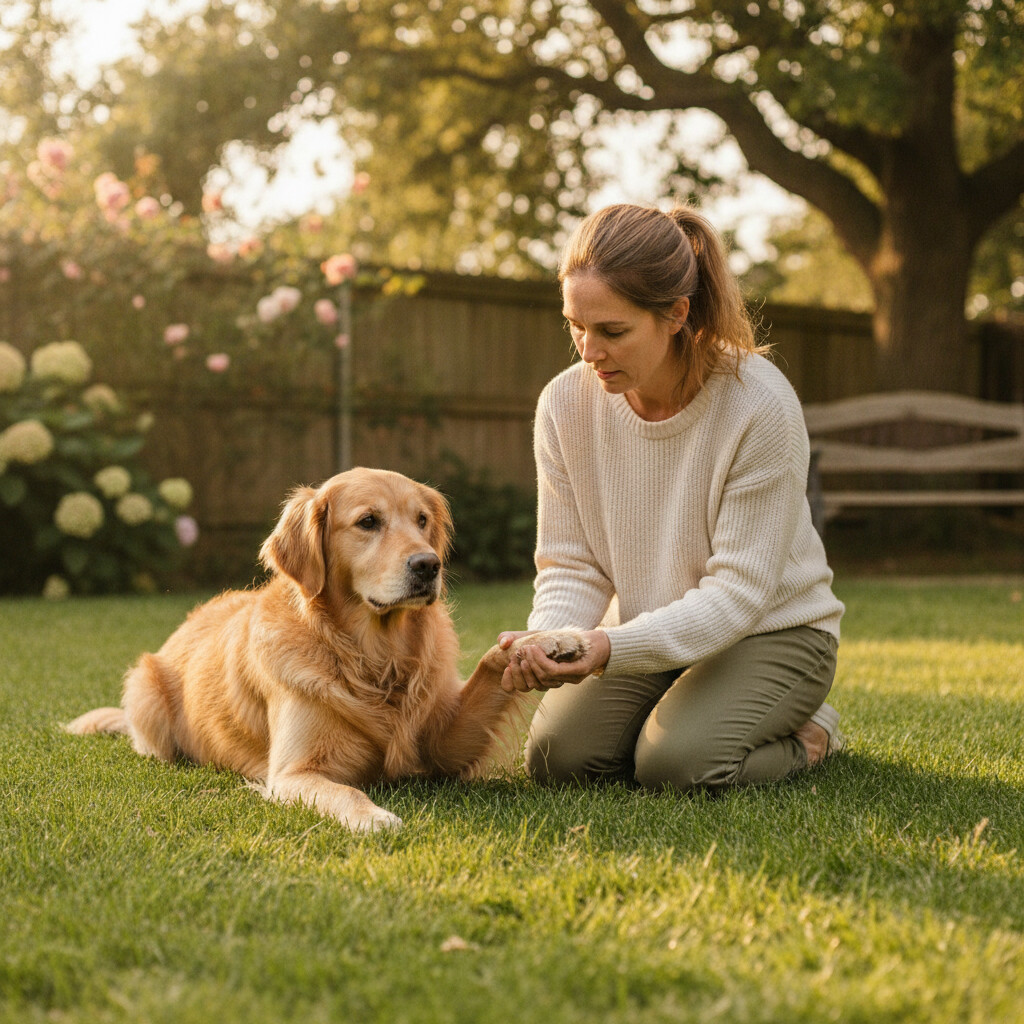
A limp is your dog telling you something hurts enough that they don’t want weight on it. Most of the time it’s minor — a stuck pebble, a strained muscle from too much fetch — and it clears up in a day or two. But a limp is also one of the more common reasons dogs end up at the vet for orthopedic issues, and a few specific signs separate “let’s watch it” from “call today.”
Check the Paw First
Before assuming the worst, do a hands-on check. Most sudden limps in otherwise healthy dogs trace back to something simple in the paw:
- A thorn, grass awn, or splinter wedged between the toes or pads
- A torn or split nail (common after running on pavement or catching a nail on carpet)
- A cut or abrasion on the pad itself
- Something sticky or irritating (tar, salt, ice-melt chemicals) stuck between the toes
Gently look between each toe and check the pads for redness, swelling, or anything embedded. Dogs will often lift and hold the paw up, lick at it repeatedly, or refuse to let you touch it if the problem is localized there. If you find and remove the object and the limp resolves within a few hours, that’s usually the end of it. If the paw looks fine and the limp continues, the problem is likely further up the leg — joint, muscle, or bone.
Sudden Limp vs. Gradual Limp: Why the Timeline Matters
The speed of onset tells you a lot.
Sudden limps (started mid-walk or after a specific jump, fall, or awkward landing) usually point to an acute injury — a sprain, strain, or in more serious cases, a torn ligament. A dog that suddenly can’t put any weight on a leg after a hard landing or a fast pivot chasing a squirrel is the classic presentation of a cranial cruciate ligament (CCL) tear — the canine equivalent of an ACL tear, and one of the most common orthopedic injuries seen in dogs, particularly in larger and overweight breeds, according to veterinary orthopedic literature from the American College of Veterinary Surgeons.
Gradual limps (getting worse over days or weeks, often more noticeable after rest or first thing in the morning) point toward something chronic — arthritis, hip or elbow dysplasia, or in young, fast-growing large-breed puppies, a condition called panosteitis (“growing pains”). Panosteitis typically affects dogs between 5 and 14 months old, can shift from leg to leg, and usually resolves on its own as the dog finishes growing — but it still warrants a vet visit to rule out other causes and manage discomfort in the meantime.
Common Causes by Age and Breed
Age and breed narrow the likely cause considerably:
- Puppies (under 1 year), especially large breeds: Panosteitis, or developmental joint conditions like hip or elbow dysplasia, which are more prevalent in breeds such as German Shepherds, Labradors, and Golden Retrievers.
- Young to middle-aged, active dogs: Soft tissue strains and sprains from exercise, or CCL injuries — especially in dogs that are overweight, since excess weight puts disproportionate stress on the knee joint.
- Senior dogs: Osteoarthritis is by far the most common cause of chronic limping in older dogs. It tends to be worse after rest and improve slightly once the dog “warms up” on a walk — the opposite pattern of an acute injury, which usually gets worse with activity.
Breed matters too: large and giant breeds carry higher lifetime risk for hip and elbow dysplasia, while small breeds like Yorkshire Terriers and Pomeranians are more prone to patellar luxation (a kneecap that slips out of place), which shows up as an intermittent skip or hop rather than a constant limp.
What You Can Do at Home (Safely)
For a mild limp with no swelling, no visible wound, and a dog who’s otherwise acting normal (eating, drinking, alert):
- Rest matters more than most owners expect. Restrict activity to short leash walks for bathroom breaks only — no running, jumping, or off-leash play — for 3 to 5 days.
- Check twice daily for swelling, heat, or the limp getting worse rather than better.
- Don’t give human pain medication. Ibuprofen, aspirin, and acetaminophen are all dangerous for dogs and can cause serious gastrointestinal bleeding or liver damage even at doses that seem small. If your dog needs pain relief, that’s a vet-prescribed conversation, not a home decision.
If the limp hasn’t meaningfully improved after 2 to 3 days of rest, it’s time for a professional look rather than continued waiting.
When to See a Vet
Some signs mean don’t wait at all:
- The dog won’t put any weight on the leg (non-weight-bearing), especially after a fall, jump, or collision
- Visible swelling, deformity, or the leg looks like it’s at an odd angle
- The limp appeared suddenly and is severe
- Your dog is in obvious pain — whimpering, panting heavily at rest, reluctant to be touched
- The limp lasts more than 2-3 days despite rest, or keeps recurring
- There’s an open wound, bleeding, or something visibly embedded that you can’t safely remove yourself
A sudden, severe limp in an active or larger-breed dog is worth treating as a possible CCL tear until a vet says otherwise — the earlier it’s diagnosed, the more treatment options (including non-surgical management for partial tears) stay on the table. Left untreated, a torn cruciate ligament often leads to early arthritis in that joint.
If you’re not sure whether what you’re seeing counts as pain versus mild stiffness, our guide on signs your dog is in pain breaks down the more subtle body-language cues dogs show before an owner would call it “obviously hurting.” And if the limp followed a particularly rough play session, it’s worth revisiting how much exercise your dog actually needs — overexertion, especially in dogs that are out of shape or carrying extra weight, is one of the most preventable causes of soft-tissue limping.
The bottom line: a brief limp that resolves in a day is rarely an emergency. A limp that’s sudden and severe, doesn’t improve, or comes with swelling or obvious pain is your dog asking for a vet visit — not something to wait out.