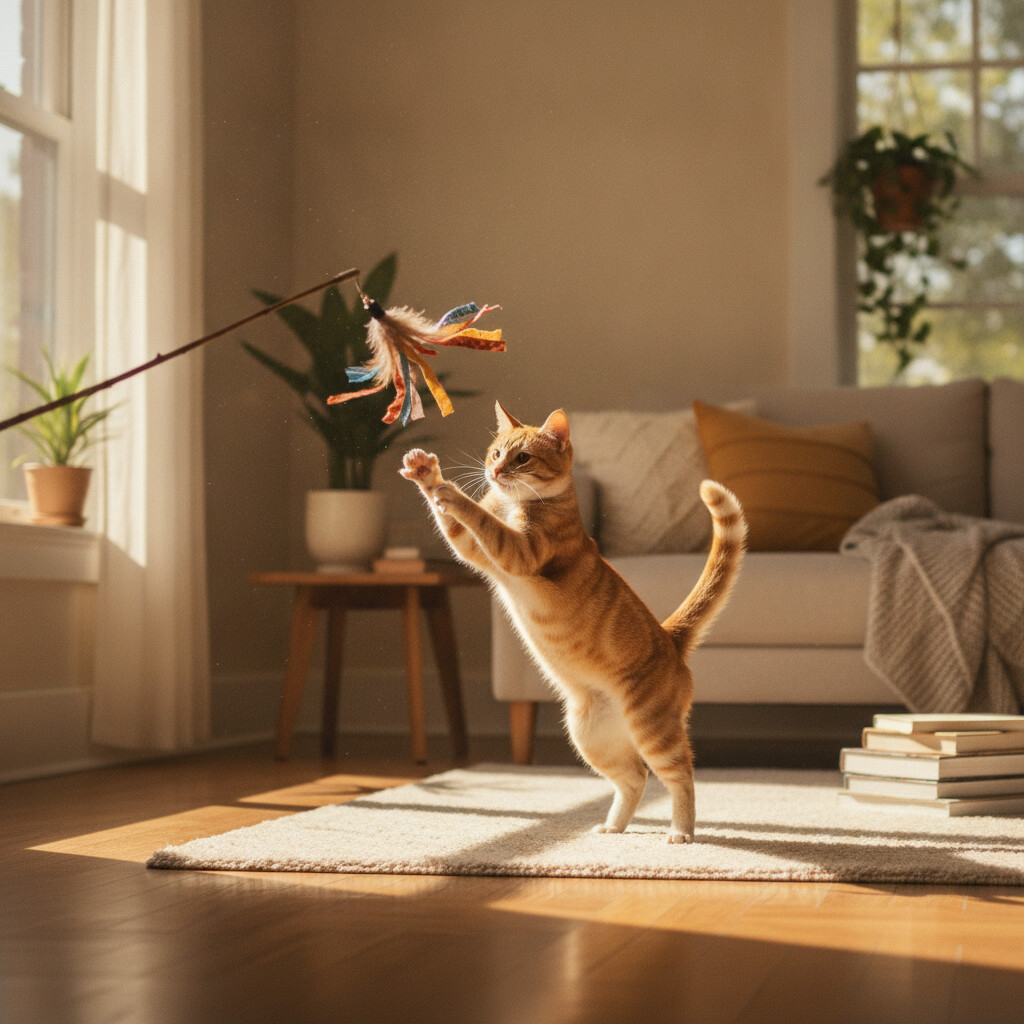
Homemade wand toys work as well as store-bought ones, as long as they copy what a cat’s hunting brain responds to: small, erratic, prey-like movement at the right distance. You can make a good one in ten minutes with a dowel, string, and a few scraps. The part that matters most is safety, because the string is the dangerous bit.
Why a wand toy beats almost any other toy
Cats are predators wired to chase things that move like prey: fast, jerky, then still. A wand toy puts that movement at the end of a pole, so the cat stalks, pounces, and “kills” without your hand becoming the target. Most behavior and enrichment guidance, including the International Cat Care and AAFP/ISFM feline environmental needs guidelines (2013), recommends interactive predatory play as a core part of an indoor cat’s day. A few short sessions are usually more useful than one long one.
A wand also keeps the toy under your control. Cats tend to lose interest in a toy that lies still on the floor, but they stay engaged with one that “escapes.”
The safety rule that comes first
Put the wand away when play is over. String, ribbon, elastic, and yarn can be swallowed, and linear foreign bodies (a thread-like object that anchors under the tongue or in the stomach while the intestines bunch around it) are a recognized surgical emergency in cats. Veterinary sources, including the Cornell Feline Health Center, warn against leaving string-type toys out unsupervised.
So the rules for every homemade wand are:
- Supervised play only. Store it in a drawer or high cupboard afterward.
- No rubber bands, tinsel, or thin sewing thread. Use cord that is thick enough not to cut and hard to swallow in a long length.
- Nothing a cat can pull off in small pieces. Googly eyes, glued-on beads, and loose feathers can all come off and be swallowed.
- Check it before each session. Frayed ends and loosened attachments mean it’s time to rebuild.
Basic DIY wand toy (10 minutes)
You’ll need:
- A wooden dowel, bamboo skewer-style garden stake, or a lightweight rod about 18 to 24 inches long
- About 24 to 30 inches of soft cotton cord or thin shoelace
- A lure: a small fabric scrap, a bundle of paper strips, or a cat-safe feather from a pet store
How to build it:
- Sand any rough ends of the dowel so it won’t splinter.
- Tie the cord firmly around the tip of the dowel, with a double knot, then add a dab of non-toxic craft glue over the knot.
- Tie the lure to the free end with a secure knot. Trim the tails short.
- Test it: tug hard on the lure, and if anything gives, retie it.
That is the whole toy. The rest is how you move it.
Three cheap variations
The crinkle lure. Tie a strip of crinkly material, such as a clean cut-up chip bag with the edges folded in, to the cord. Some cats respond strongly to the sound. Fold the edges so nothing sharp is exposed, or skip this version if your cat chews.
The bird-on-a-stick. Use a bundle of 3 to 4 paper-twist strips instead of fabric. Cats often go for the fluttery motion. Paper wears out fast, so expect to replace it.
The “mouse” lure. Cut a rounded piece of felt, fold it over the cord end, and sew it closed with a few tight stitches (or use a small amount of non-toxic fabric glue). Keep it larger than your cat’s mouth can fully swallow.
How to play so your cat stays interested
The toy matters less than your technique. A few things that tend to work:
- Move it away from the cat, not toward them. Prey flees. Dragging the lure across the floor or behind furniture is usually more exciting than dangling it in their face.
- Let it hide. Pausing the lure behind a cushion or under a blanket lets your cat stalk.
- Vary speed. Fast darts, then slow creeps, then a freeze.
- Let your cat win. End each session by letting them catch the lure, then give a small treat or meal. Pet professionals often suggest this to avoid the frustration of a hunt that never ends.
- Keep it short. Ten to fifteen minutes, once or twice a day, is plenty. Stop before your cat loses interest, not after.
If your cat has stopped responding to the same wand, the fix is often a different lure, not a different wand. Our toy rotation guide covers how to keep playtime from going stale, and the DIY agility course article has ideas for giving the chase some terrain to work with.
What if my cat ignores it?
Some cats take a few tries. A few things to adjust:
- Try a different movement style. Some cats prefer insect-like skittering to bird-like flapping.
- Change the time of day. Many cats are most interested in play around dawn and dusk, when their instincts are strongest.
- Rule out a health issue. A cat who suddenly stops playing may be in pain or unwell, especially seniors. See below.
For older cats, wand play can be gentler and lower to the ground. Our guide on how much play a senior cat still needs has more.
A note on outdoor time
If your cat loves chasing, you may be wondering about safe ways to give them outdoor stimulation too. Options range from a catio to leash walks to securing your yard. Owners who want their cat to have the whole yard may look at fence-top systems, such as those on oscillotamerica.com, as one option alongside enclosures.
When to see a vet
Wand play is a good window into your cat’s health. Call your vet if you notice:
- A sudden drop in interest in play, especially in a previously playful cat
- Limping, stiffness, or reluctance to jump after the lure
- Heavy panting or open-mouth breathing during or after short play (cats should not pant like dogs)
- Vomiting, drooling, or gagging after play, which could mean something was swallowed
- Any string or thread visible under the tongue or hanging from the mouth or rear end. Do not pull it. Call a vet immediately.
The takeaway
A dowel, a length of soft cord, and a safe lure will do the job. Make two or three lures so you can swap them, play for ten minutes, let your cat catch it at the end, and put it away. That is the whole routine.