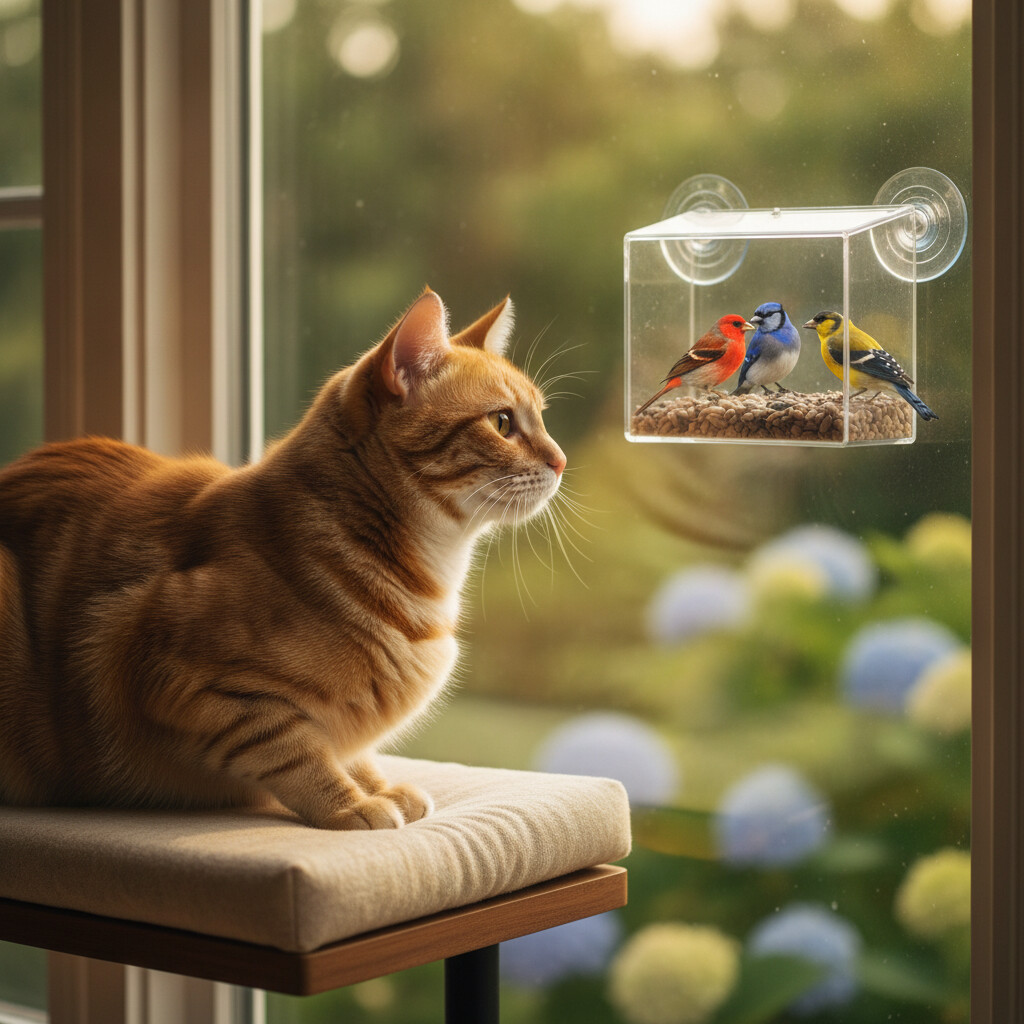
A bird feeder outside a window is one of the cheapest, most effective bits of enrichment you can give an indoor cat. To do it well, you need three things: a feeder placed so birds don’t hit the glass, a comfortable spot where your cat can watch, and a plan for the cats who get frustrated rather than entertained. Here’s how to set it up.
Why watching birds is good enrichment
Cats are built to hunt, and most of a hunt is watching, not catching. Stalking, staring, tail-twitching and chattering are all part of the predatory sequence. An indoor cat that never gets to do any of it is missing a big part of its normal behaviour.
The AAFP and ISFM’s Feline Environmental Needs Guidelines (Ellis et al., Journal of Feline Medicine and Surgery, 2013) list the chance to perform predatory behaviour as one of five core needs for a healthy cat environment. The Ohio State University Indoor Pet Initiative, a veterinary-led resource, specifically suggests window views and outdoor bird feeders as a way to provide visual stimulation for indoor cats.
A feeder works better than most “cat TV” videos because it’s real. The birds come and go unpredictably, the sounds and movement are genuine, and it changes with the seasons. Screens can hold some cats’ attention (our article on whether bird and fish videos actually help looks at that), but a live feeder doesn’t need you to press play.
Where to put the feeder (this part protects the birds)
Placement matters more than the feeder itself, because windows kill a huge number of birds. Research by Daniel Klem and colleagues (Wilson Bulletin, 2004) found that feeders placed very close to a window led to far fewer fatal collisions: birds leaving a nearby feeder can’t build up enough speed to be badly hurt.
The guidance from the Cornell Lab of Ornithology and the American Bird Conservancy follows from that research:
- Closer than about 3 feet (1 m) from the glass, or
- Farther than about 30 feet (10 m) away
Anything in between is the danger zone. For a cat, the close option is better anyway, because the birds are near enough to be interesting.
A few other placement rules:
- Out of reach of outdoor cats. If neighbourhood cats can sit under or near your feeder, you’ve built them a hunting station. Mount it high on a pole with a baffle, or on the window itself, with no ledges or fences nearby for a cat to launch from.
- Visible from where your cat already likes to sit. Cats are creatures of habit. Put the feeder outside the window they already use, rather than trying to make them adopt a new one.
- Some cover nearby, but not too close. Birds like a shrub or tree within a short flight for safety. If that cover is right next to the feeder, it’s also good cover for a predator.
If you notice birds hitting the window anyway, decals or patterned film on the outside of the glass help. The American Bird Conservancy recommends markings spaced no more than about 2 inches apart; a single hawk silhouette doesn’t do much.
Choosing a feeder
You don’t need anything fancy. The three common options:
Window-mounted feeders stick to the glass with suction cups. They give your cat a nose-to-beak view and fall well inside the 3-foot safe zone. The downside is that suction cups can fail in cold weather, so check them regularly. Some cats get very wound up by birds that close, which is worth watching for.
Pole feeders set a few feet from the window are sturdier and easier to protect from squirrels and outdoor cats. Aim for the near zone if you can.
Hanging feeders on a bracket or nearby branch are fine if they’re in the right distance band and out of reach of anything that climbs.
For seed, a basic black-oil sunflower mix draws the widest range of species in most of the US. A small water dish or bird bath within view is often just as popular, and it brings birds in through the summer when food is plentiful.
Setting up the cat side of the window
The feeder is only half the setup. Your cat needs a comfortable, secure place to watch from:
- A wide, stable perch. A window shelf, the top of a cat tree, or a cleared windowsill with a cushion. Our guide to building a window perch your cat will actually use covers sizing and mounting.
- Height. Cats feel safer watching from above. If the window is low, put a cat tree beside it. Our vertical space guide explains why it matters so much.
- Secure screens. An excited cat will lunge at a bird. Make sure screens are firmly fitted and strong enough to take a cat’s weight, especially on upper floors. Cats falling from windows is common enough to have its own name. Our article on high-rise syndrome explains why.
- Sun and warmth. A sunny perch gets used far more. In winter, a heated pad on a low setting can turn the spot into a favourite.
When bird-watching isn’t relaxing
Most cats watch for a while, chatter a bit, then go to sleep in the sun. Some don’t. A minority of cats get frustrated: they can see prey they can never catch, and that tension has to go somewhere.
Signs your cat may be more frustrated than entertained:
- Pacing along the windowsill or between windows
- Lunging or batting at the glass repeatedly
- Redirected aggression, such as swatting or attacking another pet or a person right after a watching session
- Urine marking near windows or doors
- Constant chattering that doesn’t settle
Veterinary behaviourists recognise seeing animals outside, especially other cats, as a common trigger for redirected aggression and marking indoors. If you notice this, don’t give up on the feeder straight away. Try:
- Ending the hunt. Follow a watching session with a wand-toy play session that ends in a “catch”, then a small meal or treat. This completes the hunt-catch-eat-sleep sequence. Our DIY wand toy guide has cheap options.
- Limiting access. Close the blinds for part of the day so the window isn’t a constant source of excitement.
- Moving the feeder farther away (to the 30-foot zone) so the birds are less in-your-face.
If the frustration continues, or another cat in the house is being targeted, take the feeder down and talk to your vet. Our stress signs checklist can help you work out what’s going on.
Keeping it clean and safe for the birds
A dirty feeder can spread disease among wild birds. Outbreaks of salmonellosis in songbirds have been linked to crowded, unwashed feeders. The usual advice from wildlife agencies and the Cornell Lab is:
- Clean feeders every two weeks or so, more often in wet weather, with soapy water or a dilute bleach solution (roughly 1 part bleach to 9 parts water), then rinse well and let them dry.
- Rake up spilled seed and hulls under the feeder.
- Take feeders down for a couple of weeks if you see sick birds, or if your state wildlife agency asks people to during an outbreak.
Keep stored seed sealed and out of your cat’s reach. Mouldy seed is bad for birds and not something you want your cat nosing through either.
Taking it a step further
For some cats, a window view is plenty. Others clearly want more of the outdoors. The next step is usually supervised outdoor time in a space where they can’t hunt or roam, such as a catio, a screened porch, or a contained yard (Oscillot is one fence-top system people use for this). Whichever you choose, keep the bird feeder well outside your cat’s reach. The goal is watching, not catching.
Start with one feeder, one good perch and a bit of patience. It can take birds a week or two to find a new feeder, and when they do, you’ll probably find your cat’s favourite spot in the house has changed.