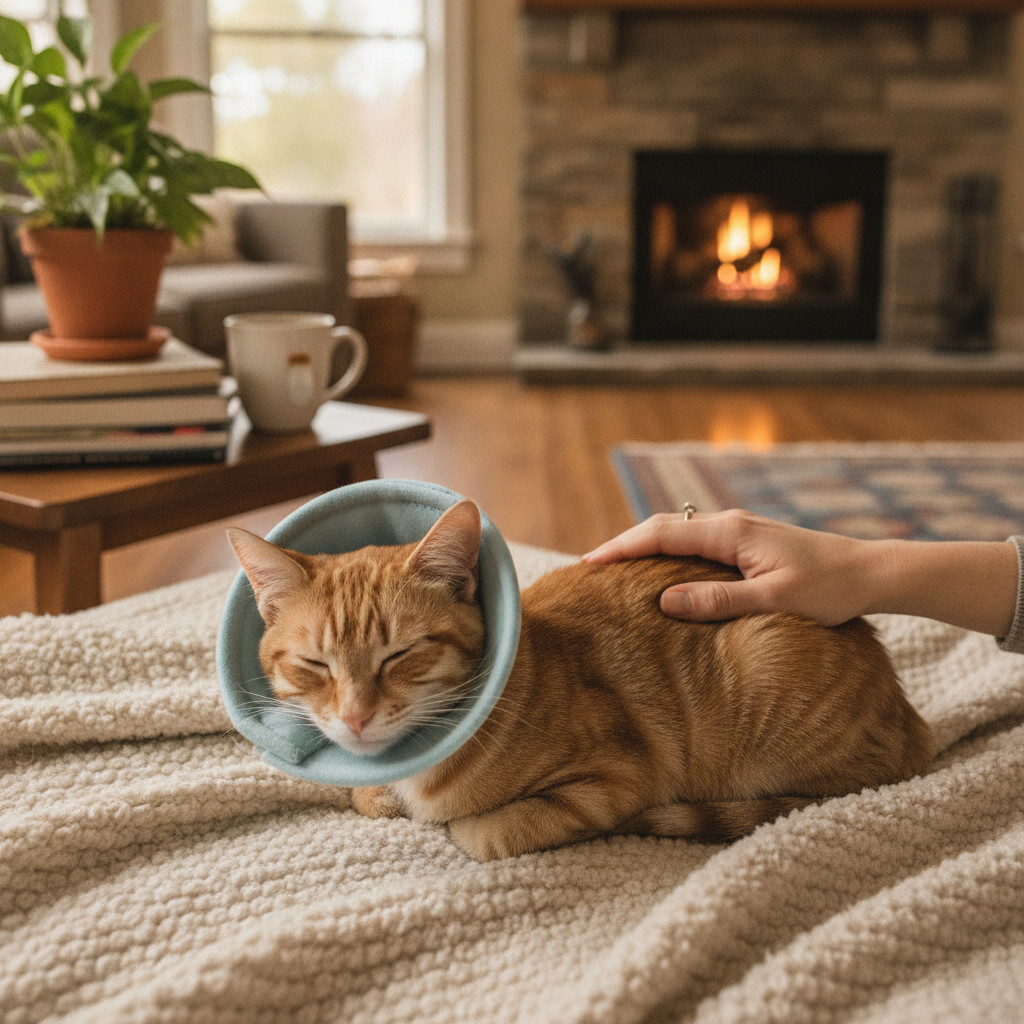
Our cat Pepper swallowed a hair tie, and for two days we told ourselves it was an upset stomach. It took an X-ray, an ultrasound and abdominal surgery to get it out. Here’s what the warning signs actually looked like, what the vet did, and what we changed at home so it can’t happen again.
The hair tie we didn’t see her eat
Pepper was two, a small tabby with a habit of batting anything stretchy off the bathroom counter. Hair ties were her favourite. We’d find them under the couch, in her water bowl, once inside a shoe. We thought it was cute. We never once saw her chew one.
On a Sunday morning she threw up her breakfast. Cats vomit sometimes, so we cleaned it up and moved on. She skipped lunch. That evening she vomited again, mostly foam, and spent the night curled in the laundry basket instead of on our bed.
Monday was more of the same: no interest in food, a little water, one more round of vomiting. She’d still purr if you sat with her, and that’s what kept us waiting. She didn’t look like a cat in danger. She looked like a cat who’d eaten something that disagreed with her.
That’s the trap. Our guide to cat vomiting lays out the line we should have paid attention to: one episode in an otherwise bright cat can be watched, but repeated vomiting combined with not eating is a reason to call the vet that day.
The signs, looking back
By Tuesday morning the picture was obvious in hindsight:
- Repeated vomiting, including after drinking water
- Not eating at all for more than 24 hours
- Hiding in unusual spots
- Hunched posture, sitting tucked up rather than lying stretched out
- Flinching when we picked her up under the belly
- Few or no stools in the litter box
The Merck Veterinary Manual lists essentially this cluster for gastrointestinal obstruction in cats: vomiting, loss of appetite, lethargy and abdominal pain. None of these signs proves a blockage on its own. Together, in a cat known to chew things, they should have sent us to the vet on Sunday night.
What the vet found
Our regular vet felt Pepper’s abdomen and didn’t like what she found. The X-ray showed gas building up in a section of small intestine, which is a typical sign that something is stopping things from moving through. Fabric and elastic often don’t show up clearly on plain X-rays, so she followed up with an ultrasound, which showed the intestine bunched up around something.
She also did something we’d never have thought of: she checked under Pepper’s tongue. Vets do this routinely when they suspect a swallowed object, because string, thread and elastic can loop around the base of the tongue while the rest travels down the gut. That creates what vets call a linear foreign body. The gut keeps trying to move the object along, the anchored end won’t budge, and the intestine bunches up along it like fabric on a drawstring. Over time the object can saw through the intestinal wall. In Pepper’s case the hair tie had partly unravelled into a long elastic strand.
The vet was blunt about two things. First, never pull on string you see in a cat’s mouth or hanging from their rear end. If it’s anchored further in, pulling can cut the intestine. Second, this was a surgery case, not a wait-and-see case, because a perforated intestine leads to peritonitis, which is much harder to treat.
Surgery and recovery
Pepper went into surgery that afternoon. The surgeon opened her abdomen and removed the elastic through two small incisions in the intestine. She told us afterwards that the tissue looked healthy enough that no section had to be removed. That’s not always the case: when the gut wall has been damaged for too long, part of the intestine may need to come out.
Recovery looked like this for us:
- Two nights in hospital on IV fluids and pain relief
- Small, frequent meals of a bland prescription diet for the first week, gradually back to her normal food
- A cone for about ten days so she couldn’t lick the incision
- Restricted activity, which with a two-year-old cat meant a spare bedroom with no jumping-height furniture
- A recheck at around two weeks to look at the incision
The bill ran into the thousands. We’re lucky we could cover it. If anything pushed us to look seriously at pet insurance afterwards, it was that number.
A retrospective study of 208 dogs and cats with gastrointestinal foreign bodies (Hayes, Journal of Small Animal Practice, 2009) found that most animals survived surgery. Outcomes were worse with linear objects and when the intestine had already been damaged, and that’s why delays matter. Our surgeon said the same thing in plainer words: “Monday would have been easier. Wednesday might have been a different conversation.”
Why some cats eat things they shouldn’t
We’d assumed Pepper just liked playing with hair ties. Our vet explained that some cats go further and chew or swallow non-food items. When it becomes a pattern, it’s called pica, and it’s more common in some breeds (Siamese and Burmese come up most often in the research) and in cats who are bored or weaned early. Our article on why cats eat plastic and fabric goes deeper on the possible causes, including medical ones worth ruling out.
Pepper probably wasn’t a true pica case. She was a young cat who loved stretchy things, and she had easy access to them. That part was on us.
What we changed at home
Nothing on this list is complicated. We just hadn’t thought to do any of it:
- Hair ties live in a lidded box in a drawer. Not on the counter, not on our wrists while we sleep.
- String, ribbon, dental floss, rubber bands and sewing thread go away immediately. Cats’ tongues have backward-facing spines (papillae), which make it hard for them to spit out something long once they’ve started swallowing it.
- Wand toys go in a closet after play. Our DIY wand toy guide makes the same rule: supervised play only.
- Holiday hazards get extra attention. Tinsel and gift ribbon are classic culprits, and our Halloween safety guide covers costume pieces and other loose bits that tempt cats.
- More daily play. Two short sessions of wand play a day seem to have taken the edge off her urge to hunt things on the counter.
If you’re setting up a home for a new kitten, our room-by-room kitten-proofing checklist covers the rest of the house.
When to see a vet
If you saw your cat swallow string, a hair tie, ribbon or thread, call your vet now, even if they seem fine. Sometimes an object can be dealt with before it causes trouble.
Call your vet the same day if your cat has:
- Vomited more than once in a day, or vomits after drinking water
- Stopped eating for 24 hours, or is eating far less than usual
- Become unusually quiet, hides, or sits hunched
- Strained in the litter box or passed little or no stool
Treat it as an emergency if you see:
- String or thread visible in the mouth or from the rear end. Don’t pull it.
- A painful or swollen belly
- Repeated vomiting together with lethargy
- Collapse, pale gums or a cat who can’t settle
Don’t wait for every sign to show up together. One or two, in a cat you know chews things, is enough to make the call. If you’re not sure whether your cat is hurting, our guide to signs of pain in cats covers the subtle ones.
Pepper is fine now. She still steals things off the bathroom counter, but now there’s nothing up there worth stealing.
A note on this story: it’s a composite, built from situations owners commonly describe and checked against published veterinary guidance. Names and personal details are illustrative. The medical information is not, so please don’t wait to call your vet.