Safe weight loss for cats is slow on purpose. The target is roughly 0.5–2% of body weight per week — for an average 12-pound cat, that’s about one to four ounces — because cats who lose weight too fast are at real risk of a liver condition called hepatic lipidosis. Here’s how to build a diet plan that actually gets there.
Why “Just Feed Less” Doesn’t Work
Cutting portions without changing anything else is the most common mistake, and it backfires two ways. First, if a cat’s intake drops too sharply, their body starts breaking down fat for energy faster than the liver can process it, which can lead to hepatic lipidosis (fatty liver disease) — a serious, sometimes fatal condition that can develop in as little as a few days of inadequate eating, according to veterinary internal medicine guidance from Cornell’s Feline Health Center. Second, a cat who’s hungry all the time is a cat who yowls at 5am, raids the counter, or starts fighting with housemates over food — none of which makes the plan sustainable.
The fix isn’t eating less food overall so much as eating different food: higher protein, lower calorie-density, portioned deliberately rather than free-fed.
What a Weight-Loss Diet Actually Looks Like
High protein, moderate-to-low fat. Protein preserves lean muscle mass while the cat loses fat — this matters because muscle loss (not fat loss) is what makes a “successful” diet actually look and feel unhealthy. Look for weight-management formulas that lead with named animal protein (chicken, turkey, salmon) rather than fillers.
Lower calorie density, not just smaller portions. A cat fed a weight-management formula can often eat a similar volume of food to before — which matters a lot for satisfaction — while taking in fewer calories, because the formula is less calorie-dense per gram or per can. This is different from simply serving less of the same food, which leaves the cat eating less volume and feeling shorted.
Higher fiber, in moderation. Some weight-loss formulas add fiber to increase satiety without adding calories. This works for some cats and does nothing for others — it’s worth trying if a straightforward calorie reduction isn’t curbing begging behavior, but it’s not a fix on its own.
Wet food has an edge for weight loss specifically. It’s higher in moisture and, gram for gram, tends to be less calorie-dense than dry kibble, so cats can often eat a satisfying volume for fewer calories. This isn’t a moral case against dry food generally — some cats do fine losing weight on a portioned dry diet — it’s just a practical lever if a wet-food conversion is realistic for your household.
How to Calculate the Actual Target
Start with your cat’s current weight and body condition score, not an arbitrary “ideal” from a breed chart — individual cats vary. A vet visit to get an accurate weight and body condition score (a hands-on assessment of rib and waist visibility, not just a number on a scale) is the right starting point before changing anything, since it also rules out medical causes of weight gain like hypothyroidism or reduced mobility from joint pain.
From there, most vets calculate a target daily calorie intake based on the cat’s estimated ideal weight, not current weight — feeding for the weight you’re trying to reach, not the weight you’re starting from, is what actually drives loss. WSAVA’s nutritional assessment guidelines recommend working with a vet to set this number rather than guessing, because overshooting the calorie cut is exactly what triggers the too-fast-weight-loss risk described above.
As a rough starting point some vets use: roughly 60–70% of the calories the cat would need to maintain their ideal weight. That’s a starting estimate to refine with your vet, not a number to lock in and forget — weigh monthly and adjust.
Making the Diet Change Without a Fight
Cats are notoriously resistant to sudden food changes, and a hungry, newly-dieting cat is not primed to be flexible. A few things that actually help:
- Transition food gradually over 7–10 days, mixing increasing amounts of the new food into the old, to avoid GI upset and outright refusal.
- Split meals into 3–4 small portions rather than one or two large ones — this mimics a cat’s natural grazing pattern and reduces the “starving” feeling between meals that drives begging.
- Use a slow feeder or puzzle feeder for the portioned meals. This adds time and mental engagement to eating, which helps satisfaction independent of calorie count.
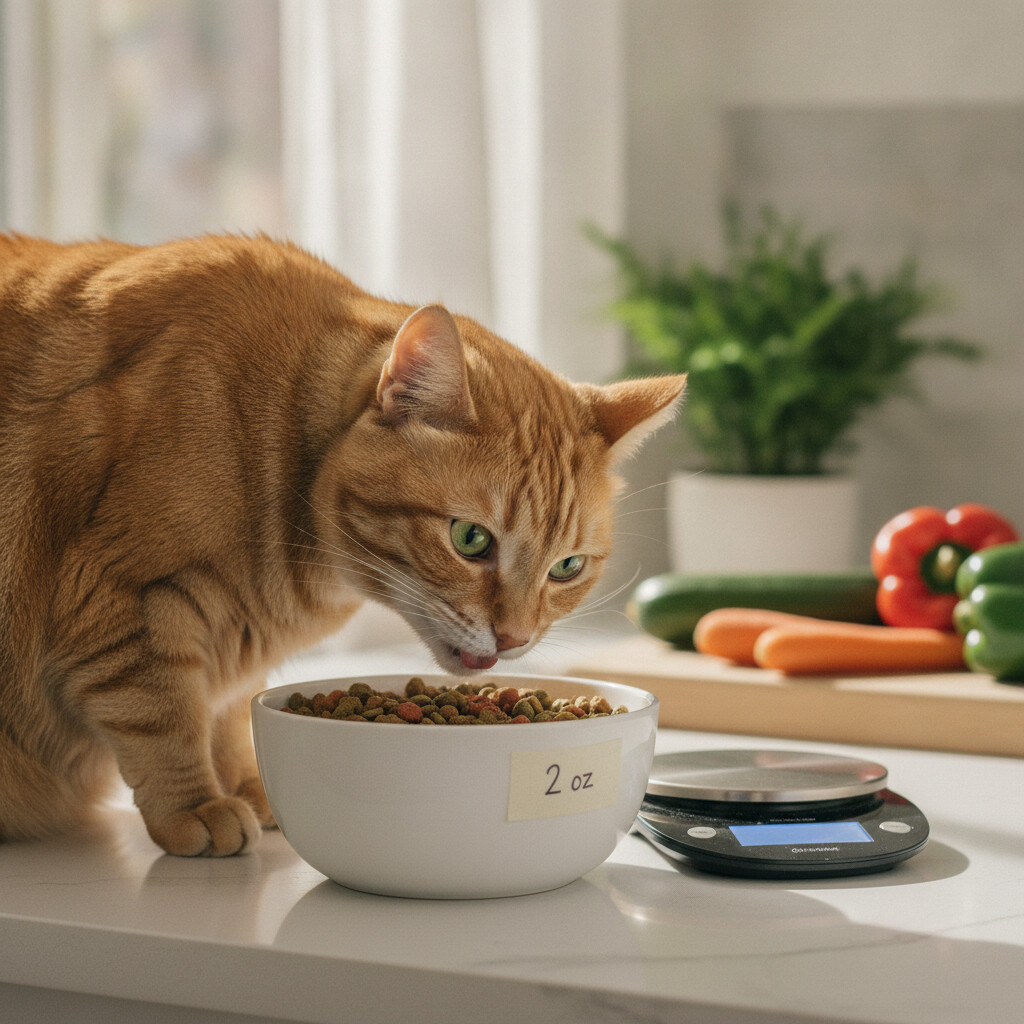
- Weigh food, don’t eyeball it. A kitchen scale is more reliable than a measuring cup, especially for dry food where a “cup” varies a lot by kibble size and density.
- Track weight monthly, not daily. Daily fluctuations from hydration and litter box timing will make the trend impossible to read; monthly weigh-ins on the same scale give you a real signal.
When to See a Vet
Talk to your vet before starting any weight-loss plan — not just to set the calorie target, but because sudden or significant weight gain can itself be a symptom of an underlying condition rather than simple overfeeding. See a vet promptly, rather than adjusting food further, if:
- Your cat goes more than 24 hours without eating anything, at any point during the diet
- You notice vomiting, lethargy, or yellowing of the gums or eyes (a sign of liver stress)
- Weight loss stalls completely for more than a month despite consistent portioning
- Your cat is losing weight faster than the 1–2% per week target, which can indicate the calorie cut was too aggressive
The Practical Takeaway
Weight loss that lasts is slow, protein-forward, and measured — not a sudden portion cut. Get a real starting body condition score and calorie target from your vet, transition food gradually, split meals into smaller portions with a puzzle feeder, and weigh in monthly rather than daily. For the signs that prompted the diet change in the first place, Is Your Cat Overweight? Signs to Look For and How to Help walks through how to assess body condition at home, and How Much Should I Feed My Cat? A Calorie Guide by Weight is a useful reference once your cat reaches a stable target weight and shifts from weight loss to maintenance.