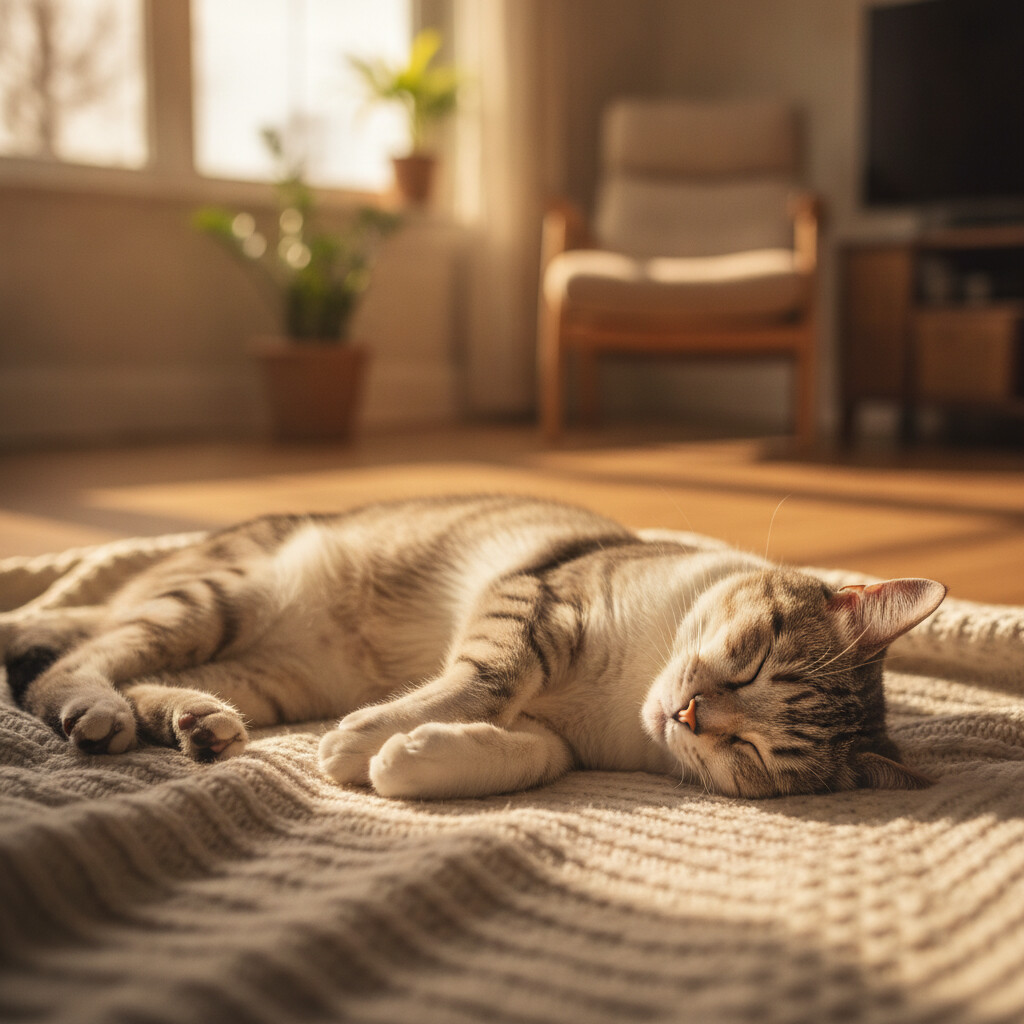
A healthy adult cat sleeping or resting quietly breathes roughly 15 to 30 times a minute, with a chest that moves gently and a mouth that stays closed. If your cat is breathing faster than that while asleep, or working visibly hard to breathe, it’s worth taking seriously. Here’s how to count, what’s normal, and when it’s an emergency.
What Is a Normal Breathing Rate for a Cat?
The most useful number is the sleeping respiratory rate: breaths per minute while your cat is soundly asleep, not dreaming and not purring.
A 2014 study in the Journal of Feline Medicine and Surgery (Ljungvall, Rishniw and colleagues) measured sleeping and resting breathing rates in healthy adult cats at home and found that rates in healthy cats were almost always below 30 breaths per minute, and frequently much lower. Cardiologists now use 30 as a practical cut-off: a sleeping rate that stays above it is a reason to call the vet.
Awake, relaxed cats breathe a little faster, and rates rise briefly with play, heat, excitement or a car trip. That’s normal, as long as breathing settles within a few minutes of calm.
What you should not normally see in a cat:
- Open-mouth breathing or panting. Dogs pant constantly; cats don’t. A few seconds after intense play or in real heat can happen, but panting that continues once the cat is still is not normal.
- Belly heaving. Breathing should be mostly quiet chest movement. A big push from the abdomen with each breath means effort.
- Unusual posture. A cat crouched with elbows out and neck stretched forward is trying to get more air in.
How to Count Your Cat’s Breathing at Home
This takes one minute and is one of the most useful things you can learn as a cat owner.
- Wait until your cat is properly asleep, ideally lying on their side, not mid-dream (twitching paws and whiskers will throw the count off).
- Watch the chest or flank. One rise plus one fall equals one breath.
- Count for 30 seconds and multiply by two. Do it twice and average.
- Write it down with the date. A phone note works fine.
If your cat purrs, wait. Purring changes the breathing rhythm and makes counting unreliable.
The real value comes from having a baseline. A cat that normally sleeps at 20 breaths per minute and is now at 34 tells you far more than a single reading ever could. The 2020 ACVIM consensus statement on feline cardiomyopathies recommends exactly this kind of home monitoring for cats diagnosed with heart disease, because a rising sleeping rate is often the earliest warning of fluid building up in or around the lungs.
Why Is My Cat Breathing Fast? Common Causes
Fast breathing is a symptom, not a diagnosis. Only your vet can work out the cause, usually with an exam, chest X-rays and sometimes an ultrasound of the heart. The broad categories are:
Harmless and temporary
- Play, exercise or zoomies
- Heat (cats can’t cool down by sweating, so a hot room shows up in their breathing)
- Stress or fear, such as a car ride or vet visit; see our guide to helping a cat who panics in the car
Medical causes vets look for
- Heart disease. Hypertrophic cardiomyopathy (HCM) is the most common heart disease in cats and is often silent until fluid builds up around the lungs. Our article on HCM and heart disease in cats covers the warning signs.
- Asthma and airway disease. Typically episodes of coughing, wheezing or fast breathing, sometimes mistaken for hairballs. More in feline asthma symptoms and triggers.
- Respiratory infections and pneumonia. Upper respiratory infections usually come with sneezing and discharge; a cat whose breathing rate also rises may have something deeper going on. See upper respiratory infections in cats.
- Fluid in the chest (pleural effusion), from heart failure, infection or cancer.
- Pain. Cats hide pain well, and faster, shallower breathing can be one of the few outward signs.
- Anaemia, fever, trauma or toxins, including after a fall, being hit by a car, or exposure to smoke.
- Overheating or heatstroke, especially in flat-faced breeds and overweight cats.
None of this is a reason to panic over one high reading after a run around the house. It is a reason not to ignore a sleeping rate that stays high, or breathing that looks like hard work.
Is My Cat’s Breathing an Emergency?
Go to a vet or emergency clinic now if you see any of these:
- Open-mouth breathing or panting while your cat is resting
- Blue, grey or very pale gums or tongue
- Belly heaving with every breath, or breathing with elbows out and neck extended
- A sleeping or resting rate above about 40 breaths per minute
- Noisy, rattling or wheezing breaths that don’t settle
- Collapse, weakness, or any breathing change after a fall, accident or possible poisoning
A cat in respiratory distress can go downhill quickly, and stress makes it worse. Phone ahead so the clinic is ready, keep the carrier quiet and covered with a light towel, and don’t pick your cat up in a way that squeezes their chest. Don’t try to give any human medicine.
When to See a Vet (Non-Emergency)
Book an appointment within a day or two if:
- Your cat’s sleeping rate is consistently above 30 on more than one check
- Their baseline rate has crept up over days or weeks
- Fast breathing comes with coughing, reduced appetite, hiding, weight loss or less interest in play
- You see repeated short episodes of fast or wheezy breathing, even if your cat seems fine in between
Bring your written record of breathing rates. It genuinely helps your vet, and if it turns out to be heart disease or asthma, you’ll keep using the same habit to track how treatment is working.
It’s also one more reason not to skip routine check-ups. Heart murmurs and early disease are often picked up on a regular exam before a cat shows any symptoms at all; our life-stage guide to vet visits explains how often to go.
The Takeaway
Learn your cat’s normal sleeping breathing rate while they’re healthy. Under 30 breaths a minute while asleep is reassuring. Persistently above 30 deserves a vet visit. Open-mouth breathing, heaving or a blue tinge to the gums is an emergency. One minute of counting while your cat naps could be the earliest warning you ever get.
Have you ever counted your cat’s breathing while they sleep, and what number did you get?