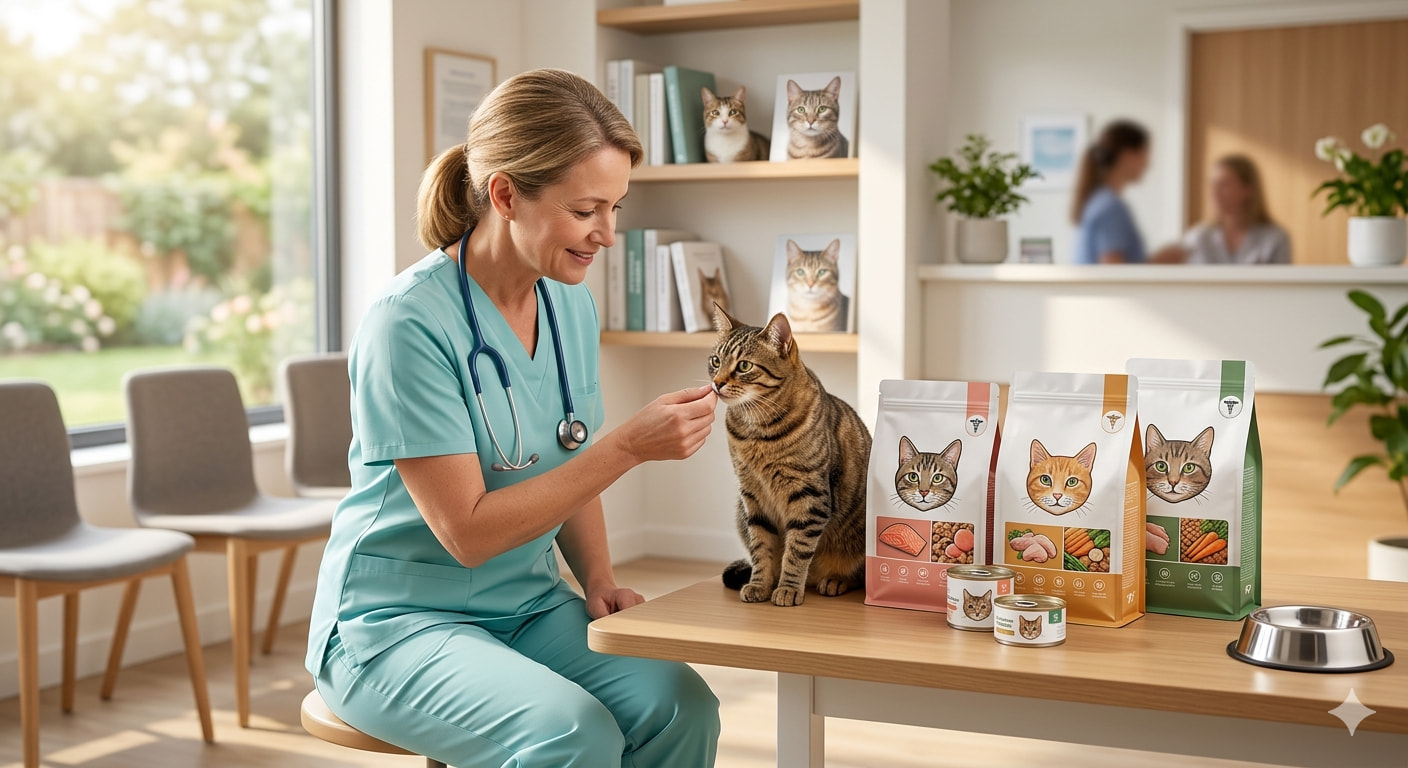
Cat food marketing is so good it’s almost impressive. Grain-free formulas, “ancestral diets,” celebrity vet endorsements — if you’re trying to choose a brand for your cat, you’re navigating a landscape where marketing does most of the heavy lifting and nutritional evidence does very little.
Here’s the short version: there’s no single “best” brand for every cat. But there are criteria that make a brand worth trusting, and most brands fail them quietly.
How Vets Evaluate Cat Food Companies
The single most useful framework for evaluating a pet food company comes from WSAVA — the World Small Animal Veterinary Association. Their published guidelines identify five questions every owner should ask any brand:
- Does the company employ a full-time nutritionist with a board-certified credential? In North America, that means a Diplomate of the American College of Veterinary Nutrition (DACVN) on staff — not a consultant hired for marketing.
- Does the company conduct feeding trials? (More on why this matters below.)
- Do they manufacture their own food, or outsource to a co-manufacturer who also produces other brands?
- Are their quality control protocols documented and available on request?
- Do they have peer-reviewed research supporting their formulas?
Most brands won’t answer these questions readily. The ones that answer directly and specifically are doing something right.
In practice, the brands that most consistently meet these criteria are Hill’s Science Diet, Royal Canin, Purina Pro Plan, and Eukanuba. These don’t win Instagram. They win in veterinary clinics — because they employ full-time veterinary nutritionists, run long-term feeding trial programs, and publish research. That’s why vets in clinical practice disproportionately reach for them.
Why Feeding Trials Matter More Than You’d Think
Most cat foods are formulated to meet nutritional requirements. That means the recipe, on paper, hits the required nutrient levels. That’s the minimum bar.
Feeding trials go further. They test the actual food on real cats over a defined period to confirm nutrients are absorbed and cats thrive on it. It’s a meaningful distinction.
The American Association of Feed Control Officials (AAFCO) sets the standards in the US. When you see “complete and balanced” on a label, it means either: (a) the formulation meets AAFCO nutrient profiles, or (b) the food was tested in an AAFCO feeding trial. Only option (b) proves the food works in a living animal.
Labels don’t always tell you which standard was used. You have to look for specific language: “animal feeding tests using AAFCO procedures substantiate…” — that phrase means it passed a feeding trial. If the label says “formulated to meet…” instead, no feeding trial was done.
The Grain-Free Question
Grain-free has become almost synonymous with “healthy” in pet food marketing. It’s worth being direct about this.
Cats don’t require grains, and grains are not inherently bad for cats. But the evidence doesn’t support grain-free as a categorical health upgrade. What grain-free formulas typically do is substitute grains with high concentrations of legumes — peas, lentils, chickpeas — ingredients that have been associated with diet-related dilated cardiomyopathy in dogs. The link in cats is less established, but the FDA issued an alert on grain-free diets in 2018 and the investigation is ongoing.
The current veterinary consensus: unless your cat has a diagnosed intolerance to a specific grain ingredient, there’s no compelling reason to choose grain-free. The broader question of what your cat’s food should actually contain is covered in our comparison of wet vs. dry cat food — the format question often matters more than the grain question.
Prescription and Veterinary Diets: A Separate Category
Prescription diets — Hill’s Prescription Diet, Royal Canin Veterinary, Purina Pro Plan Veterinary Formulas — are formulated for specific medical conditions: urinary health, kidney disease, weight management, food sensitivities, and others.
These aren’t about brand prestige. They’re tested for a medical purpose, and the clinical outcome data behind them is generally more robust than standard commercial food. If your vet recommends one of these for a condition, the recommendation reflects actual research, not a brand deal.
If your cat is healthy, prescription food isn’t necessary. But if your cat has kidney disease, urinary issues, or significant weight problems, the veterinary formulas in these lines are worth taking seriously — the evidence base is genuinely different.
Red Flags Worth Knowing
Not every brand worth avoiding is obviously bad. A few patterns to watch for:
Boutique brands with exotic proteins. Small-batch companies often have compelling stories and limited research infrastructure. Novelty proteins (bison, rabbit, kangaroo) aren’t dangerous, but they haven’t been tested at scale, and many boutique brands have no nutritionist on staff.
Heavy social media presence, light on science. If you found the brand via an Instagram pet account rather than a vet recommendation, apply extra scrutiny. Marketing budget and nutritional quality don’t correlate.
Vague health claims. “Supports immune health,” “promotes shiny coat,” “boosts vitality” — these phrases are legal to print without substantiation. They mean nothing unless backed by research the company can point to.
Non-answers to the WSAVA questions. If you email a company asking whether they employ a board-certified veterinary nutritionist and they don’t give you a direct answer, that’s the answer.
The Practical Bottom Line
You don’t need the most expensive cat food or the most novel protein. You need a food that:
- States “complete and balanced” with AAFCO feeding trial backing (not just formulation)
- Comes from a company with a board-certified veterinary nutritionist on staff
- Uses a protein source your cat tolerates and actually eats consistently
For most healthy adult cats, the mid-range offerings from Hill’s, Royal Canin, and Purina Pro Plan meet all of these criteria and have decades of feeding data behind them. If your cat does better on a different brand — stable weight, good coat, consistent digestion, no vomiting — that matters too. Food that your cat actually eats and thrives on beats a theoretically superior formula your cat refuses.
The cat food aisle is overwhelming by design. If you’re looking for a starting point, ask your vet what they actually feed their own cats. The answer is almost always one of the four brands above — and that’s not a coincidence.