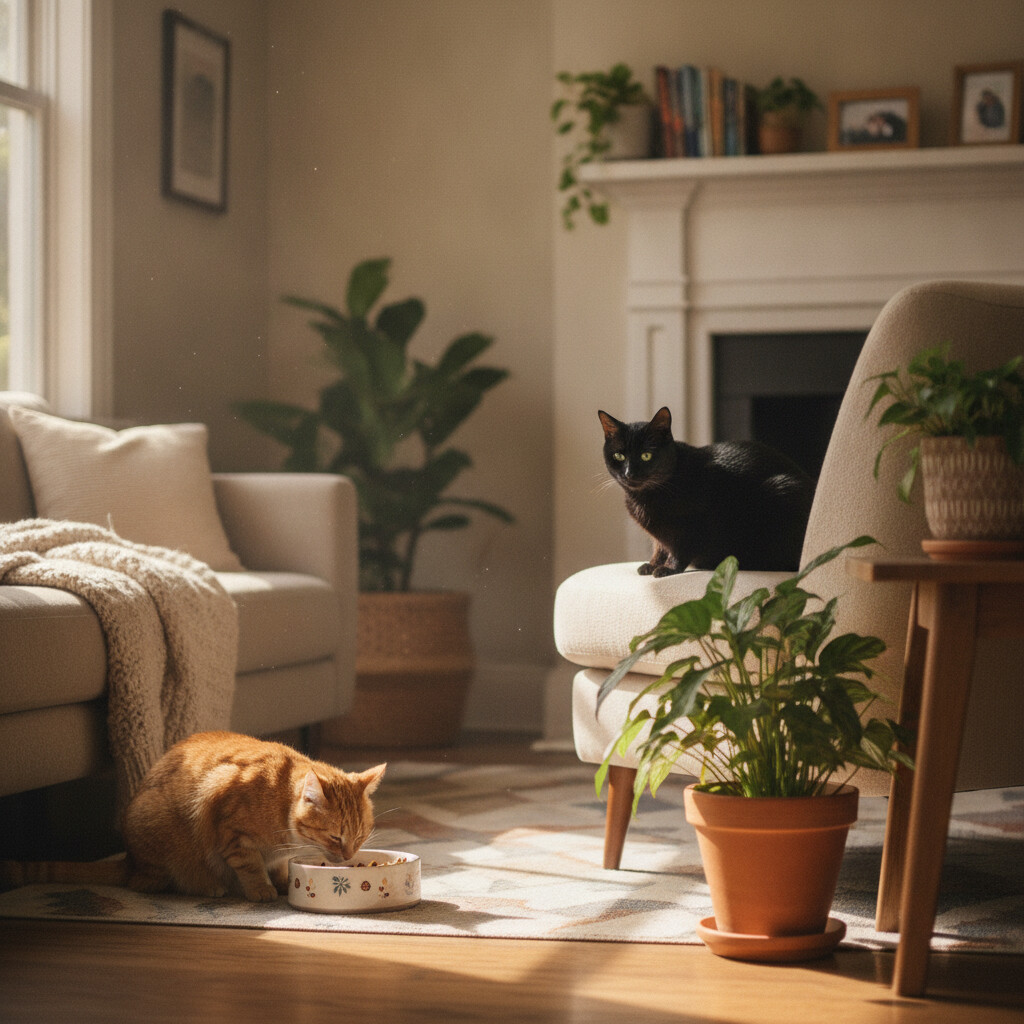
Resource guarding in cats isn’t meanness — it’s a survival instinct misfiring in a home with too few resources for too many cats. If one of your cats is blocking another from the food bowl, the litter box, or the best window perch, the fix usually isn’t punishment or “letting them work it out.” It’s addressing scarcity, real or perceived, before it escalates into chronic stress or outright fighting.
Here’s how to recognize it, why it happens, and what actually helps.
What Resource Guarding Actually Looks Like
Guarding rarely looks like a dramatic fight. More often it’s quiet and easy to miss:
- One cat “stares down” another as they approach the food bowl, litter box, or a favorite sleeping spot, and the second cat backs off
- A cat parks itself near a resource (the litter box, the hallway to the food area, a window perch) and controls access without ever attacking
- A subordinate cat starts avoiding certain rooms or times of day, eating less, or using the litter box less consistently
- Hissing or a swat when another cat gets too close to food, toys, or a person’s lap
The subtlety is the problem. Owners often notice the symptom — a cat urinating outside the box, losing weight, or hiding — long before they notice the guarding behavior causing it.
Why It Happens
Cats are solitary hunters by evolutionary design, even the highly social ones. Unlike dogs, they didn’t evolve to cooperatively share a kill, and that instinct doesn’t fully disappear just because two cats share a living room. According to feline behavior guidelines from the American Association of Feline Practitioners (AAFP), competition over resources — food, water, resting spots, litter boxes, and human attention — is one of the most common sources of tension in multi-cat households, and it’s frequently under-recognized by owners because cats express it through avoidance rather than open conflict.
It’s also not always about actual scarcity. A cat can guard a food bowl even when there are two others nearby, because the perceived value of that specific bowl, or its proximity to a favored sleeping spot, matters more than the total food supply. Cats think in terms of individual resource points, not aggregate abundance.
Guarding vs. Something More Serious
Not every stare-down needs intervention, but some patterns are worth escalating quickly:
- Guarding usually stays at the level of blocking, staring, or brief hissing, and the guarded cat backs off without injury.
- Redirected aggression happens when a cat is worked up by something else (another animal outside, a loud noise) and takes it out on the nearest cat — this can look identical to guarding but has a different trigger and different fix.
- Pain-driven aggression is a real possibility, especially in older cats. A cat with arthritis or dental pain may guard resting spots or resist being approached simply because contact hurts. If guarding behavior appears suddenly in a previously easygoing cat, a vet visit to rule out a physical cause should come before any behavioral plan — see our guide on how to tell if your cat is in pain.
How to Fix It
The AAFP and most certified feline behaviorists converge on the same core principle: the fix is almost always about resources, not discipline. Punishing the guarding cat tends to increase anxiety for both cats and makes the behavior worse.
Multiply and spread out resources. The standard rule of thumb is one litter box per cat plus one extra, placed in different locations — not lined up in a row, which just creates one contested territory instead of solving the problem. Our guide on how many litter boxes you actually need covers the placement logic in more depth. The same principle applies to food and water: multiple stations in different rooms remove the need to compete for a single point of access.
Add vertical and separate territory. Cat trees, shelves, and window perches let a subordinate cat retreat and observe without directly confronting the guarding cat. More vertical space reduces the number of forced face-to-face encounters per day, which is often enough to lower overall tension on its own.
Feed separately if guarding centers on food. Even a temporary setup — feeding in separate rooms for a few weeks — can break the guarding pattern before you reintroduce shared spaces gradually.
Don’t force interaction. Letting cats “work it out” by confining them together rarely helps and can teach the subordinate cat that there’s no safe way to avoid conflict, which raises baseline stress for everyone in the house.
Consider pheromone diffusers. Synthetic feline facial pheromone products (Feliway is the most studied brand) have reasonable evidence behind them for reducing tension-related behaviors in multi-cat homes, though they work better as one part of a broader plan than as a standalone fix.
For a fuller framework on introducing new cats or resetting a household that’s already at the fighting stage, see our guide on how to stop cats from fighting in multi-cat households.
When to Get Professional Help
Call your vet first if the guarding behavior appeared suddenly, if either cat has stopped eating or using the litter box normally, or if there’s any physical injury — these can indicate pain or illness rather than a purely behavioral issue. Once medical causes are ruled out, a veterinary behaviorist or certified feline behavior consultant is worth the cost if guarding has escalated to real fights, if one cat is losing weight or showing signs of chronic stress (over-grooming, hiding, appetite changes), or if your own resource and space changes haven’t improved things after several weeks.
The Takeaway
Resource guarding is a cat solving a scarcity problem the only way it knows how — by controlling access. Your job isn’t to referee who “deserves” the food bowl; it’s to make sure there’s no reason to guard it in the first place. Multiply the resources, spread out the territory, and rule out pain before assuming it’s purely behavioral. Most multi-cat households can defuse this without ever needing a single confrontation to “resolve.”