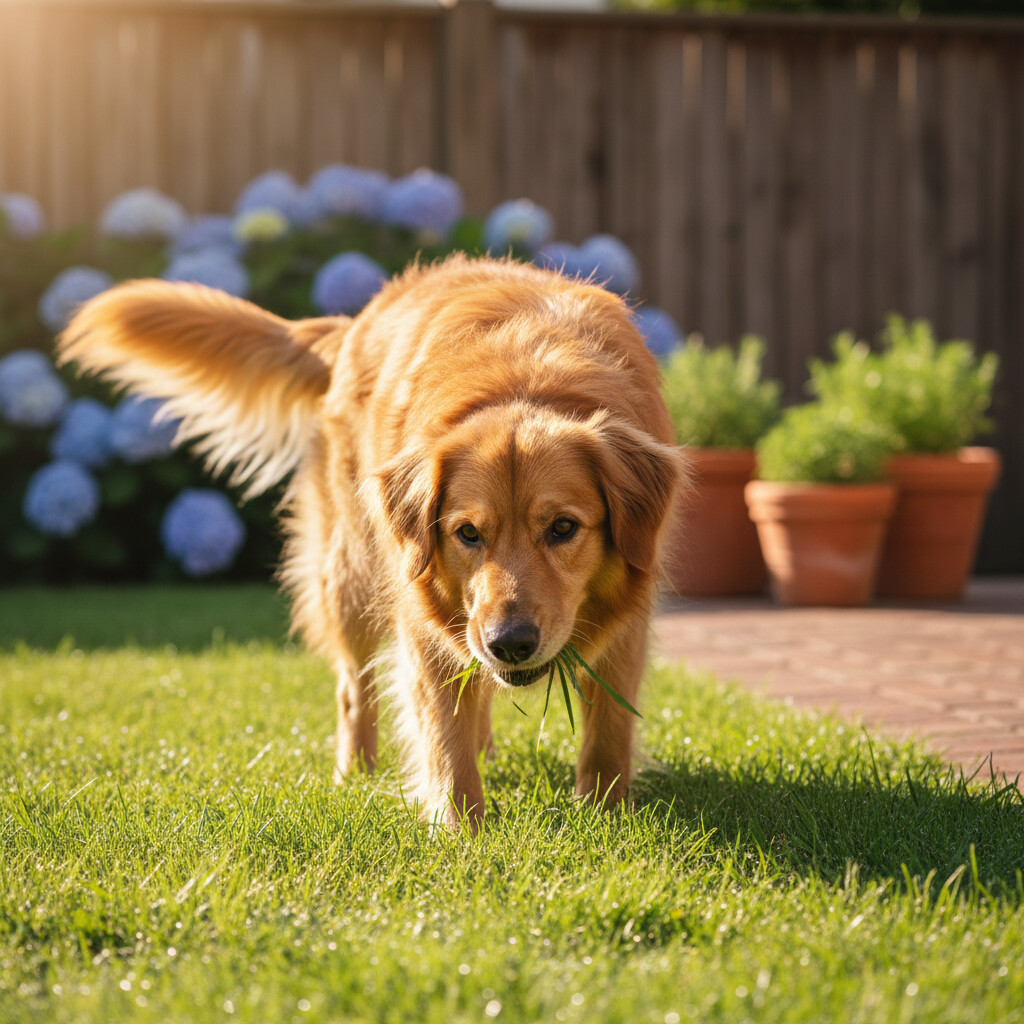
Most dogs eat grass at some point, and most of the time it’s completely harmless. Despite the concern it tends to cause, grass-eating is one of the most normal dog behaviors out there — and the science behind it is more interesting than the popular explanation of “they must be sick.”
So Why Do Dogs Eat Grass?
The honest answer is: we’re not entirely certain, but research points to several plausible explanations.
Omnivore instinct. Dogs aren’t obligate carnivores. They’re omnivores with flexible digestive systems shaped by thousands of years of eating whatever was available — including plants. Wild canid diets contain significant plant material, and eating grass may simply be an expression of that ancestral flexibility.
Fiber and gut regulation. A 2008 study published in Applied Animal Behaviour Science (Sueda, Hart & Cliff, UC Davis) surveyed dog owners and found that the majority of dogs who eat grass show no signs of illness beforehand and don’t vomit afterward — directly challenging the assumption that grass-eating is always a response to nausea. Dogs on higher-fiber diets ate significantly less grass, suggesting that fiber intake plays a role.
Boredom or habit. Some dogs eat grass when under-stimulated, or because it’s simply become part of their outdoor routine. The texture of grass in the mouth may be satisfying. And if an owner reacts with attention every time their dog grazes, the behavior can be inadvertently reinforced.
Nausea relief (sometimes). The upset-stomach theory isn’t entirely wrong. Some dogs do appear to eat grass specifically when nauseated, and some do vomit afterward. But it’s more accurate to describe this as one possible trigger among several, not the primary explanation for grass-eating generally.
Is It Actually Dangerous?
Grass itself is not toxic to dogs. The risks come from what surrounds it:
Pesticides and herbicides. This is the main concern. If your lawn has been treated, keep your dog off it until it’s fully dry — follow the product’s instructions. In parks or other people’s gardens, you can’t know what’s been applied.
Other plants. Dogs grazing happily don’t limit themselves to grass. Clover, ornamental plants, flowering weeds, and garden borders are all fair game. Some of these are genuinely problematic. The ASPCA maintains a searchable toxic plant database that’s worth bookmarking if your dog is a committed plant-eater.
Parasites. Grass in areas frequented by other animals can carry parasite eggs and larvae. This is a reason to keep your dog’s parasite prevention current, not necessarily a reason to ban grass-eating outright.
When to See a Vet
Most grass-eating doesn’t require a vet visit. Call your vet if:
- Vomiting is frequent after grass-eating, or if vomit contains blood or looks unusual
- You see signs of abdominal pain — bloating, obvious discomfort, your dog guarding their belly
- The behavior is new and compulsive — a dog who has never been interested in grass and suddenly can’t stop may have a dietary deficiency or underlying gastrointestinal issue worth investigating
- Your dog ate treated grass and shows symptoms — lethargy, excessive drooling, coordination problems, or seizures. Treat this as an emergency: contact your vet or animal poison control immediately
For occasional, relaxed grass nibbling with no other symptoms? Monitor and move on.
Should You Try to Stop It?
You don’t need to, unless your dog is consistently vomiting afterward or you can’t rule out treated grass.
If you want to reduce the behavior:
- Review their diet for fiber content — a small amount of cooked pumpkin or switching to a higher-fiber food can help if that’s the underlying driver. Ask your vet before making changes.
- Increase stimulation — if boredom is the cause, more exercise, training sessions, and enrichment activities address the root rather than just the symptom.
- Teach a “leave it” cue — a reliable interrupt gives you control on walks without a physical struggle.
- Give them their own patch — if grass access is making you anxious, designating a small untreated area they’re allowed to graze in takes the uncertainty out of the equation.
The Takeaway
Your dog eating grass is almost certainly normal, ancient behavior and not a health crisis. What matters is context: what’s on the grass, what else they’re eating alongside it, and whether anything has changed. A dog who’s grazed casually their whole life with no ill effects is expressing a normal canine behavior, not signaling a problem.
For dogs on poor-quality food or with recurring digestive issues, grass-eating can occasionally be a signal worth investigating — which is a good reason to keep up with regular vet checkups. Our article on signs your dog is in pain covers the behavioral cues that are actually worth watching for.