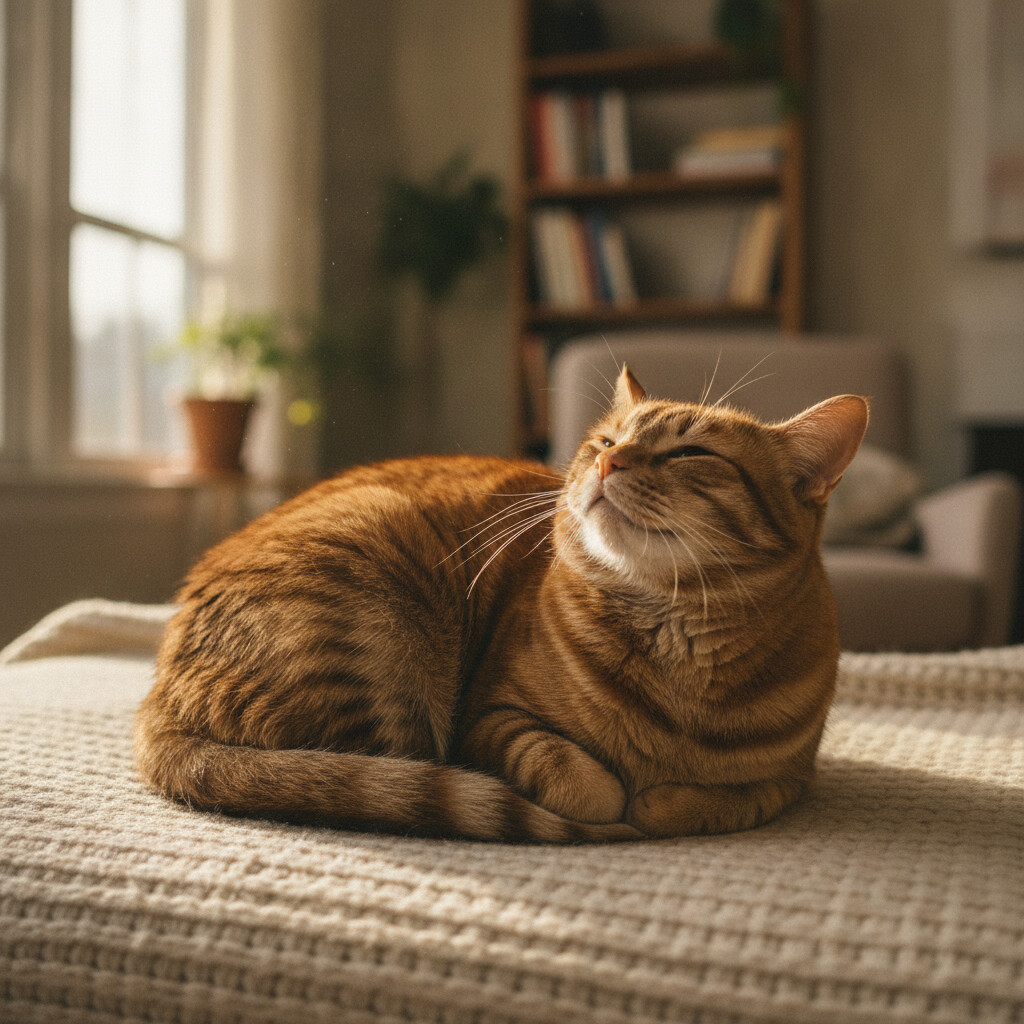
Cats purr for a lot more reasons than “happy.” They purr when content, sure, but also when hungry, in labor, injured, anxious, and — some vets believe — even while dying. The sound itself is doing something mechanically unusual, and researchers still don’t fully agree on why cats do it or what it’s for. Here’s what’s actually known.
How Cats Physically Make the Sound
Purring comes from rapid, repeated contractions of the muscles in a cat’s larynx (voice box), combined with movement of the hyoid bone structure that anchors the tongue and throat. As the cat breathes in and out, those muscles twitch roughly 25 to 150 times per second, opening and closing the space between the vocal folds and creating that steady vibration — audible on the inhale and the exhale, unlike a meow.
This is different from how big cats vocalize. Lions, tigers, and other roaring cats have a flexible hyoid bone that allows a roar but not a true purr. Domestic cats, along with cheetahs, cougars, and a handful of other small wild cats, have a rigid hyoid — which is why they can purr continuously but can’t roar. It’s a structural trade-off, not a matter of mood.
It’s Not Just a Happiness Signal
The instinct to read purring as pure contentment is understandable, but it’s incomplete. Cats also purr:
- While giving birth
- When injured or in pain
- During vet visits or other high-stress situations
- While approaching death, in some documented cases
One theory, backed by research from animal behaviorist Karen McComb at the University of Sussex, is that cats have a “solicitation purr” — a version layered with a higher-frequency cry embedded in it, similar in pitch to a human infant’s cry. Cats seem to use this specific purr-cry combination when soliciting food from their owners, and people rate it as more urgent and harder to ignore than an ordinary purr. It’s a manipulation tool as much as an emotional signal, and it’s a different sound from the low rumble of a cat dozing on your lap.
So purring isn’t a single-purpose signal. It’s closer to a multi-use tool: sometimes contentment, sometimes a request, sometimes self-soothing under stress.
The “Self-Healing” Theory — What the Evidence Actually Shows
The most-cited piece of purring research is a 2001 study by bioacoustics researcher Elizabeth von Muggenthaler, which measured purr frequencies across several cat species and found they clustered in the 25–150 Hz range — frequencies that overlap with ranges used in therapeutic vibration and low-intensity ultrasound treatments shown to promote bone density and tissue repair in other contexts.
That overlap is genuinely interesting, and it’s the basis for the popular idea that purring helps cats heal faster and explains why cats purr when injured. But it’s worth being honest about what this evidence does and doesn’t show: it’s a correlation between purr frequency and known therapeutic frequency ranges, not a controlled study showing that purring cats actually heal measurably faster than non-purring cats. No large-scale clinical trial has confirmed a direct healing effect in cats. It’s a reasonable, biologically plausible hypothesis — not settled science. Treat “cats purr to self-heal” as an interesting theory worth watching, not a proven mechanism.
When Purring Isn’t a Compliment
Because cats purr under stress and pain as well as contentment, a purring cat at the vet or after an injury isn’t necessarily a relaxed cat. This matters practically: if you assume purring always means “everything’s fine,” you can miss real distress.
The more reliable read comes from combining the purr with everything else the cat’s body is doing. A cat purring with a relaxed body, slow blinking eyes, and loose posture is likely genuinely content — our Cat Body Language Guide breaks down how to read those other signals together. A cat purring while crouched, ears flattened, or tense after a fall or limping is more likely self-soothing through pain or fear, and worth a closer look.
Purring shows up alongside other affection behaviors too — many cats purr while kneading (working paws rhythmically against a soft surface, a leftover kitten nursing instinct) or while headbutting, both of which are worth understanding on their own terms if you want the fuller picture of what your cat is communicating.
When to See a Vet
Purring itself is never a symptom you need to treat. But if a cat is purring more than usual and it’s paired with any of the following, it’s worth a vet visit — the purring may be masking or accompanying a problem rather than announcing good news:
- Hiding, reduced appetite, or lethargy alongside the purring
- Limping, flinching when touched, or reluctance to jump
- Labored or noisy breathing along with the purr (this can sometimes be confused with purring but signals respiratory distress)
- Purring that started suddenly in an older cat with no clear trigger
The Takeaway
Purring is a genuinely multi-purpose signal — comfort, communication, and possibly a low-grade self-soothing or healing mechanism your cat’s body reaches for automatically. The sound alone doesn’t tell you everything; read it alongside your cat’s posture, ears, and overall behavior for the real picture. If in doubt, especially around an injury or unexplained change in behavior, treat persistent purring as a reason to look closer, not a reason to relax.