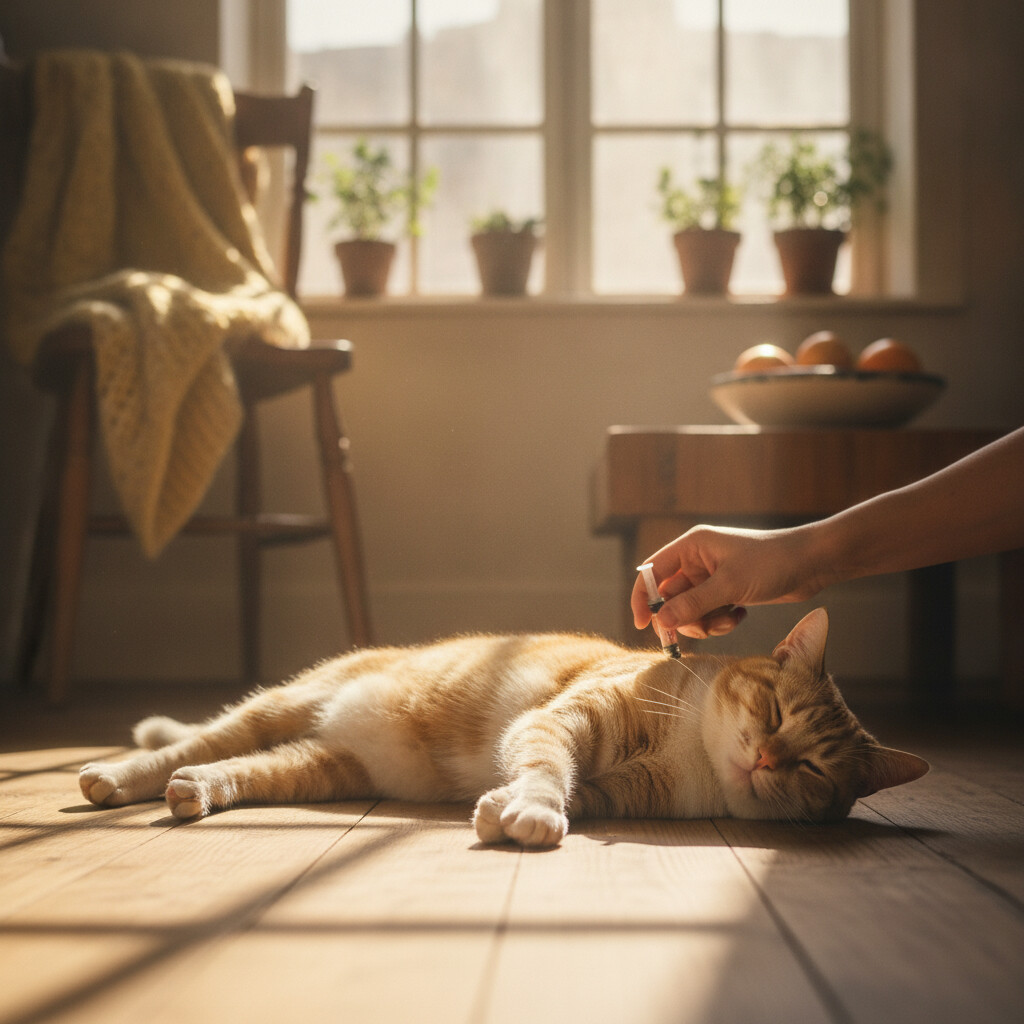
Our cat Pepper was diagnosed with diabetes on a Tuesday, and by Thursday I’d cried in the pharmacy parking lot over a box of insulin needles. Six months later, I could draw up a dose and give the shot in under ten seconds, and Pepper barely looked up from her food bowl. Here’s what changed in between, and what I wish someone had told me on day one: the hard part isn’t the needle. It’s everything you’re afraid the needle means.
The Diagnosis Nobody Warns You About
Pepper was twelve, a little overweight, and suddenly drinking like she’d crossed a desert. She was also losing weight despite eating more than usual — the classic contradiction of feline diabetes mellitus. Our vet ran a blood glucose and fructosamine panel (fructosamine matters because a single glucose reading can spike from stress alone, especially in cats who hate car rides as much as Pepper does) and confirmed it: type 2 diabetes, the form that accounts for the vast majority of feline cases, according to the American Animal Hospital Association’s (AAHA) diabetes management guidelines.
The vet handed me a prescription for insulin, a box of syringes, and a pamphlet. I remember almost none of what she said after the word “insulin.” My brain just stopped. If that’s where you are right now, you’re not failing at this. Everyone’s brain does that.
Learning to Give the Shot (Is Not the Hard Part)
Here’s the thing I genuinely didn’t believe until I did it myself: giving a cat an insulin injection is close to painless for them. The needles used are tiny — thinner than the ones for human insulin — and cats have loose, elastic skin over the shoulders that barely registers a needle passing through it. Pepper flinched at her first shot the way she flinches at a sudden noise, not the way she flinches when you accidentally step on her tail.
What actually took practice:
- Timing it with meals. Most insulin protocols call for injections roughly 12 hours apart, ideally right after your cat eats, so their blood sugar is already rising when the insulin starts working.
- Rotating injection sites. We alternated sides of her shoulders and flank to avoid soreness or fatty tissue changes at one spot.
- Storing the insulin correctly. Ours needed refrigeration and gentle rolling (never shaking) before each dose — a detail that’s easy to get wrong when you’re exhausted and running late for work.
By week three, the injection itself was the easiest part of our morning. What was hard was living with the uncertainty underneath it.
The Part That Actually Changed: Us, Not the Needle
The turning point wasn’t a technique. It was a phone call with our vet about two weeks in, when I admitted I was giving the shots but I didn’t trust myself to know if they were working. She walked me through what to actually watch — not obsessively testing blood glucose at home (some owners do, many don’t, and both can be fine with vet guidance), but watching Pepper’s water bowl, her weight on our bathroom scale wrapped in a towel, and her general energy.
Within about six weeks, the drinking dropped back to normal. Pepper stopped losing weight. She started, for the first time in over a year, jumping onto the counter to steal a look at what we were cooking — a nuisance we were thrilled to have back. Research published in veterinary internal medicine journals consistently shows that a meaningful percentage of cats with type 2 diabetes can enter remission with early, well-managed treatment and, often, a shift to a low-carbohydrate diet, though remission isn’t a promise every cat gets and management should always be led by your vet, not a forum post.
What made the difference for us wasn’t perfection. We missed a shot timing more than once. We gave a slightly-off dose during a chaotic week. Diabetes management in cats, unlike in humans, tends to have a bit more forgiveness in the small mistakes as long as the big pattern — consistent timing, consistent food, consistent monitoring — holds.
What I’d Tell Someone on Their Diagnosis Day
If your cat was just diagnosed, here’s the short version of six months of learning:
- The needle fear fades fast. Almost everyone says this, and almost everyone doesn’t believe it until it happens to them.
- Ask your vet to show you, not just tell you. We had our vet tech demonstrate the injection on a stuffed toy, then on Pepper, with us watching, before we did it ourselves at home.
- Diet matters more than people expect. Our vet moved us toward a higher-protein, lower-carbohydrate wet food, which is consistent with broader veterinary guidance on managing feline diabetes.
- You will get better at this faster than you think. The learning curve is real but it is short — most owners report feeling confident within two to four weeks.
When to Call the Vet Immediately
Diabetic cats can develop hypoglycemia (dangerously low blood sugar) if a dose is too high, a meal is skipped, or activity changes unexpectedly. Know the warning signs and treat them as an emergency, not a wait-and-see:
- Wobbliness, disorientation, or stumbling
- Weakness or collapse
- Seizures
- Unresponsiveness
If you see any of these, follow your vet’s emergency protocol immediately (many owners are told to rub a small amount of corn syrup on the gums while heading to the clinic) and call ahead so they’re ready for you. On the other end, untreated diabetes can progress to diabetic ketoacidosis, a life-threatening complication — so persistent vomiting, lethargy, or rapid breathing in a diagnosed diabetic cat also warrants an urgent call, not a next-available appointment.
The Takeaway
A diabetes diagnosis feels like the end of easy mornings with your cat. In practice, it becomes a new, quieter routine — one that, for us, brought Pepper back to herself faster than we expected. If your cat was just diagnosed, read up on feline diabetes symptoms and daily management so you know what to expect, and don’t hesitate to lean on your vet clinic’s staff for hands-on training — most will happily show you the injection technique more than once. If you’re still shopping for a vet you trust with something this significant, here’s how to find one you can rely on.
Pepper is nine months into treatment now. Her fructosamine is back in a healthy range, she’s stable on a lower insulin dose than when we started, and she still steals a look at dinner every night. Some days the shot takes longer to catch her than to give it. That, it turns out, is what winning looks like.