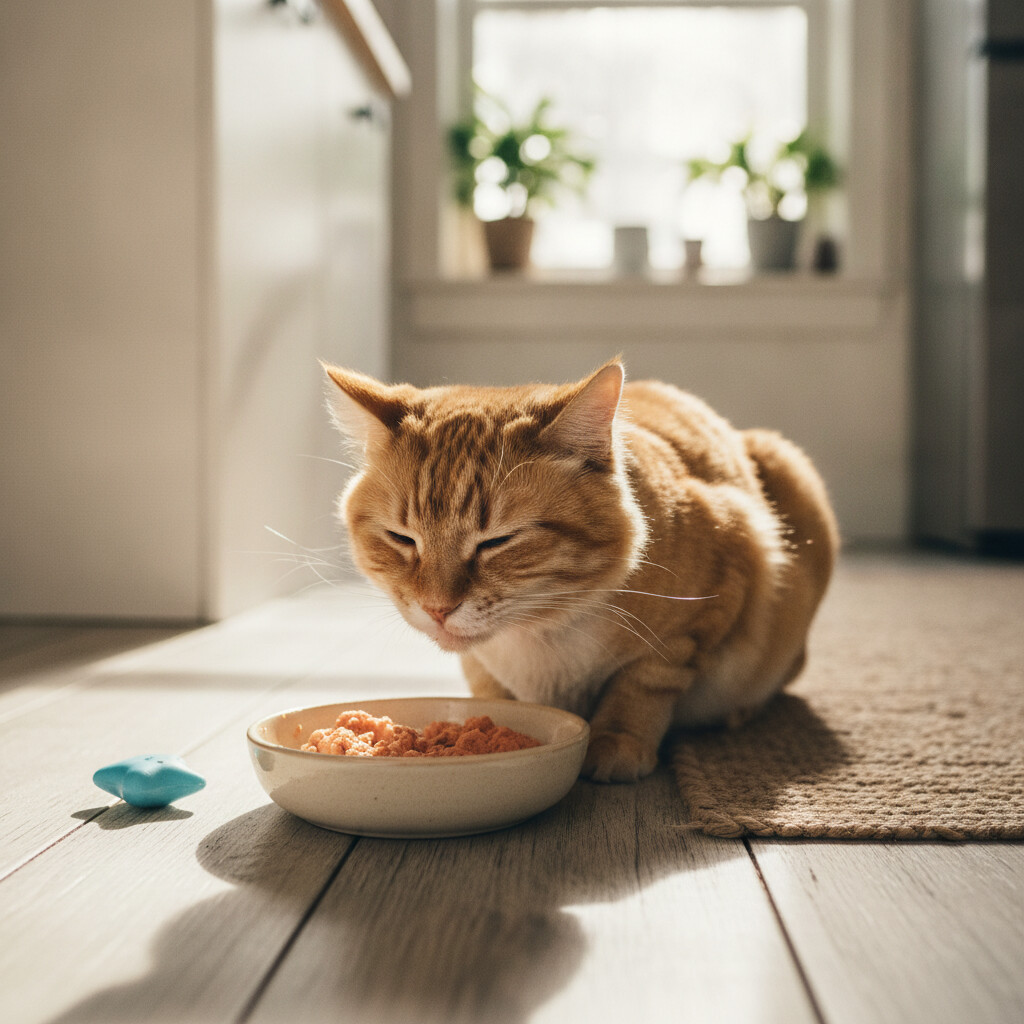
Our cat Moose spent most of a year chewing on the left side of his mouth, and we thought it was a quirk. It turned out to be tooth resorption, a painful and very common dental disease in cats that most owners have never heard of. Two extractions later, he’s a different cat.
If your cat has started eating oddly (dropping kibble, chewing on one side, tilting their head while they eat, or suddenly refusing hard food), book a dental check. Here’s what happened to us, and what we learned about a condition that hides very well.
The quirk we didn’t question
Moose was eight, a big orange tabby, and he’d always eaten like it was a competitive sport. So when he started eating more slowly, we put it down to him getting older and calmer.
Then there was the chewing. He’d pick up a piece of kibble, shift it to the left side of his mouth, crunch, and sometimes drop half of it on the floor. Every so often his jaw would chatter for a second after a bite, the way some cats chatter at birds through a window. We joked that he was complaining about the menu.
He still ate. He still demanded breakfast at 5:30am. His weight was steady. Nothing about him said “sick cat,” which is exactly why we let it go for months.
What finally made me call the vet was a single moment: he yowled once while eating, shook his head, and walked away from a full bowl. Moose had never walked away from a full bowl in his life.
What tooth resorption actually is
I’d never heard the term before our vet said it. Here’s the plain-English version.
Tooth resorption is a condition where the body’s own cells (called odontoclasts) start breaking down the structure of a tooth, usually starting near the gumline and working inwards. Over time the tooth erodes. Once the damage reaches the sensitive inner layers, it hurts, and the American Veterinary Dental College describes these lesions as painful once they’re exposed.
A few things surprised me:
- It’s very common. Published studies have found resorptive lesions in anywhere from about a quarter to well over half of the adult cats they examined, depending on the population and how carefully teeth were X-rayed (for example, Ingham et al., Journal of Small Animal Practice, 2001; Lommer and Verstraete, JAVMA, 2000). It becomes more likely as cats get older.
- Nobody knows exactly what causes it. Researchers have looked at diet, vitamin D and other factors, but there’s no confirmed cause, and so no proven way to prevent it.
- Brushing doesn’t stop it. Good dental care still matters for gum disease, but resorption can happen in cats with otherwise clean mouths.
- There are different types. Vets broadly describe one type linked to inflammation around the tooth and another where the root is gradually replaced by bone. The type affects how the tooth is treated, which is why X-rays matter so much.
The vet visit
Our vet looked in Moose’s mouth while he was awake and saw a small pink spot on one of his lower left premolars, where the gum seemed to be growing up into the tooth. She touched it with a cotton swab and his jaw chattered instantly. That chatter, she said, is a classic response.
What she couldn’t see was everything below the gumline. Tooth resorption often does most of its damage in the root, where it’s invisible without dental X-rays. The AAHA Dental Care Guidelines for Dogs and Cats (2019) recommend full-mouth dental radiographs as part of a proper dental assessment, and those have to be done under general anesthesia. Cats don’t hold still for X-rays of their teeth.
I was nervous about the anesthetic. Moose was eight and I’d read horror stories. Our vet walked us through it: pre-anesthetic blood work to check his kidneys and liver, IV fluids, monitoring throughout, and a plan for pain relief afterwards. If you’re worried about anesthesia in an older cat, our article on anesthesia in senior cats covers what vets check and what the actual risks look like.
What the X-rays showed
The X-rays found two affected teeth: the premolar she’d spotted, and a lower molar on the same side that looked completely normal from the outside. Its root was already being replaced by bone.
So that was the chewing explained. Both bad teeth were on the left, and Moose had been chewing on the left side. I’d assumed cats chew on the side that feels fine. It turns out he’d been favouring the side that hurt least at any given moment, swapping back and forth, and dropping food whenever he got it wrong. He’d been in pain for months and had simply worked around it.
Treatment for painful resorption is removal. Depending on the type, the vet either extracts the whole tooth or, for some root-replacement lesions, removes the crown and leaves the remaining root to be absorbed. There are no fillings or crowns for this in cats, because the process keeps going underneath. Moose had one full extraction and one crown amputation.
Recovery was faster than I expected
I’d pictured a week of a miserable cat. In reality he came home groggy, slept it off, and ate soft food that evening.
Our vet sent us home with:
- pain relief for several days (only the medication she prescribed; never give a cat human painkillers, several are toxic to them)
- instructions to feed soft or wet food for about two weeks while the gums healed
- a recheck appointment to look at the extraction sites
Within a few days he was eating faster than he had in a year. Within two weeks he was back on his usual food, chewing on both sides. The jaw chattering stopped completely. He also became noticeably more playful, which was the moment I realised how much he’d been putting up with.
Cats manage perfectly well with missing teeth. Plenty of cats have multiple extractions, or even all their teeth removed, and go on eating kibble happily. A mouth with fewer teeth is far better than a mouth that hurts.
What I’d tell any cat owner now
- Changes in how a cat eats are a symptom, not a personality trait. Slow eating, dropping food, one-sided chewing, head tilting, drooling, pawing at the mouth or suddenly preferring soft food all deserve a vet look.
- A cat that’s still eating can still be in pain. Cats are very good at hiding discomfort. Our guide to how to tell if your cat is in pain lists the subtle signs vets watch for.
- Ask whether X-rays are included in a dental. A dental cleaning without radiographs can miss resorption entirely, because the damage is often below the gumline.
- Expect it to come back elsewhere. Cats that have had one resorptive lesion often develop more. Moose now has a dental exam at every annual check-up.
- Keep up general dental care. It won’t prevent resorption, but it helps with gum disease, which is common too. Our guide to feline dental health and brushing is a good place to start, and older cats have some extra considerations covered in dental care for senior cats.
When to see a vet
Book a vet appointment if your cat:
- chews on one side, drops food, or tilts their head while eating
- chatters their jaw, flinches or yowls when eating or when their mouth is touched
- drools, paws at their mouth, or has blood in their saliva or on toys
- has bad breath, red or swollen gums, or a pink spot where the gum seems to grow onto a tooth
- suddenly prefers wet food or stops eating hard food altogether
Call your vet the same day if your cat stops eating entirely. Cats that go without food for even a couple of days are at risk of serious liver problems, so a sore mouth that stops a cat eating is never a “wait and see” situation.
Moose is ten now, two teeth lighter and no worse for it. Has your vet ever found a dental problem in your cat that you’d never have guessed from the outside?
A note on this story: it’s a composite, built from situations owners commonly describe and checked against published veterinary guidance. Names and personal details are illustrative. The medical information is not, so please talk to your vet about your own cat.