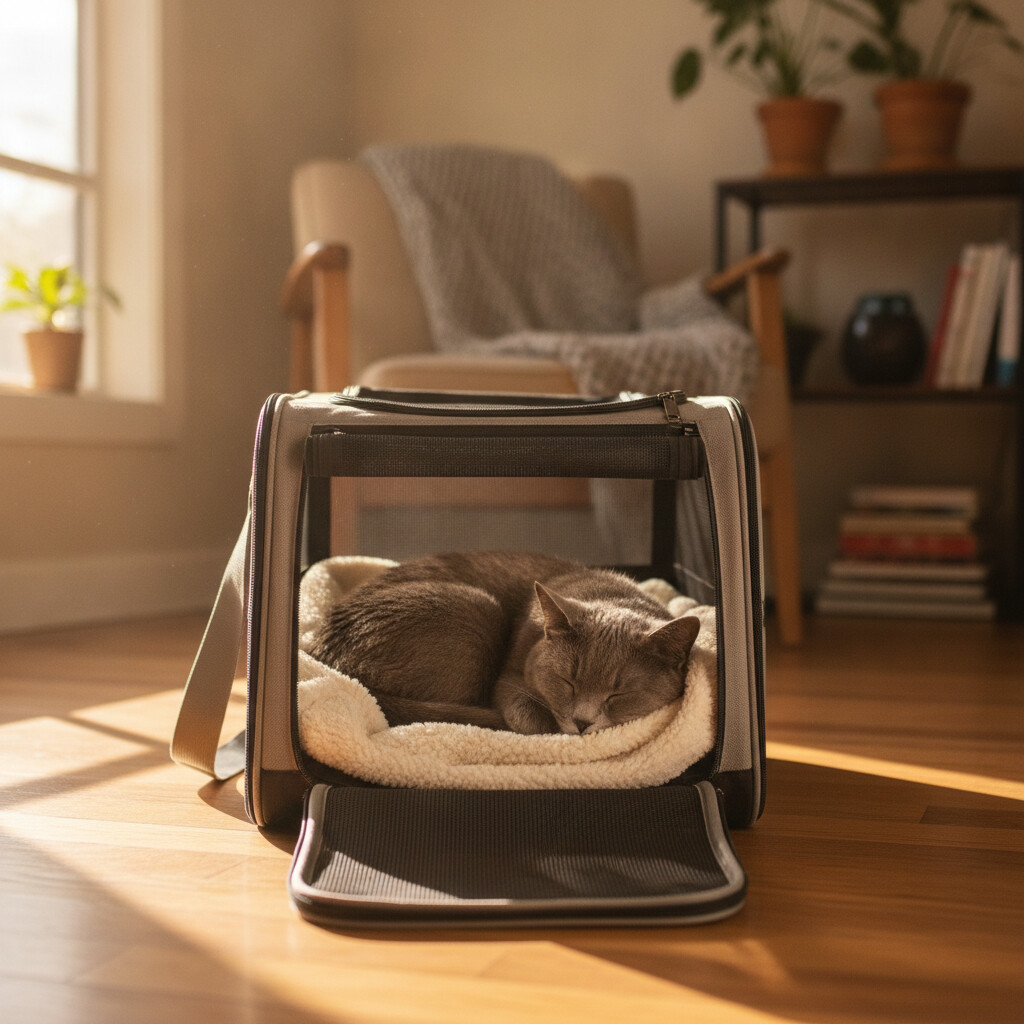
Our cat Juniper used to turn every vet appointment into a twenty-minute wrestling match. We fixed it in about six weeks, without sedating her for the trip and without buying anything fancy. What worked was teaching her that the carrier is furniture, not a trap. Here’s how it went and what we’d tell anyone in the same spot.
The carrier only came out for bad news
Juniper was four, a solid grey shorthair with strong opinions and very good hearing. The carrier lived in the garage. It came into the house about twice a year, and every time it did, something unpleasant followed: a car ride, a cold exam table, a needle.
So she learned. The moment the carrier hit the hallway floor, she was under the bed, wedged against the wall where no arm could reach her. Getting her out took two of us, a towel, and usually some blood (ours). By the time we got to the clinic she was panting, drooling and growling, and the vet could barely examine her.
We figured this was just how cats are. In one sense it is. A large US survey published in the Journal of the American Veterinary Medical Association (Volk and colleagues, 2011) found that more than half of cat owners said their cat hates going to the vet, and around four in ten said they get stressed just thinking about the trip. A lot of owners respond by going less often, which is the opposite of what an animal that hides illness needs.
What we hadn’t understood is that much of the fear starts at home, with the carrier itself.
Why the carrier was the problem, not the vet
Cats are very good at linking an object to what usually comes next. If a carrier only ever means car plus clinic, the carrier becomes the warning sign, and the fear kicks in before you’ve even left the house.
The AAFP and ISFM Cat Friendly Veterinary Interaction Guidelines (2022) make this point directly. They recommend that owners leave the carrier out at home as a familiar resting place and teach cats to go into it calmly, because a cat who arrives at the clinic already panicked is harder to examine and gets a less accurate check-up. Heart rate, blood pressure and even blood glucose can all read high in a frightened cat.
There’s research behind the training approach too. A 2018 study from the University of Veterinary Medicine Vienna, published in Applied Animal Behaviour Science, trained cats to the carrier at home over several weeks. Trained cats showed fewer stress behaviours on the trip and were easier to examine than untrained cats. It was a small study, but it matched what the vet guidelines were already saying.
What we changed, week by week
We didn’t follow a formal protocol. We pieced this together from the AAFP guidance and our vet’s advice. The principle throughout: go at the cat’s pace, and stop a step back if she shows fear.
Week 1: the carrier moved into the living room. We brought it in from the garage, took the door off completely, and put her favourite fleece inside. Then we ignored it. So did she, for about four days. On day five she sniffed it. That was the whole week.
Week 2: good things started happening near it. Her evening treats went first beside the carrier, then just inside the entrance, then further back. We never pushed her in or blocked the exit. By the end of the week she was stepping in to get the treat and stepping straight back out.
Week 3: meals inside. Her dinner bowl went in the back of the carrier. This was the turning point. Once she was eating in there daily, she started napping in it too, which we would not have believed in week one.
Week 4: door back on, left open. We reattached the door and left it open. Then we began closing it for a few seconds while she ate, and opened it before she finished. Slowly, a few seconds became a minute.
Week 5: lifting. With her inside and the door shut, we’d lift the carrier a few inches, set it down, open the door and give her a treat. Then a short carry across the room. We held it with two hands underneath, level, not swinging from the handle.
Week 6: short drives. We did a lap of the block in the car and came home, with a treat at the end. Then a drive to the clinic car park and back without going in. A towel over the carrier helped, and so did a seatbelt through the handle so it didn’t slide.
Not every day went forward. One evening a delivery driver hammered on the door while she was in it, and we went back to door-off meals for a few days. That’s normal, and it’s why patience matters more than any particular schedule.
The appointment that went differently
Her next check-up was a booster and a weight check. On the morning, Juniper was asleep in the carrier when we closed the door. No towel, no chase, no blood.
She still didn’t love the clinic. She hissed once at the thermometer, which seems fair. But she stayed in the carrier until the vet lifted the top half off (a top-loading carrier, which the AAFP guidelines also recommend, so the exam can start with her still inside). She let the vet examine her, and her heart rate was normal this time. The vet said it was the easiest exam she’d done on Juniper.
A few things helped on the day, beyond the training:
- A carrier that opens from the top, so nobody had to tip her out. If you’re shopping, our guide to cat carriers for vet visits and travel covers what to look for.
- Her own fleece inside, so the carrier smelled like home.
- A towel over the carrier in the waiting room, so she wasn’t staring at the dog across the room.
- No food for a few hours before the drive, which our vet suggested because Juniper tends to drool and get queasy in the car. If your cat gets properly carsick, this guide to carsick and panicky cats goes into more detail.
When training isn’t enough: talk to your vet
Some cats are too frightened for training alone, or there’s an urgent appointment and no six weeks to spare. That isn’t a failure. Ask your vet about options, including:
- Pre-visit medication. Some vets prescribe a single dose of an anti-anxiety drug to give at home before the trip. Gabapentin is the one most studied: a 2017 trial in JAVMA (van Haaften and colleagues) found cats given it before the visit showed lower stress scores and were easier to handle. Only your vet can decide whether it suits your cat and what dose to use. Never give your cat a human medication on your own.
- A cat-only appointment slot or waiting area. Many clinics have one, especially those certified as Cat Friendly Clinics.
- A house-call vet for cats who truly can’t manage the trip.
Call your vet sooner rather than later if your cat’s fear is getting worse visit by visit, or if you’ve started skipping check-ups because the trip is too hard. Cats hide pain and illness well, so missed exams can mean problems are caught late. Our guide to how often cats should see the vet lays out the recommended schedule by age.
What we’d tell anyone starting out
- Keep the carrier out permanently. If it disappears into storage again, so does the training.
- Start further back than you think. If your cat won’t look at it, start with treats near it, not inside it.
- Pair it with something your cat really wants. For Juniper that was dinner. For your cat it might be a particular treat or a favourite blanket.
- Never use the carrier as a punishment or a place to trap them.
- Expect setbacks and go back a step without fuss.
Juniper still sleeps in her carrier most afternoons. It sits under the window with her fleece in it, and she treats it like her own room. That was the whole trick: the carrier stopped meaning “vet” and started meaning “my spot”.
How does your cat handle the carrier on vet day?
A note on this story: it’s a composite, built from situations owners commonly describe and checked against published veterinary guidance. Names and personal details are illustrative. The training steps and medical information are not, so please talk to your vet about your own cat.