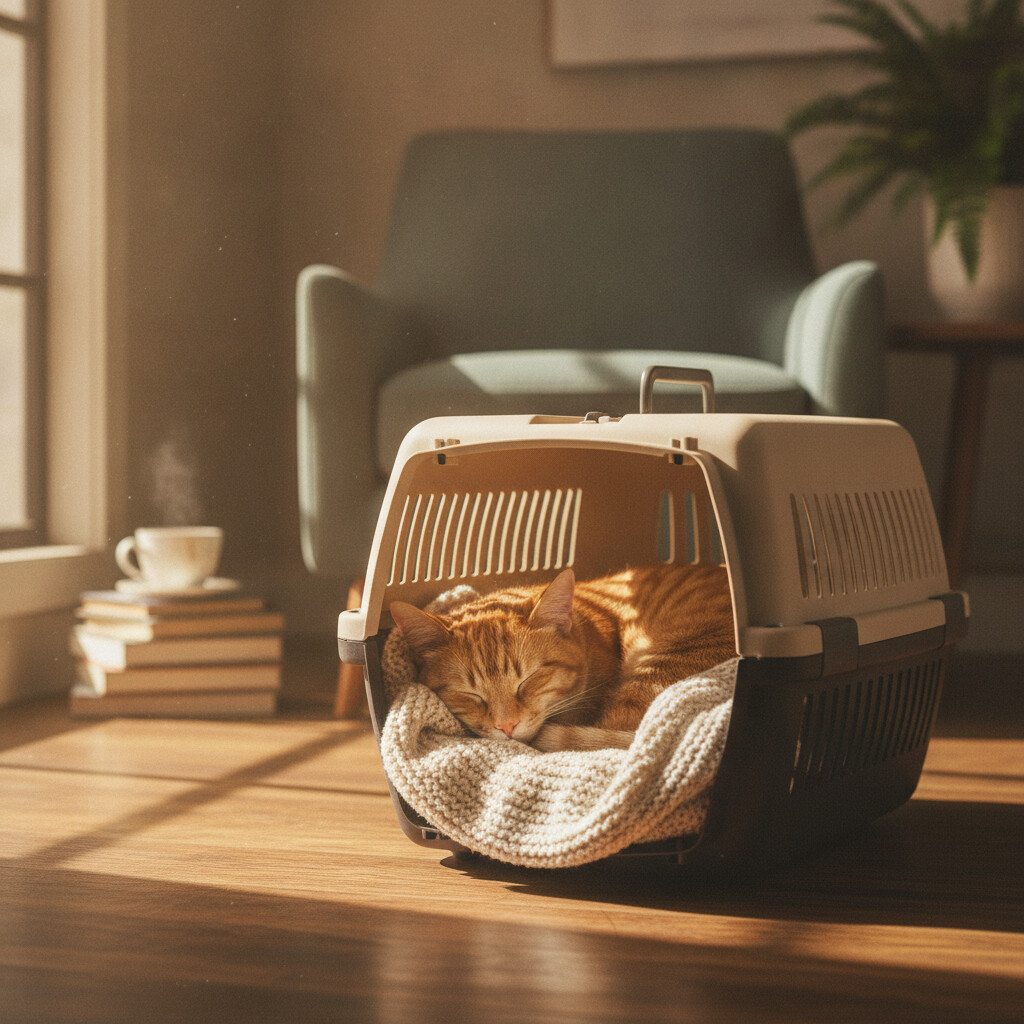
Most cats hate the carrier because they only ever see it right before something bad happens. Carrier training fixes that by turning the carrier into an ordinary piece of furniture, then a place where good things happen. With a few minutes a day, most cats will walk in on their own within two to six weeks.
Here’s the step-by-step method vets and feline behaviour specialists recommend, plus what to do with a cat who’s already decided the carrier is the enemy.
Why carrier training is worth the effort
The fight at the front door isn’t a small thing. In the Bayer Veterinary Care Usage Study (Volk and colleagues, Journal of the American Veterinary Medical Association, 2011), 58% of cat owners said their cat hates going to the vet, and 38% said they got stressed just thinking about the trip. Many owners admitted they put off visits for exactly this reason.
The AAFP and ISFM Cat Friendly Veterinary Interaction Guidelines (2022) recommend carrier training as one of the most useful things owners can do before a cat ever reaches the clinic. A cat who arrives calm is easier to examine, gives more accurate readings (stress raises heart rate, blood pressure and blood glucose), and recovers faster afterwards.
There’s research behind it, too. A study in Applied Animal Behaviour Science (Pratsch and colleagues, 2018) found that cats given carrier training showed less stress during the car journey and the veterinary exam than untrained cats. It’s one small study, but it matches what cat-friendly clinics see every day.
Choose a carrier that makes training easier
You don’t need an expensive carrier, but the design matters. Look for:
- A removable top. The AAFP guidelines favour carriers that open from the top and come apart in the middle, so a nervous cat can stay in the bottom half during the exam rather than being tipped out.
- A hard shell that won’t collapse when your cat moves.
- A size your cat can stand up and turn around in, without being so big they slide around in the car.
- A secure door and clips that you can open quietly.
Our guide to the best cat carriers for vet visits and travel compares the main types.
Step-by-step: how to carrier train your cat
Go at your cat’s pace. If they show signs of stress (flattened ears, crouching, a twitching tail, leaving the room), go back a step. Short sessions of two to five minutes, once or twice a day, work better than one long one.
Step 1: Make the carrier part of the furniture
Take the top and door off, put a soft blanket or a worn T-shirt inside, and leave the bottom half somewhere your cat already likes to spend time. Not a cold garage, and not next to the front door. Leave it there permanently. For some cats this step alone takes a week before they’ll even sniff it.
Step 2: Add good things
Drop a few treats or a little catnip in and around the carrier at random times, without fuss. Feed meals next to it, then gradually move the bowl inside. If your cat likes to play, drag a wand toy past and into it. You want them to stumble on nice surprises there.
Step 3: Put the top back on
Once your cat is happily going into the bottom half, reattach the top, still without the door. Keep the treats and meals going. Plenty of cats start napping in it at this stage, which is exactly what you want.
Step 4: Add the door, then close it briefly
Fit the door and leave it open for a few days. Then, while your cat is eating inside, gently close it for a second or two and open it again before they react. Slowly build to 10 seconds, 30 seconds, a minute, a few minutes. Always open the door while they’re still calm, not once they start scratching to get out.
Step 5: Lift and move
With your cat inside and the door shut, lift the carrier an inch or two off the floor, then put it down and reward. Build up to carrying it across the room, then around the house. Carry it with both arms against your body, like a box of eggs, rather than swinging it by the handle.
Step 6: Short car trips
Carry your cat to the car, sit for a minute with the engine off, then go back inside and reward. Next time, start the engine. Then drive around the block. If your cat drools, vomits or cries in the car, our article on carsick and anxious cats in the car covers what helps, including medication your vet can prescribe.
If your cat already knows a marker word or clicker, it speeds this all up a lot. See how to clicker train your cat for how to set one up, and you can use the same method to teach a “go to your carrier” cue.
What if your cat already hates the carrier?
Start the same way, but expect it to take longer, and consider these changes:
- Try a different carrier. If the old one has bad associations, a carrier your cat has never seen is a fresh start.
- Wash the old one. Carriers can hold the smell of fear, urine or the clinic. Wash it with an enzyme cleaner and let it air out before you start again.
- Synthetic pheromone sprays. Some owners and vets use a feline facial pheromone spray on the blanket 15–30 minutes before a trip. The evidence is mixed, so treat it as a possible extra, not a fix.
- Ask about pre-visit medication. For cats who panic, vets can prescribe a medication to give at home before the appointment. A study in JAVMA (van Haaften and colleagues, 2017) found a single dose of gabapentin before a vet visit reduced stress scores and made cats easier to handle. Never give your cat human medication without your vet’s advice.
One family shared how they turned years of vet-day battles around in The Cat Who Fought the Carrier, and their slow-and-boring approach is a good model.
On vet day
- Don’t bring the carrier out just before you leave. If it lives in the house, this problem mostly disappears.
- Cover it with a light towel in the car and waiting room so your cat can hide. Cats feel safer when they can’t see other animals.
- Keep the carrier off the floor in the waiting room, on a chair or your lap, and away from dogs.
- Bring a few high-value treats for the clinic and for the trip home.
- At home, leave the carrier open so your cat can come out in their own time. In multi-cat homes, the cat who stayed behind can react to the clinic smell; keep them apart for a little while if there’s hissing.
If you’re still looking for a clinic that handles cats gently, our guide on how to find a good vet for your cat includes what Cat Friendly Practice accreditation means.
When to talk to your vet
Carrier training is for routine trips. It should never delay care your cat needs now. Don’t wait to train if your cat:
- Is straining to pee or can’t pass urine
- Hasn’t eaten for 24 hours or more
- Is having trouble breathing
- Has been injured, poisoned, or has collapsed
In those cases, get them into the carrier however you can (a towel wrap and lowering them in from the top usually works best) and go.
It’s also worth a vet conversation if your cat’s fear is extreme, such as panting, urinating or defecating in the carrier, or becoming aggressive. That level of distress can be eased with medication, and the clinic may be able to schedule quieter appointment times.
What’s the one trick that finally got your cat into the carrier?