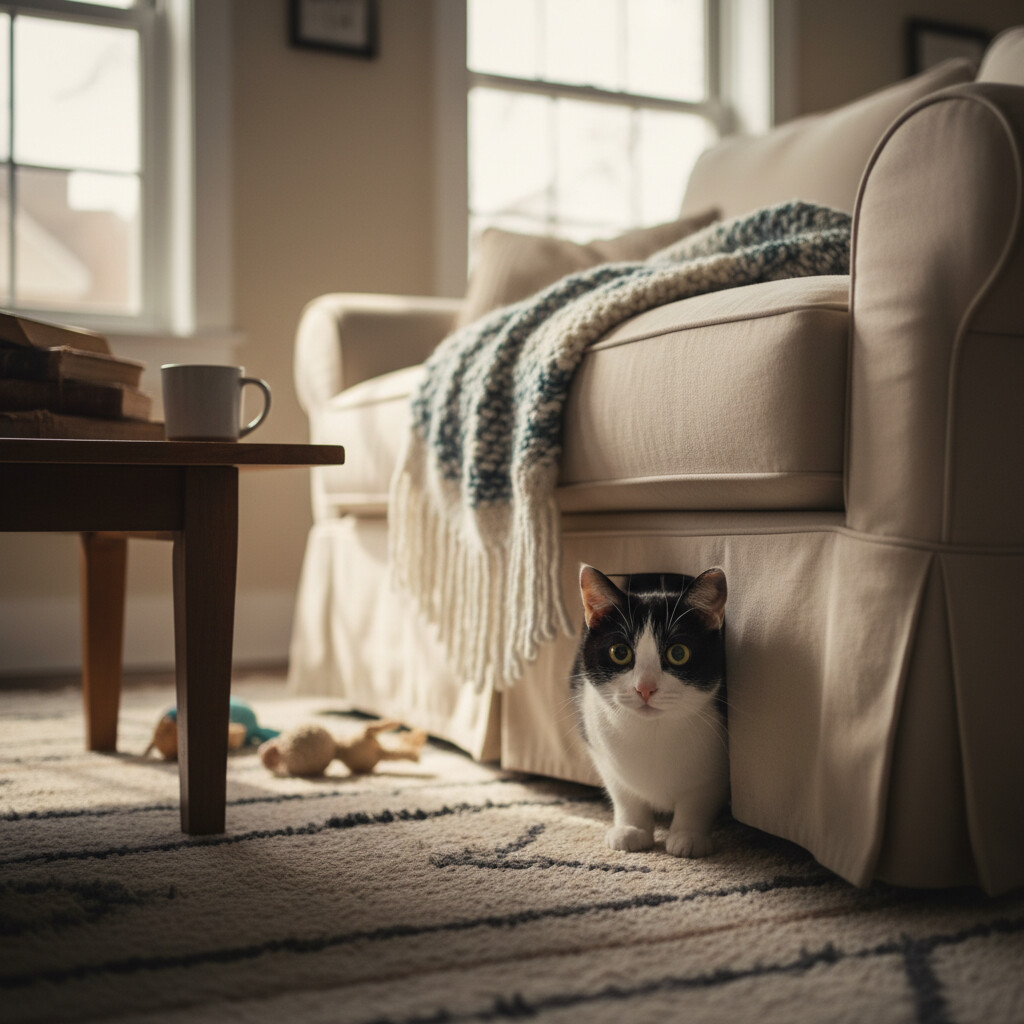
I adopted Magpie on a Wednesday in February, and by Friday I was Googling “how long does it take a rescue cat to adjust” at 2am, wondering if I’d made a terrible mistake.
She hadn’t eaten. She hadn’t moved from behind the washing machine in 48 hours. She hadn’t made a single sound.
This is the story of how I didn’t give up on her — and what it taught me about patience, cat psychology, and my own need for immediate results.
The Beginning: A Cat Who Wanted Nothing to Do With Me
Magpie came from a rescue that had pulled her from a hoarding situation. She was approximately 3 years old, had received basic veterinary care, and was described in her adoption profile as “shy but warming up.” That turned out to be a generous reading.
She spent the first four days entirely behind the washing machine, emerging only when I left the room. I knew she was eating because the food disappeared overnight. I knew she used the litter box — because, well, evidence. Beyond that, I had no cat.
The rescue had told me to give it time. An article I found on recognising 10 signs of cat stress helped me understand that what I was seeing — hiding, refusing human contact, eating only when unobserved — was normal fear behaviour, not pathology. But knowing that intellectually and sitting in a silent house with an invisible cat are very different experiences.
What Helped (And What I Had to Unlearn)
The first thing I had to unlearn was the impulse to accelerate trust. I kept wanting to crouch down, extend my hand, show her I was safe. Every time I did, she pressed herself further into the wall. From her perspective, a large predator was approaching. My gestures of reassurance were exactly what they looked like to her.
The shift that worked: I stopped trying. I started just being near her, without agenda.
I’d sit on the laundry room floor and read with my back turned to the washing machine. I put a worn t-shirt near her hiding spot so my scent became background noise rather than a threat signal. I moved the food dish a few centimetres toward the open room each day — slowly enough that she kept eating without noticing the progress.
By week three, she was eating while I was in the room, as long as I was at least six feet away and not making eye contact.
The First Real Moment
It happened at around five weeks, in the evening, while I was on the couch watching television. I heard the soft pad of feet, then nothing. I didn’t look. I kept my eyes on the screen.
Then there was a small weight on the couch cushion, six inches from my feet.
I held completely still for forty minutes. She left before I fell asleep. But she came back the next evening. And the evening after that.
That’s how it started: not with me reaching toward her, but with her choosing to be in the same room.
Three Months In: Who She Turned Out to Be
By month three, Magpie had opinions — strong ones. She wanted breakfast at exactly 7am and achieved this by sitting on my chest and staring at me. She had a particular interest in rustling plastic bags and would appear from nowhere when I opened a grocery delivery. She had learned that if she sat in the bathroom while I brushed my teeth, I would talk to her, and she seemed to find this arrangement satisfactory.
She was not a lap cat. She was a “same-room” cat, a “sleep-at-the-foot-of-the-bed” cat. She tolerated brief head scratches but would walk away after 30 seconds. That was her threshold, and she communicated it clearly. I learned to respect it.
She was, it turned out, exactly the cat I needed: independent enough not to require constant entertainment, affectionate in ways I had to learn to recognise.
What I’d Tell Someone Considering a Fearful Rescue
Be honest with yourself about your patience. If you need a responsive, affectionate cat from week one, a fearful rescue may not be the right match — not because there’s anything wrong with the cat, but because the mismatch is hard on both of you.
If you can genuinely sit with uncertainty for two to four months, understanding that you’re building something the cat will fully own once it’s built — then a fearful rescue is worth every difficult week.
The breakthrough, when it comes, is unlike anything you get with a confident, immediately trusting cat. It means more because you both worked for it.
For anyone going through an even more challenging version of this — working with a cat that came from a truly feral background — the From Feral to Family story covers that harder journey in detail.
Magpie is asleep on my desk as I write this. She is technically in my way. I am not moving her.