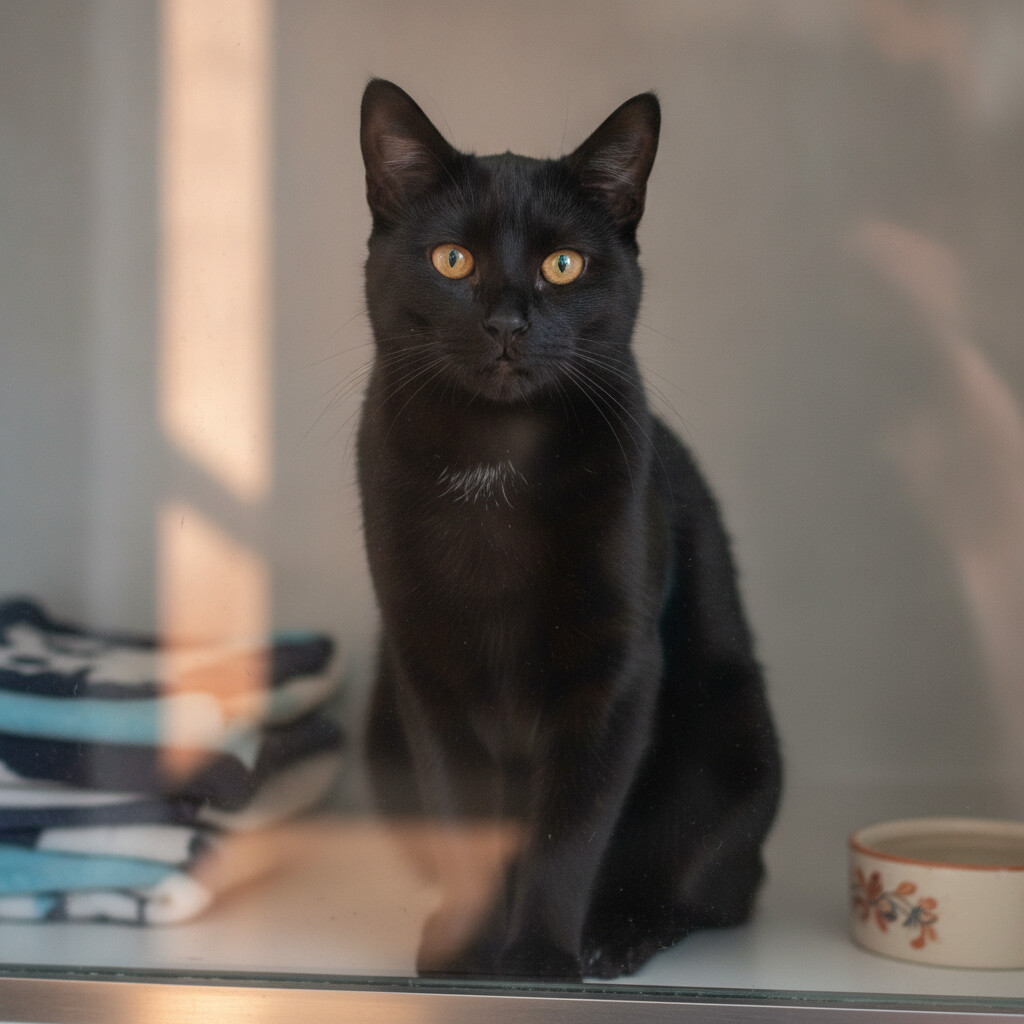
She’d been at the shelter longer than any other cat on the adult floor — eight months, through two adoption events and a holiday push that cleared out almost every other kennel. Volunteers knew her by name. Visitors walked past her every week. Nobody took her home. The only thing unusual about her was her color.
The Cat Nobody Photographed Well
Her name was Olive, a shorthair with a coat so black she barely showed up in shelter photos taken under fluorescent lights — just two amber eyes and a vague shape in a listing full of tabbies and calicos with more visual pop. Shelter staff will tell you this isn’t a coincidence. Black cats are consistently reported to have longer average shelter stays than cats of other colors, and animal welfare organizations including Best Friends Animal Society have written about the pattern for years, pointing to a mix of factors: they photograph less distinctly, some lingering superstition still follows them, and a subset of adopters — often without realizing it — simply scroll past.
None of that showed up in person. Olive was, according to every volunteer who spent time with her, one of the easiest cats in the building — she chirped at the sound of the food cart, flopped over for belly rubs from strangers, and greeted every visitor at the front of her kennel. It didn’t matter. Adopters kept choosing someone else.
Eight Months, One Decision
We weren’t looking for a black cat specifically. We weren’t looking for an “unadoptable” cat, or trying to make a statement. We went in wanting a calm adult cat who wouldn’t mind an apartment with no yard, and a volunteer suggested Olive because she matched the description on paper. It was only once we sat down in the meet-and-greet room that the eight-months detail came up, almost as an aside.
That’s the part that stuck with us on the drive home. Nothing about her temperament explained it. If we’d walked past her in a wall of kennels, we probably would have too, without meaning anything by it — which is exactly the mechanism the shelter behaviorists describe. It’s not usually one dramatic bias; it’s a hundred small unconscious scrolls past a cat who doesn’t jump out of a photo.
If you’re considering a shelter cat and want a practical rundown of the process, we’ve written a step-by-step adoption guide that covers what shelters actually check for and what to ask before you commit.
The First Few Weeks Were Not Instant
We want to be honest about this part, because “shelter cat comes home and immediately curls up on the couch” isn’t the realistic version. Olive spent her first four days almost entirely under the bed. She ate at night, used the litter box when we were asleep, and didn’t come out for visitors at all — a complete reversal of the social cat we’d met at the shelter.
This is normal, not a sign we’d made a mistake. Cats generally need real time to decompress after a shelter stay and a move, often broken into rough phases: a few days of hiding while they assess the new environment for threats, followed by a few weeks of cautious exploration, before anything like their real personality shows up consistently. Our guide on helping a rescue cat settle in goes through what that timeline usually looks like and how to avoid rushing it.
We stopped trying to coax her out and started just existing quietly in the same room — reading on the floor near the bed, letting her decide when curiosity beat caution. By day six she was sniffing our hands. By day twelve she was sleeping on the bed instead of under it.
What Changed
Two months in, the shelter cat who “photographed poorly” was doing what she’d apparently always done in person: greeting us at the door, chirping instead of meowing, following us room to room. The only thing that had ever been wrong with Olive was a picture that didn’t do her justice and a wait that had nothing to do with her.
We’re not going to pretend one cat’s story fixes an industry-wide adoption pattern. But if there’s a practical takeaway, it’s a small one: if you’re scrolling a shelter’s adoption photos, it’s worth clicking into the black cats’ profiles specifically, or better, going in and meeting a few cats in person rather than filtering by photo alone. The ones with the least flattering pictures are sometimes the easiest cats in the building, and the eight-month wait was never about anything they did.
Why This Is Worth Knowing Before You Adopt
If you’re cat-shopping right now, a few practical notes worth carrying in:
- Photos undersell black cats. Ask the shelter if you can meet cats in person rather than ruling anyone out from a listing photo.
- Superstition is still quietly in the mix. Some shelters report seasonal dips in black cat adoptions or extra caution around them near Halloween — a pattern with no basis in anything about the cats themselves.
- A long shelter stay says nothing about temperament. Ask staff directly which cats have been there longest and why — sometimes it really is a medical or behavioral reason, but often, as with Olive, it isn’t.
Eight months is a long time for any animal to wait in a kennel for reasons that have nothing to do with who they are. Ours spent it being exactly as good a cat as she is now — just unphotographed.