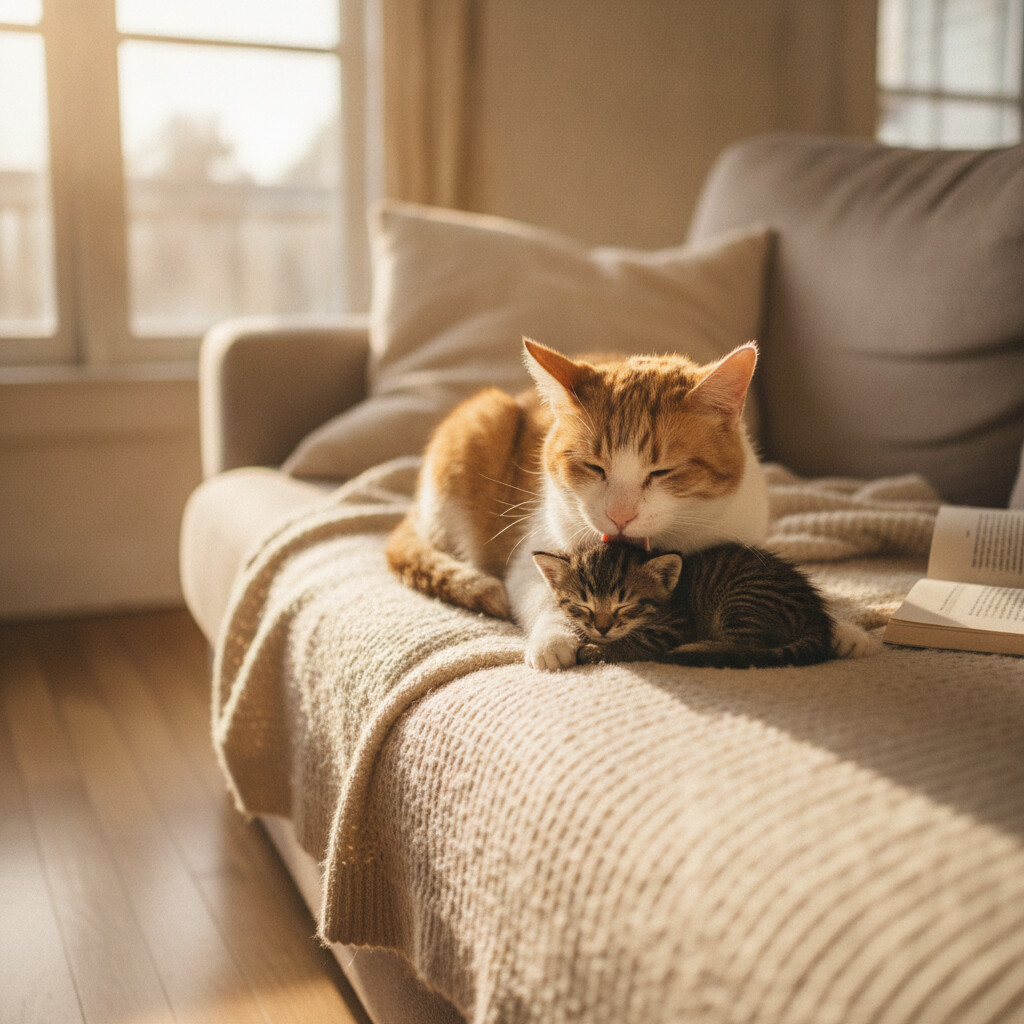
My 14-year-old cat Winnie has never liked anyone. Not me, most days — she tolerates me. So when a foster coordinator called asking if I could take a four-week-old orphaned kitten for a few weeks, my honest first thought wasn’t “how exciting,” it was “Winnie is going to hate this.” She didn’t. Six weeks later, that kitten wouldn’t sleep anywhere except curled against Winnie’s stomach, and Winnie had started grooming her like she’d always been there. Here’s what actually happened in between.
The Kitten Nobody Expected
The kitten — we ended up calling her Pepper — had been found alone in a parking garage, too young to be away from her mother, dehydrated and underweight. The rescue group needed an emergency foster who already had cat-proofed space and, ideally, an adult cat who could model normal feline behavior once Pepper was old enough to socialize. I had the space. I did not have an adult cat with any track record of tolerating other animals.
Winnie came to me as an adult rescue eight years ago with a reputation, confirmed almost immediately: she’d hiss at the vacuum, the mail carrier, and on one memorable occasion, her own reflection in a new mirror. Cats do not need to be socially warm to be good cats. But it meant I went into this expecting a strict, permanent boundary between them — kitten in one room, Winnie ruling the rest of the house, indefinitely.
Why I Thought My Senior Cat Would Never Accept Her
For the first two weeks, that boundary held exactly as planned. Pepper was still bottle-and-syringe feeding on a schedule my vet had mapped out — orphaned kittens under four weeks need feeding roughly every 2–3 hours, and getting the formula and temperature right matters more than people expect, so I wasn’t taking chances on introductions until she was steadier and eating on her own. Winnie sat outside the closed door sometimes, ears back, clearly aware something was in there. I read that as territorial irritation. In hindsight, I think it was closer to curiosity she didn’t know how to name.
Once Pepper was eating solid food and past the most fragile stage, I started the introduction slowly — scent swapping first (a blanket from each of them in the other’s space for a few days), then short supervised visits through a cracked door, then a baby gate instead of a closed one. This is the same gradual approach that works for introducing any two cats, not just a kitten and a senior — I’ve written before about how to do that step-by-step, and it held true here even with a 14-year age gap between them.
The Slow Introduction (What Actually Worked)
Winnie’s first real reaction to seeing Pepper move around freely was a long, unimpressed stare and a slow retreat to the top of the cat tree — not aggression, just distance. That distance is normal and, honestly, a good sign. The bad sign to watch for is sustained growling, swatting with claws out, or a cat that won’t eat or use the litter box because of the stress. None of that happened. What happened instead was Winnie watching Pepper from a height for about ten days, occasionally coming down to sniff a spot Pepper had just walked through, and steadily shortening the distance she was willing to tolerate.
The turning point wasn’t dramatic. Pepper, fearless in the way only very young kittens are, walked straight up to Winnie’s food bowl mid-meal. I braced for a hiss. Winnie just… shifted over. Not an invitation, exactly. Just no longer a refusal.
The Moment Everything Changed
About three weeks in, I found them both asleep on the same section of the couch — not touching, but closer than Winnie had voluntarily been to anything with a heartbeat since I’d known her. Within a few more days, Pepper had decided Winnie’s stomach was the correct sleeping location, full stop, and Winnie let her. Then Winnie started grooming her — quick, businesslike licks to the top of Pepper’s head, the kind of thing a mother cat does on autopilot. Nobody taught her that. I don’t think you can.
I want to be careful not to oversell this as some universal formula — not every senior cat will bond with a foster kitten, and plenty of perfectly healthy relationships between cats stay at “peaceful coexistence” rather than affection, which is a completely fine outcome too. What I can say is that giving it real time, reading Winnie’s body language instead of rushing the calendar, and never forcing proximity, is what let something happen instead of forcing something that wasn’t there.
What I’d Tell Anyone Trying This
If you’re fostering a kitten with a resident senior cat, or just adding a kitten to a household with an older cat who’s set in their ways, the biggest lever you have is patience measured in weeks, not days. Watch for real stress signals rather than assuming any hiss means failure — hissing is often just a cat saying “I need space,” not “this is never going to work.” And if you’re taking in a very young orphaned kitten specifically, get your vet involved early on feeding schedule and weight checks; underweight or lethargic kittens need medical attention fast, and that’s not something to guess your way through. A week-by-week guide to what kittens need at each stage is worth reading before day one, not after a problem shows up.
Pepper got adopted by a wonderful family two towns over, and I cried more than I expected to. Winnie, for her part, went back to mostly tolerating me. But for about six weeks, my most antisocial cat ran a small, reluctant, entirely voluntary daycare — and I got to watch it happen.