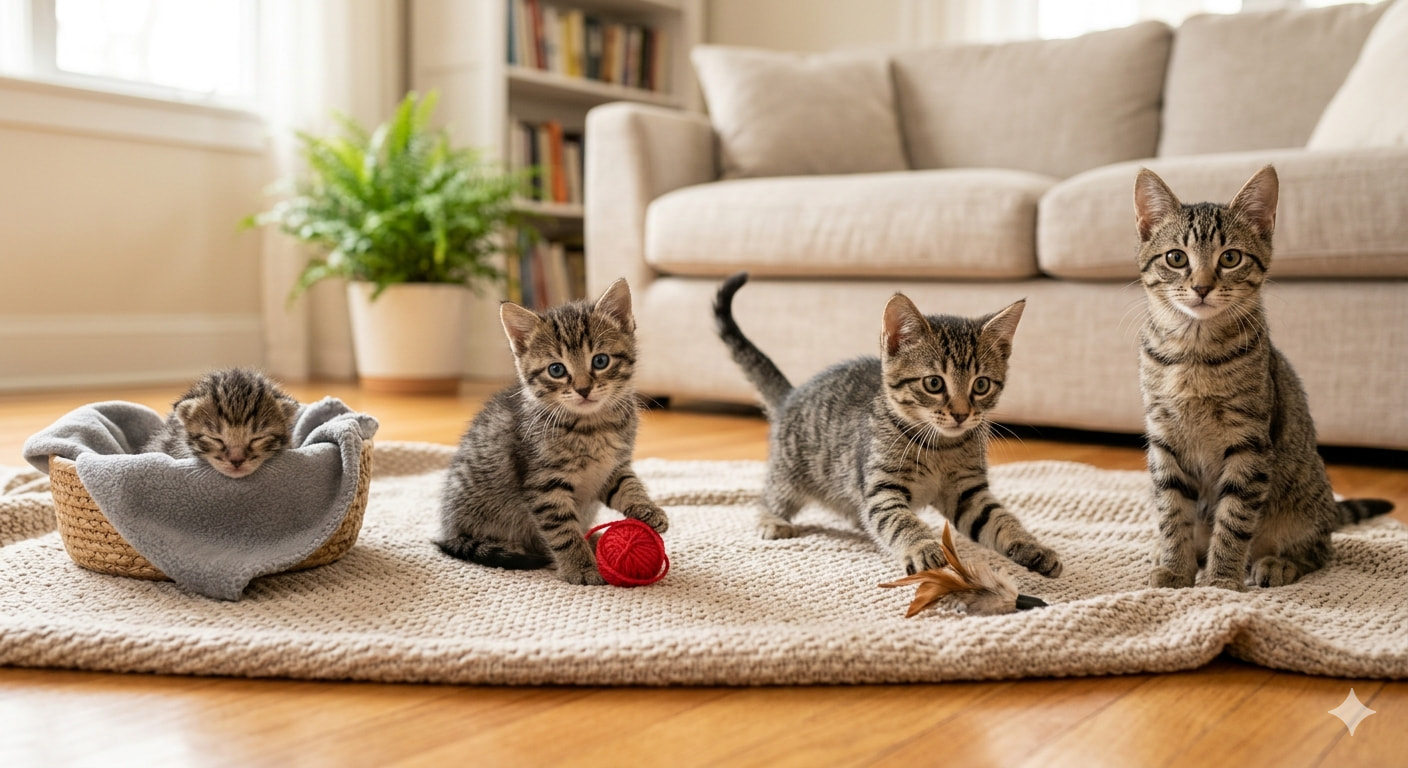
Kittens grow faster than almost any other domestic animal. In their first 12 weeks, they go from blind, deaf, and completely helpless to a fully socialised cat who can eat solid food, use a litter box, and form lasting bonds with humans. What happens during these weeks shapes their behaviour for life — which means what you do (or don’t do) during this window matters enormously.
This guide covers what to expect at each stage, what the kitten needs from you, and when something’s worth a vet call.
The First Two Weeks: Keeping Them Alive
Neonatal kittens (birth to two weeks) can’t regulate their own body temperature, can’t urinate or defecate without stimulation, and can’t see or hear. They’re entirely dependent on their mother — or, in orphaned cases, on you.
What’s happening developmentally:
- Eyes and ear canals sealed shut
- Spend about 90% of their time sleeping
- Double their birth weight in the first week (healthy birth weight is typically 3.5–4 oz / 100–115g)
If you’re raising orphaned kittens:
Use a commercial kitten milk replacer (KMR) — never cow’s milk or adult cat milk, which causes diarrhoea. Feed every 2 hours around the clock for the first two weeks. After each feeding, gently stimulate the genital area with a warm, damp cloth to trigger urination and defecation; the mother would do this by grooming.
Keep ambient temperature at 85–90°F (29–32°C) for the first week, gradually reducing to 80°F by week four. Hypothermia is the leading cause of death in neonatal kittens.
With a nursing mother: Your job is mostly surveillance. Weigh each kitten daily using a kitchen scale. A kitten who isn’t gaining weight — or loses weight two days running — needs vet attention, fast.
Weeks 3–4: The World Switches On
Around day 10–14, eyes open (though vision remains blurry for another week or two). Ear canals open around day 17. This is when kittens begin to orient toward sound and light.
By week 3, kittens start attempting their first wobbly walks. By week 4, they’re genuinely mobile and increasingly curious about the world outside the nest.
Key milestones:
- Week 3: Eyes and ears open; early attempts at walking
- Week 4: Play behaviour begins; first teeth erupt; can start transitioning to shallow litter box
Weaning starts around week 4. Offer a shallow dish of kitten-specific wet food mixed with a little warm water to create a gruel. Most kittens take to it quickly — the nursing mother will naturally reduce milk availability as solid food becomes more appealing.
Weeks 5–8: The Socialization Window
This is the most important developmental window in a cat’s life. Research published in Applied Animal Behaviour Science has consistently shown that kittens exposed to gentle handling by multiple people between weeks 2–7 are significantly more sociable, confident, and less fearful as adults.
Put simply: handle kittens gently every day during this period. Expose them to different humans (including children, if the household has them), different sounds, and different textures. Kittens who aren’t handled during this window often grow into cats who are fearful of strangers or resistant to touch.
What’s happening:
- Week 5–6: Running, jumping, play fighting with littermates; fully weaned or nearly so
- Week 7–8: Predatory play behaviour intensifies; kittens are learning from each other what’s “too rough”
Littermates matter here. Kittens raised with siblings learn bite inhibition and appropriate play intensity. Single kittens, or those separated too early, often have more play aggression problems as adults. The AAFP advises against separating kittens from their mother and littermates before 8 weeks — 12 weeks is even better for social development.
Vaccinations begin around week 6–8, depending on your vet’s protocol. The first FVRCP (distemper combination) vaccine is typically given at 6–8 weeks, with boosters every 3–4 weeks until 16 weeks.
Weeks 9–12: Learning to Be a Cat
By week 9, kittens look like miniature versions of adult cats. They’re fully weaned, eating solid food independently, and using the litter box reliably. The socialization window is narrowing — this is the last stretch to make positive associations with handling, travel, vet visits, and anything else you want them to accept as normal.
Practical focus for this phase:
- Continue daily handling; introduce nail trimming in short sessions
- Begin very brief carrier acclimation (leave carrier out with comfortable bedding; feed treats inside)
- Introduce play sessions with wand toys; this is critical for developing hunting behaviour in a safe channel
- Schedule a full vet check if you haven’t already — parasite screen, first vaccines, and weight check
The 12-week mark matters because this is the standard minimum adoption age in most reputable shelters and breeders. Kittens adopted before 12 weeks miss key socialization from littermates and show higher rates of problem behaviour, aggression, and anxiety as adults. If you’re rehoming kittens, hold them until 12 weeks minimum.
Introducing Kittens to Other Cats
A new kitten shouldn’t just be dropped into a household with existing cats. The introduction needs to be managed the same way any cat-to-cat introduction does — gradual scent exchange, controlled visual exposure, supervised free time. Our guide on how to introduce two cats for the first time walks through the full protocol.
One important note: kittens are often more vulnerable than adult cats during introduction because they lack the size and confidence to disengage from conflict. Keep the kitten’s space accessible only to them until you’re confident the resident cat’s response is calm curiosity, not predatory or defensive aggression.
When to Call a Vet
Kittens can decline fast. These signs warrant same-day or emergency vet contact:
- Not feeding / refusing food for more than 4 hours in a neonate; more than 12–18 hours in a weaned kitten
- Persistent diarrhoea or vomiting — causes dehydration quickly at this size
- Weight loss over any 48-hour period
- Gasping, laboured breathing, or blue/grey gums — emergency
- Eyes sealed shut past day 16, or discharge before eyes fully open (can indicate infection that needs prompt treatment)
- Crying continuously despite feeding and warmth — pain signal
- Pale or cold body despite warm environment — hypothermia or fading kitten syndrome
Fading kitten syndrome — where a kitten declines rapidly in the first week or two without obvious cause — has a high mortality rate even with intervention. Catching it early is the only lever available.
Before the kittens arrive home, identifying a vet with experience in neonatal and paediatric feline care is worth doing in advance. Our piece on how to kitten-proof your home covers environmental preparation that runs in parallel with this developmental work.
The Takeaway
The first 12 weeks set the trajectory. Kittens handled gently by multiple humans during the socialization window become more adaptable, confident adult cats. Kittens who gain weight steadily, eat well, and have minimal early illness do better long-term. The interventions aren’t complicated — consistent daily engagement, close monitoring of weight and feeding, and a vet relationship established early.
Most of what goes wrong in kitten development is either caught by daily weighing or solved by slowing down introductions. Those two things alone cover a lot of ground.