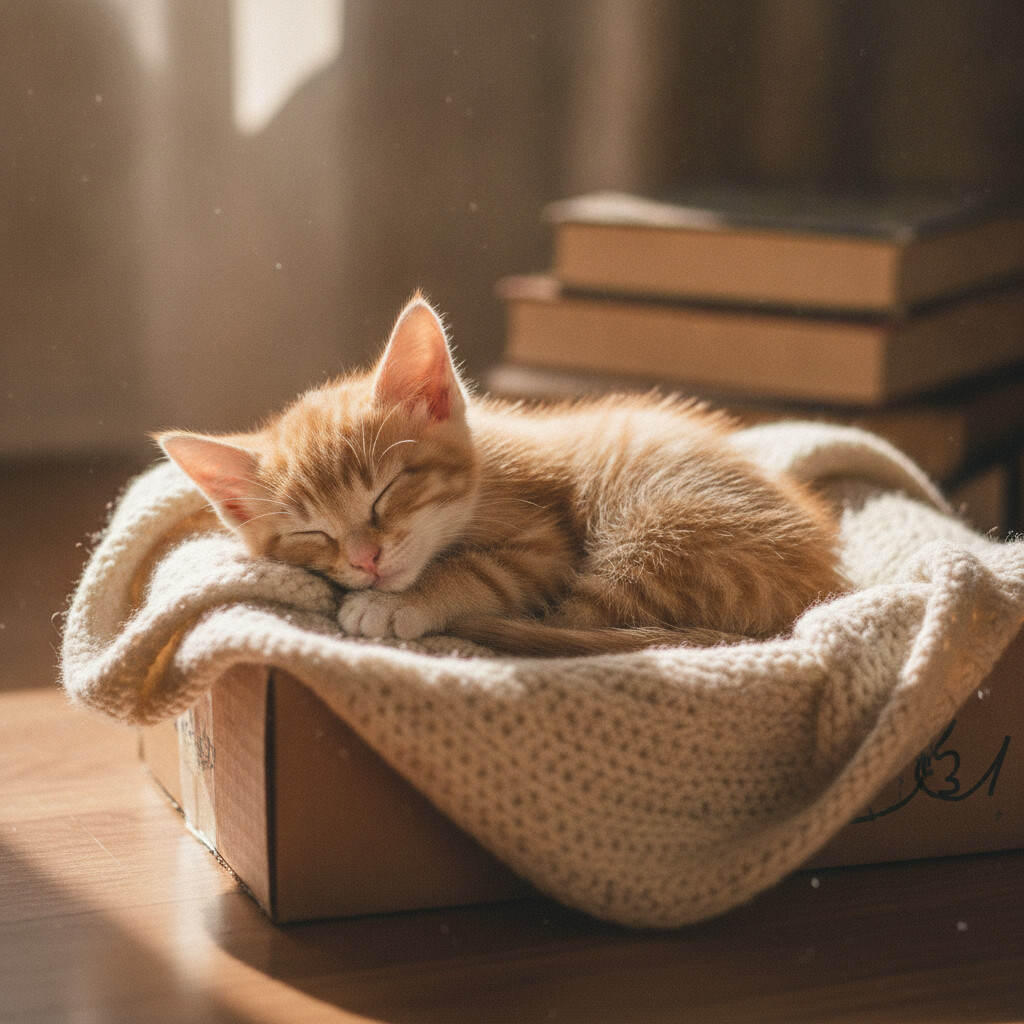
Kittens sleep a lot, and almost always more than new owners expect. A newborn kitten spends most of the day asleep, and even a lively three-month-old can easily sleep for well over half the day, in short bursts between frantic play. If your kitten wakes easily, eats well and plays hard when awake, all that sleep is normal.
Here’s what’s typical at each age, why kittens need so much sleep, and the signs that mean sleepiness is something else.
How much do kittens sleep at each age?
There’s no precise number that applies to every kitten, and you’ll see a wide range of figures online. What veterinary sources consistently agree on is the overall pattern: sleep is highest at birth and gradually settles toward adult levels over the first year. As a rough guide:
- Birth to 2 weeks: Newborns do very little except sleep and nurse. Their eyes and ears are still closed, and they can’t control their own body temperature, so they spend their time piled up with their mother and littermates. Expect them to be asleep for the large majority of the day.
- 2 to 4 weeks: Eyes and ears open, and kittens start wobbling around. They’re awake a bit more, but sleep still takes up most of the day.
- 4 to 12 weeks: Play arrives in earnest. Kittens burn huge amounts of energy in short, intense bursts, then crash, often mid-game, sometimes mid-meal. Long sleeps are still normal at this stage, broken up by bursts of play.
- 3 to 12 months: Sleep gradually settles toward adult levels. Adult cats are commonly described by vets as sleeping somewhere around 12 to 16 hours a day, and adolescent kittens are often at the upper end of that or above it.
If you’re not sure how old your kitten is, our guide to estimating a kitten’s age will help you work out which stage you’re in. For more on what changes week by week, see raising kittens from birth to 12 weeks.
Why do kittens sleep so much?
The honest answer is that researchers don’t fully understand why any animal needs sleep, but kittens have a few obvious reasons to need a lot of it.
They’re growing fast. A kitten can multiply its birth weight many times over in its first few months. In mammals generally, deep sleep is closely linked to the release of growth hormone, and it’s reasonable to think kittens are no exception, though most of that research has been done in other species.
Their brains are developing. Cats have been central to sleep research for decades. The French neuroscientist Michel Jouvet’s work on cats in the 1950s and 60s helped define REM (“paradoxical”) sleep. Studies on how sleep develops in young animals, including work by Jouvet-Mounier and colleagues (Developmental Psychobiology, 1970), found that newborn kittens spend a much larger share of their sleep in this active, REM-like state than adults do, and that the share falls over the first month. Many scientists believe that this early active sleep plays a role in brain development.
They play hard. Kitten play is intense. Pouncing, wrestling and chasing are how kittens build coordination and practise hunting skills, and that sprint-and-crash pattern means they need long recovery naps.
Is it normal for kittens to twitch in their sleep?
Yes. Twitching paws, flicking whiskers, little squeaks and fluttering eyes are all typical, especially in very young kittens. That’s the active, REM-like sleep described above. It looks dramatic, but it’s normal.
What isn’t normal is rhythmic jerking of the whole body that continues when you gently try to wake the kitten, stiffness, or a kitten who seems confused or unresponsive afterwards. Those can be signs of a seizure and need a vet promptly.
Why is my kitten awake all night?
Cats are naturally most active around dawn and dusk, and a kitten with plenty of energy often decides that 3am is the perfect time to attack your feet. A few things genuinely help:
- Play hard in the evening. A proper 10 to 15 minute session with a wand toy before bed, ending with a “catch”, uses up that energy.
- Feed after play. A small meal after the play session completes the natural hunt-eat-groom-sleep sequence, and many kittens settle afterwards.
- Keep the days interesting. A kitten that sleeps all day out of boredom has more energy at night.
- Don’t reward the 3am wake-up. If getting up and feeding them works, they’ll keep doing it.
Our article on night zoomies goes deeper into why cats go wild at night and how to cope.
Where should a kitten sleep?
Kittens sleep best somewhere warm, quiet and enclosed. A covered bed or a cardboard box with a soft blanket in a draught-free corner works well. Very young kittens (under about four weeks) can’t regulate their own temperature, so if you’re caring for one without its mother, warmth is essential, and your vet should guide you on how to provide it safely.
If you’ve just brought a kitten home, keeping them in one quiet room at first makes sleep easier. Our guide to your first night with a new cat covers setting that space up.
When to see a vet
Plenty of sleep is normal. Sleep that comes with other changes is not. Call your vet if your kitten:
- is hard to wake, or seems floppy, weak or “flat” when awake
- stops eating or nursing, or isn’t gaining weight
- doesn’t want to play at all, even when awake and alert
- has vomiting, diarrhoea, sneezing, discharge from the eyes or nose, or breathing that seems fast or laboured
- feels cold to the touch, or has pale gums
- sleeps apart from littermates and seems weaker than them
Young kittens can go downhill fast. The Merck Veterinary Manual describes “fading kitten syndrome”, where kittens that seemed normal at birth stop thriving and decline, sometimes over hours. If a very young kitten seems weak, cold or isn’t feeding, treat it as urgent and call a vet the same day.
The short version
A kitten who sleeps most of the day, wakes up easily, eats well and plays hard is a kitten doing exactly what they should. Watch for sleepiness that comes with other changes, and enjoy the naps while they last. They’ll be running laps at 3am soon enough.
Where’s your kitten’s favourite place to crash after a play session?