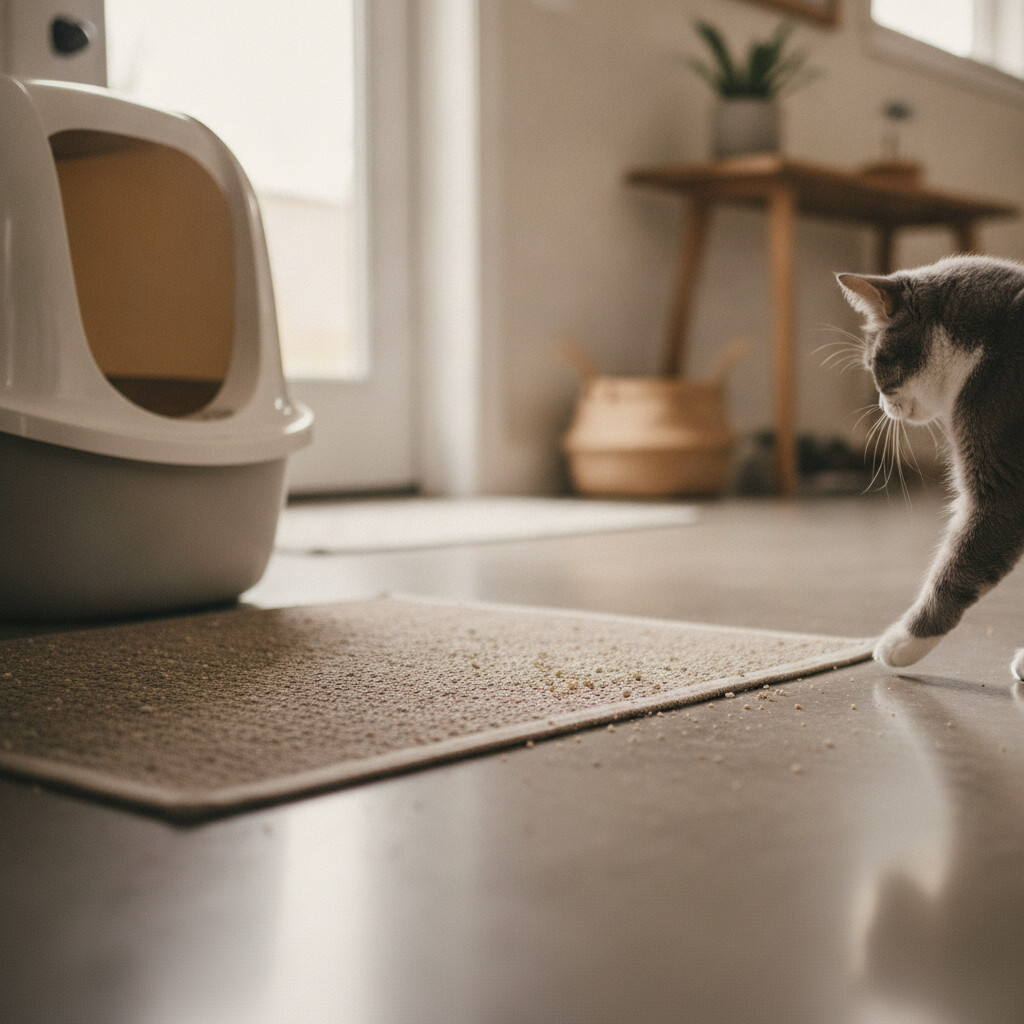
Short answer: a good litter mat won’t eliminate tracking, but the right kind can cut it dramatically — and the wrong kind is basically a doormat that does nothing. The difference comes down to material and depth, not price or branding.
What a Litter Mat Is Actually Trying to Do
Litter tracks because it clings to a cat’s paws and fur after they dig, and it falls off in stages — some right at the box, more a few steps later, and a little bit essentially everywhere your cat walks for the next hour. A litter mat’s whole job is to catch that litter in the first few steps, before it makes it onto your floors, into your socks, and eventually into the rest of the house.
That means the mat’s design matters far more than its price tag. A flat mat with a smooth surface does almost nothing — litter granules just slide across it like they would across bare floor. The mats that actually work rely on one of two mechanisms: a textured or looped surface that grabs litter out of paw fur through mechanical friction, or a honeycomb/waffle structure with holes that let litter fall through the top layer so it can’t be tracked further, trapping it in a lower chamber.
The Two Designs That Actually Work
Honeycomb or waffle-style mats are the most effective at containment. Litter falls through holes in the top surface into a catch layer below, and stays there until you shake the mat out. Because the litter physically drops out of paw contact, cats can’t re-track it on their next few steps. The tradeoff: these mats are usually made of a single rigid or semi-rigid piece of plastic or silicone, which some owners find less comfortable for a cat to stand on, and the holes need to be small enough to trap standard clumping litter but large enough not to clog with finer crystal or tofu litters.
Looped or textured fabric mats work through friction — the loops pull litter granules out of a cat’s paw fur as they walk across. These are gentler underfoot and often more attractive as home decor, but they only work as well as their pile depth and density allow. A thin, low-pile mat barely outperforms bare floor. A dense, deep-pile mat can trap a genuinely useful amount of litter, but it needs regular shaking out or vacuuming, since it will hold onto litter until you remove it.
Elevated double-layer mats — a mesh or grid top layer over a solid catch tray — behave similarly to honeycomb designs and tend to perform well for the same reason: litter drops away from paw contact instead of sitting on a surface a cat keeps stepping on.
What Doesn’t Work (Even If It’s Marketed As a Litter Mat)
Flat carpet-style mats with short, dense pile look effective in product photos but underperform in practice — litter sits on top of the pile rather than sinking into it, so the next step re-tracks it. Thin rubber-backed doormats marketed for “pet messes” are usually built for dirt and mud, not fine granular litter, and don’t have the pile depth or hole structure to catch it.
Size matters more than most owners expect, too. A mat that only covers the immediate exit of the box catches the first stride, but cats often carry litter several steps further before it fully sheds. A mat that extends at least 3–4 feet from the box entrance, or wraps around it if space allows, catches meaningfully more than a mat sized to just the box’s footprint.
Litter Type Changes the Equation
The litter itself is often a bigger tracking factor than the mat underneath it. Fine-grain clumping litters, silica crystal litters, and lightweight litters track more because smaller, lighter particles cling to paw fur more easily and travel further before falling off. Larger-pellet litters — some paper, wood, and corn-based formulas — track less simply because the granules are too big and heavy to hitch a ride as easily. If tracking is a serious problem in your home, switching litter type can matter as much as any mat, and it’s worth testing before assuming you need a better mat. Our comparison of litter types breaks down tracking behavior alongside odor control and clumping performance for each major type.
Self-cleaning and automatic litter boxes don’t inherently reduce tracking either — tracking happens on the way out of the box, not during cleaning, so it’s an independent problem regardless of what box you use. If you’re weighing automatic options, our guide to automatic litter boxes covers what they solve and what they don’t.
Getting the Most Out of Any Mat
A few habits make a bigger difference than mat choice alone:
- Shake it out daily, not weekly. A mat that’s already full of trapped litter can’t catch more — it just sits on the surface and gets tracked again.
- Place it on both sides if your setup allows. A cat sometimes steps out, pauses, and steps back in briefly before leaving for good. A mat only on one side misses that.
- Vacuum rather than sweep for fabric mats — sweeping tends to push fine litter deeper into the pile instead of removing it.
- Match the mat’s hole size to your litter. A honeycomb mat built for standard clumping clay litter may not trap fine crystal litter at all; check the manufacturer’s stated compatibility before assuming any honeycomb mat works with any litter.
The Takeaway
No litter mat will get you to zero tracking — some amount is physically inevitable any time a cat digs in loose granular material and then walks away from it. But a honeycomb or deep-pile mat, sized generously and shaken out daily, can trap a large share of what would otherwise end up on your floor. If you’re still fighting tracking after switching mats, look at your litter type next — it’s often doing more of the damage than the mat you’re blaming.