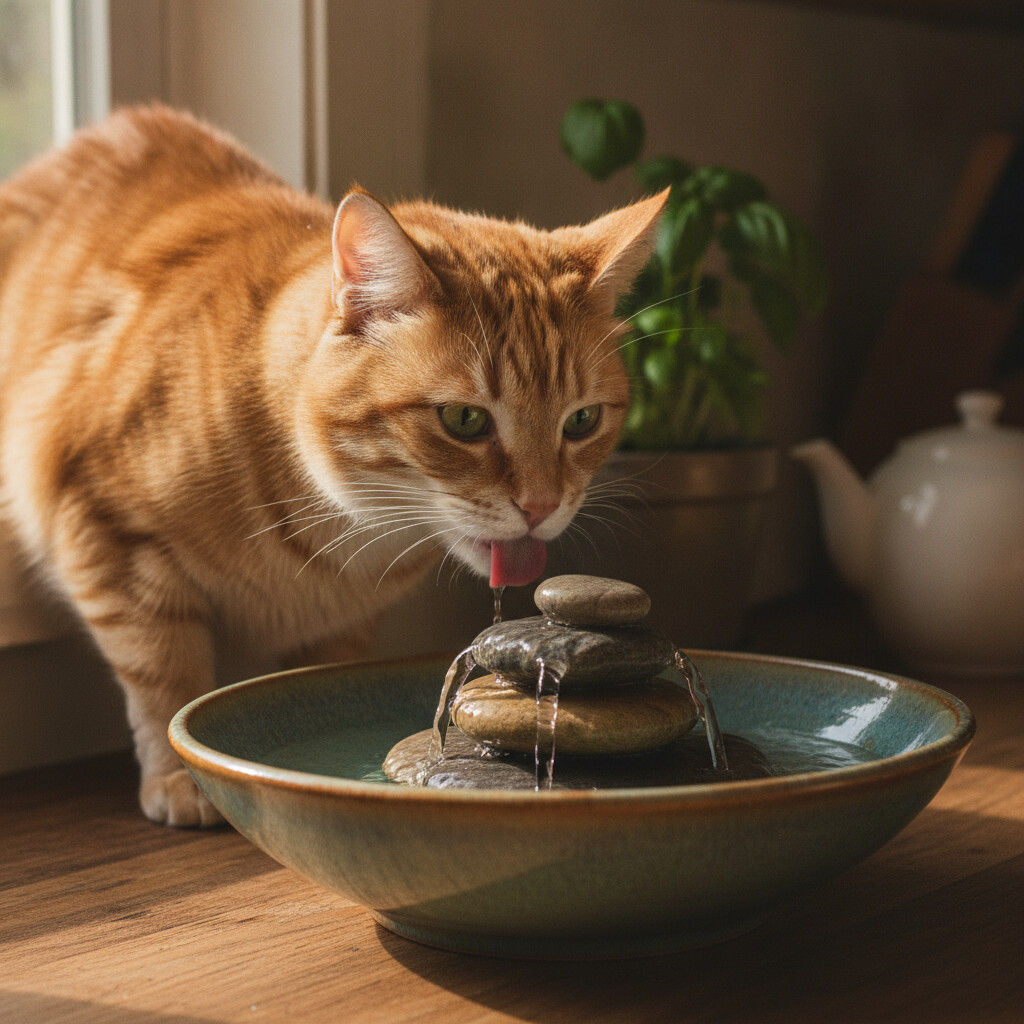
Most cats don’t drink enough water, and a lot of them will ignore a full bowl sitting two feet away while begging for water straight from a dripping tap. That’s not pickiness for its own sake — cats are genuinely more inclined to drink moving water than still water, and a DIY fountain is one of the cheapest, most reliable ways to get a reluctant drinker to take in more fluid. Here’s how to build one properly, and how to tell if it’s actually working.
Why Cats Are Drawn to Moving Water
The leading explanation, and the one most veterinary behaviorists point to, traces back to where the domestic cat came from. Felis lybica, the North African wildcat that all house cats descend from, evolved in arid regions where still water was more likely to be stagnant, contaminated, or guarded by a predator. Moving water — a stream, a spring — was a better bet. That instinct didn’t disappear just because cats moved indoors a few thousand years later.
There’s a second, more mundane factor: whisker fatigue. Cats’ whiskers are packed with nerve endings, and a narrow, deep bowl forces those whiskers to brush against the sides with every sip. Some cats tolerate this fine. Others visibly avoid it, pawing water out of the bowl to drink off the floor instead, or refusing to drink from anything but a wide, shallow surface. This idea hasn’t been rigorously tested in controlled studies, but it’s widely reported by feline behaviorists and lines up with what a lot of owners already notice.
Either way, the practical upshot is the same: cats are often under-hydrated not because they don’t need water, but because the way it’s presented doesn’t suit them. The 2013 AAFP and ISFM Feline Environmental Needs Guidelines, published in the Journal of Feline Medicine and Surgery, specifically recommend offering water in multiple locations, in wide vessels, away from food and litter — and note that some cats show a strong preference for moving or freshly changed water. A fountain checks several of those boxes at once.
How to Build a Simple DIY Cat Fountain
You don’t need to buy a $60 plastic unit to test whether your cat responds to running water. A basic version costs under $20 and takes about twenty minutes to put together.
What you need:
- A wide, shallow, food-safe container — a ceramic planter saucer, a glass casserole dish, or a stainless mixing bowl all work
- A small submersible aquarium pump (look for one rated 40–80 GPH; anything stronger will splash and spook most cats)
- A short length of flexible tubing if you want the water to arc rather than just bubble
- A few large, smooth river stones (optional, for cats who like dipping a paw)
- Filtered or distilled water
Steps:
- Wash the container thoroughly with dish soap and rinse well — no fragrance, no residue.
- Place the pump in the center or to one side of the container, and run the cord out over the rim rather than through a drilled hole, which keeps things simple and reversible.
- If using tubing, attach it to the pump outlet so it creates a small, low arc or a gentle upward flow. Test the height — most cats prefer a soft trickle to a jet.
- Arrange stones around the pump if you’re using them, both to disguise it and to give your cat somewhere to perch a paw.
- Fill with water until the pump is fully submerged, plug it in, and watch the flow for a minute before introducing your cat. Adjust so there’s no splashing outside the container.
- Let your cat investigate on their own terms. Don’t carry them to it — that tends to backfire.
Keep the cord managed with a cord protector or clip, especially in kitten households, since a chewed cord is a real electrocution risk.
Placement, Cleaning, and Safety
Where you put the fountain matters almost as much as the fountain itself. Keep it away from the litter box (cats instinctively avoid drinking near where they eliminate) and a few feet from the food bowl if possible — in the wild, food and water sources rarely overlap, and some cats are more willing to drink when the two aren’t visually paired. A quiet, low-traffic spot works better than the middle of the kitchen.
Maintenance is where most DIY fountains fail. Biofilm — the slightly slimy layer that builds up on the pump and container — forms within days and can put cats off entirely, even if the water looks clean to you. Rinse the container and wipe the pump impeller every 2–3 days, and do a full soap-and-water clean weekly. Change the water at the same time. If you’re in an area with hard water, use filtered or distilled water to cut down on mineral buildup, which both shortens pump life and can leave a taste cats notice before you do.
When a Store-Bought Fountain Might Be the Better Call
A DIY setup is a genuinely good way to test whether a fountain will work for your cat before spending real money — but it’s not always the long-term answer. Multi-cat households usually need higher capacity and a pump built to run continuously for weeks, which most aquarium pumps aren’t designed for. If noise is an issue, dedicated pet fountains use quieter, purpose-built pumps, whereas aquarium pumps can have a faint hum some cats (and owners) find grating. And if your cat turns out to hate the fountain entirely — some do — a wide, shallow bowl with water changed twice daily gets you most of the same benefit without the upkeep.
Give any new water source at least a week or two before judging it. Cats are slow to trust new things, and a fountain they ignored on day one is sometimes the same fountain they’re drinking from by day ten.
When Low Water Intake Is More Than a Preference Problem
A fountain solves a preference problem, not a medical one. If your cat’s water intake has changed suddenly, or if you’re also seeing excessive drinking, frequent urination outside the litter box, lethargy, or weight loss, those can be signs of conditions like kidney disease or diabetes rather than a bowl your cat simply doesn’t like. Persistent low intake is also a known contributor to urinary tract problems in cats. If you’ve tried improving access to water — including addressing low water intake directly — and nothing changes, or if anything about your cat’s drinking, urination, or energy seems off, that’s a conversation for your vet, not another bowl swap.
The takeaway: most cats that “don’t drink enough” aren’t being stubborn — they’re responding to real instincts about what water should look and taste like. A cheap DIY fountain, placed and maintained properly, solves that for a surprising number of them. If it doesn’t, that’s useful information too — it’s a sign to look past the water dish for what else might be going on.