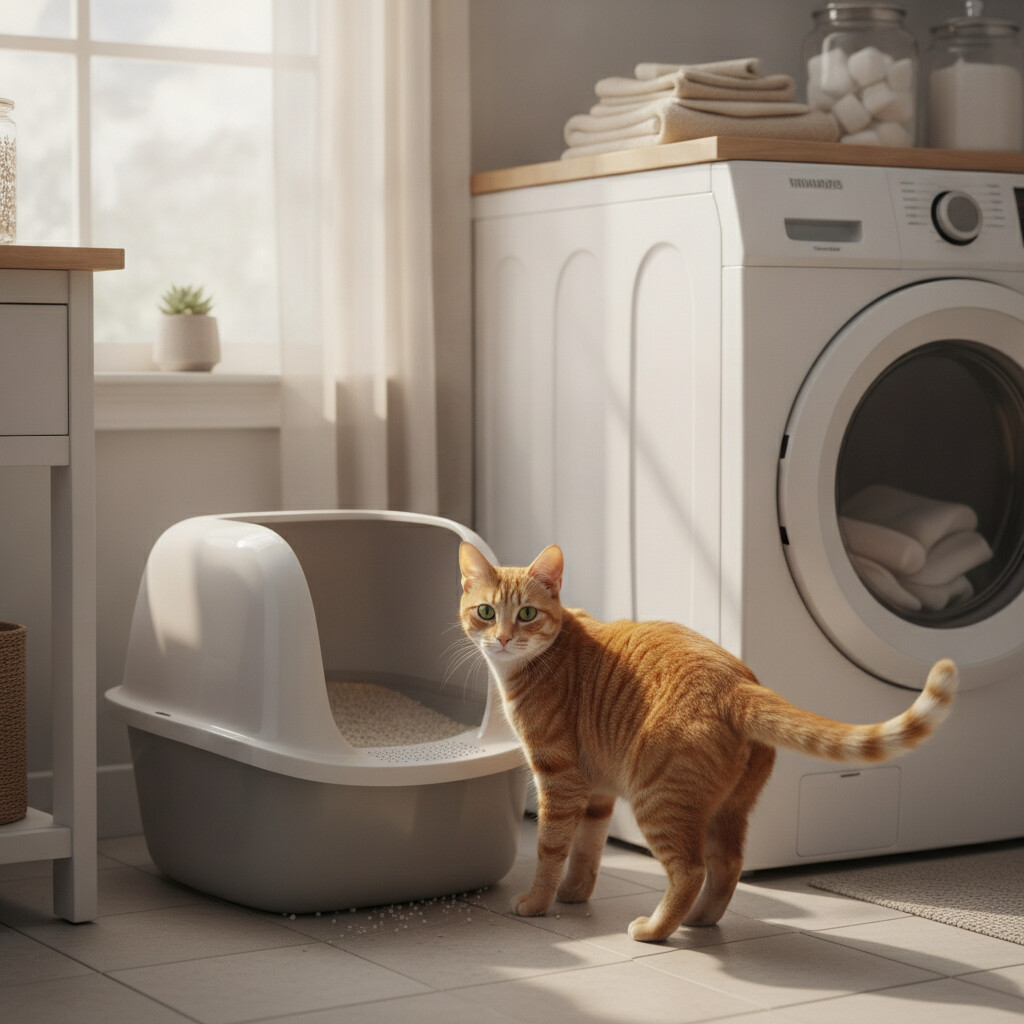
When a cat stops covering their poop, it’s usually one of three things: something about the litter box puts them off, something hurts, or they simply never learned to do it. Plenty of cats are casual coverers their whole lives, and that’s fine. A sudden change in a cat who always used to bury it is the one to pay attention to.
Here’s how to work out which one you’re dealing with, and what to change.
Why do cats bury their poop in the first place?
Burying waste is instinctive, but researchers are still debating exactly why cats do it. The most common explanation is scent control: covering droppings makes a cat less obvious to predators and to other cats.
Field studies of free-roaming farm and feral cats, summarised in the standard behaviour reference The Domestic Cat: The Biology of Its Behaviour (Turner and Bateson, Cambridge University Press), have reported that cats tend to bury their droppings near the centre of their home range but often leave them uncovered further out. That suggests an uncovered pile can sometimes act as a scent message, not just carelessness.
Kittens usually start digging and covering at around three to four weeks old. They seem to pick it up partly by instinct and partly by watching their mother. Kittens who were orphaned or weaned very early sometimes never get the hang of it.
So not covering isn’t automatically a problem. What matters is whether it’s new, and what else is going on.
The most common reason: the litter box itself
When a cat that used to bury stops, or does a quick token scratch at the wall and leaves, the box is the first thing to check. Cats are fussy about where they go to the toilet. If the setup is uncomfortable, they get in and out as fast as possible and skip the digging.
Things that commonly put cats off covering:
- The box is too small. The joint AAFP/ISFM guidelines on house soiling (Journal of Feline Medicine and Surgery, 2014) suggest a box at least one and a half times the length of the cat, nose to base of tail. Most boxes sold as standard are smaller than that for an adult cat. A cat who can’t turn around comfortably can’t dig properly either.
- The litter feels wrong. Many cats prefer fine, soft, sand-like clumping litter. Coarse pellets, crystals or heavily scented litter can be unpleasant on the paws. Our article on scented vs. unscented cat litter goes into what cats actually choose when given the option.
- There’s too little litter, or too much. Too shallow and there’s nothing to dig in. Too deep and some cats don’t like standing in it. A couple of inches is a sensible starting point.
- It isn’t clean enough. Many cats don’t want to dig through old waste. Scooping at least once a day makes a real difference.
- The hood or liner bothers them. Covered boxes trap smell and can feel cramped. Plastic liners can snag claws when a cat digs. Here’s more on covered vs. open litter boxes.
- The location feels exposed or noisy. A box next to a rumbling washing machine, or in a spot where the dog or another cat can ambush them, encourages a quick exit.
If you change something, change one thing at a time so you can tell what worked.
Could it be pain?
This is the cause most worth ruling out, especially in an older cat. Digging and covering takes a squat, a twist and a fair bit of paw work. If any of that hurts, the cat may skip it.
Arthritis is far more common in cats than most owners realise. A 2002 study in the Journal of the American Veterinary Medical Association (Hardie and colleagues) found X-ray evidence of degenerative joint disease in 90% of cats over 12 years old. Most of those cats had never been diagnosed, because cats rarely limp. They just quietly stop doing the things that hurt, like jumping, climbing into high-sided boxes and digging. Our guide to arthritis in senior cats covers the subtle signs.
Other painful causes include:
- Sore paws, for example after a nail injury, or in declawed cats. A 2018 study in the Journal of Feline Medicine and Surgery (Martell-Moran and colleagues) found declawed cats were more likely to have litter box problems and signs of back pain than cats that hadn’t been declawed.
- Constipation, diarrhea or anal gland discomfort, which can make a cat want to get away from the box as fast as possible.
- Urinary problems, such as cystitis, which often go along with other changes in litter box habits.
If your cat has started leaving poop uncovered and is also jumping less, peeing or pooping outside the box, straining or hiding, a vet check comes before any litter experiments.
Is it a dominance thing in multi-cat homes?
You’ll often read that a cat leaves poop uncovered to “show dominance” over other cats in the house. It’s a tidy theory, but there’s very little direct evidence for it in household cats. Most feline behaviourists now prefer to look at tension and competition for resources rather than dominance.
What does seem to matter in multi-cat homes is access. If one cat blocks the hallway to the box, or ambushes others as they come out, the cat being targeted may rush through and skip the covering. The usual guideline is one litter box per cat plus one extra, spread across different locations, not lined up together. Here’s our breakdown of how many litter boxes you actually need.
What to try at home
If your cat is healthy and the change isn’t sudden, work through this list:
- Go bigger. A large, open storage tote often works better than a standard litter box.
- Switch to unscented, fine-grained clumping litter, mixing it in gradually over a week if your cat is fussy.
- Scoop daily, and fully change and wash the box regularly, using mild soap rather than strong-smelling cleaners.
- Add a box if you have more than one cat, in a different, quiet spot.
- Lower the entry for older cats. A box with a low side, or one cut down on one side, makes getting in and out easier.
- Leave it alone. If your cat has never covered and is otherwise healthy, some cats simply don’t. Scoop promptly and let it go.
Don’t punish a cat for not covering, and don’t try to “show them” by moving their paws in the litter. It adds stress around the box, which is the opposite of what you want.
When to see a vet
Book a vet visit if:
- your cat always used to cover and has suddenly stopped
- the change comes with peeing or pooping outside the box
- your cat is jumping less, walking stiffly or seems reluctant to climb into the box
- you’ve noticed diarrhea, very hard stools, blood or mucus, or straining
- your cat is hiding, eating less or seems “off”
Contact a vet straight away, as an emergency, if your cat is straining in the litter box and producing little or no urine. This is especially urgent for male cats. A urinary blockage can become life-threatening within a day or two.
Most of the time, an uncovered poop is a litter box review waiting to happen. Occasionally it’s the first sign that something hurts, and that’s worth catching early.
Does your cat bury it like treasure, or walk away like nothing happened?