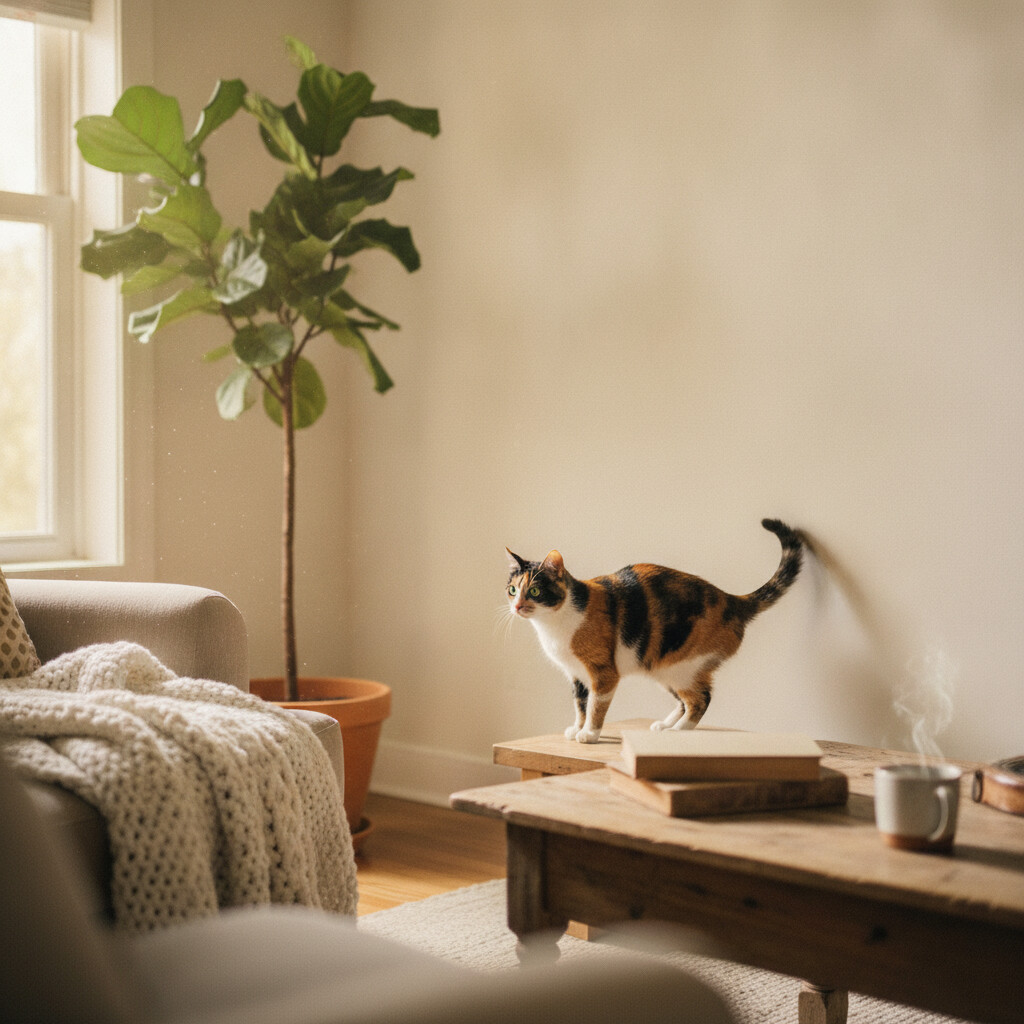
Most of the time, a cat staring fixedly at a blank wall is tracking something you can’t see or hear — not “sensing a ghost.” Cats have wider peripheral vision, sharper motion detection, and far better high-frequency hearing than we do, so a patch of empty drywall to you can be a moving shadow, a scurrying insect, or a sound behind the plaster to them. In a small number of cases, though, prolonged wall-staring is a sign worth mentioning to a vet — and knowing the difference matters.
The Sensory Explanation: They’re Probably Seeing or Hearing Something Real
Cats process motion differently than humans do. Their retinas are packed with rod cells built for detecting movement in low light — useful for a nocturnal hunter, less useful for reading fine detail. A dust mote drifting in a sunbeam, the flicker of a reflection, or a spider moving along a baseboard can all register to a cat’s eye as something worth locking onto, even when it’s invisible or irrelevant to us.
Hearing plays a bigger role than most owners realize. Cats can detect frequencies up to roughly 64 kHz, well above the human ceiling of about 20 kHz and even above most dogs’ range. Mice, insects, and the electrical hum of appliances all produce sound in ranges we simply can’t register. A cat staring at a wall near a pipe, vent, or wiring run may genuinely be listening to something moving inside it — which is also why “phantom” wall-staring sometimes coincides with an actual pest problem the owner discovers weeks later.
Hunting Instinct and Play Behavior
This is a different behavior than a cat locking eyes on you — see our piece on why cats stare at people without blinking if that’s the staring you’re actually dealing with. Even indoor cats retain a full predatory sequence: stalk, chase, pounce, kill. When there’s no real prey available, that sequence can misfire onto imaginary targets — a behavior ethologists sometimes call vacuum activity, where an instinctive behavior fires even without the stimulus that normally triggers it. A cat crouched and staring at a wall, tail twitching, is often mid-hunt for something that either isn’t there or has already retreated out of sight (behind the wall, under a cabinet, into a vent).
This is more likely if the staring is accompanied by:
- A low crouch or “loaf” position with tense shoulders
- Twitching tail tip
- Sudden pounces or swats at the wall or floor
- The behavior happening most often at dawn or dusk, when hunting instincts peak
If that’s your cat’s pattern, it’s almost certainly normal predatory behavior, not a medical concern.
When Staring Might Signal a Health Issue
Occasional wall-staring is unremarkable. A few patterns are worth flagging to a veterinarian:
Disorientation or confusion alongside the staring. Cats with feline cognitive dysfunction — the feline equivalent of dementia — sometimes stare blankly at walls or into corners as part of a broader pattern of nighttime vocalizing, disrupted sleep, and confusion in familiar spaces. This is almost always a senior-cat issue; see our guide on feline cognitive dysfunction in senior cats for the full symptom picture and what helps.
Repetitive staring with no clear trigger, especially with a “glazed” or unresponsive look. In rare cases, fixed staring, sudden freezing, or a blank unresponsive stare can be a subtle form of focal seizure activity. This is uncommon, but if the episodes are brief, repetitive, and the cat seems briefly “not there” — unresponsive to your voice or touch during the episode — it’s worth a vet visit to rule out.
Staring paired with visible discomfort. Cats hide pain well. If wall-staring appears alongside hiding, reduced appetite, or reluctance to move, treat it as one symptom among several rather than the main event — vomiting or appetite changes deserve their own workup; see when cat vomiting is or isn’t worth worrying about.
A genuine change in behavior. The key word is change. A cat that has always people-watched or bug-watched from a windowsill isn’t showing new behavior. A previously non-staring cat suddenly developing the habit, especially over age 10, is the pattern most worth a vet visit.
What Veterinary Behaviorists Say
Feline behavior researchers, including those cited by the American Association of Feline Practitioners (AAFP), generally categorize “staring at nothing” under normal environmental scanning and predatory behavior in healthy cats — it’s one of the most commonly reported “odd” behaviors owners ask about, and one of the least often linked to actual pathology. The exception carved out consistently in veterinary behavior literature is repetitive, stereotypic staring combined with other neurological or cognitive signs, which is where it crosses from quirky to clinical.
When to See a Vet
Book a vet visit if wall-staring is joined by any of the following:
- Sudden onset in a cat that’s never done it before, especially in a senior cat
- Brief freezing or unresponsiveness during the episode, or a “glassy” look
- Disorientation, wandering, or getting “stuck” in corners
- Changes in appetite, litter box habits, sleep-wake cycle, or vocalization
- Any signs of pain, hiding, or reduced grooming alongside it
Bring a phone video if you can. Behavior that’s hard to describe in words is often obvious to a vet on video, and it helps rule seizure activity in or out much faster than a verbal description alone.
The Practical Takeaway
For the vast majority of cats, staring at a wall is your cat’s excellent senses doing exactly what they evolved to do — noticing movement, sound, or scent you’ll never perceive. Watch the context, not just the behavior itself: a crouched, twitchy-tailed stare during dawn or dusk is a hunting cat. A blank, disoriented stare in an older cat that’s also acting confused is worth a conversation with your vet. Most of the time, you can just let your cat watch the wall in peace.