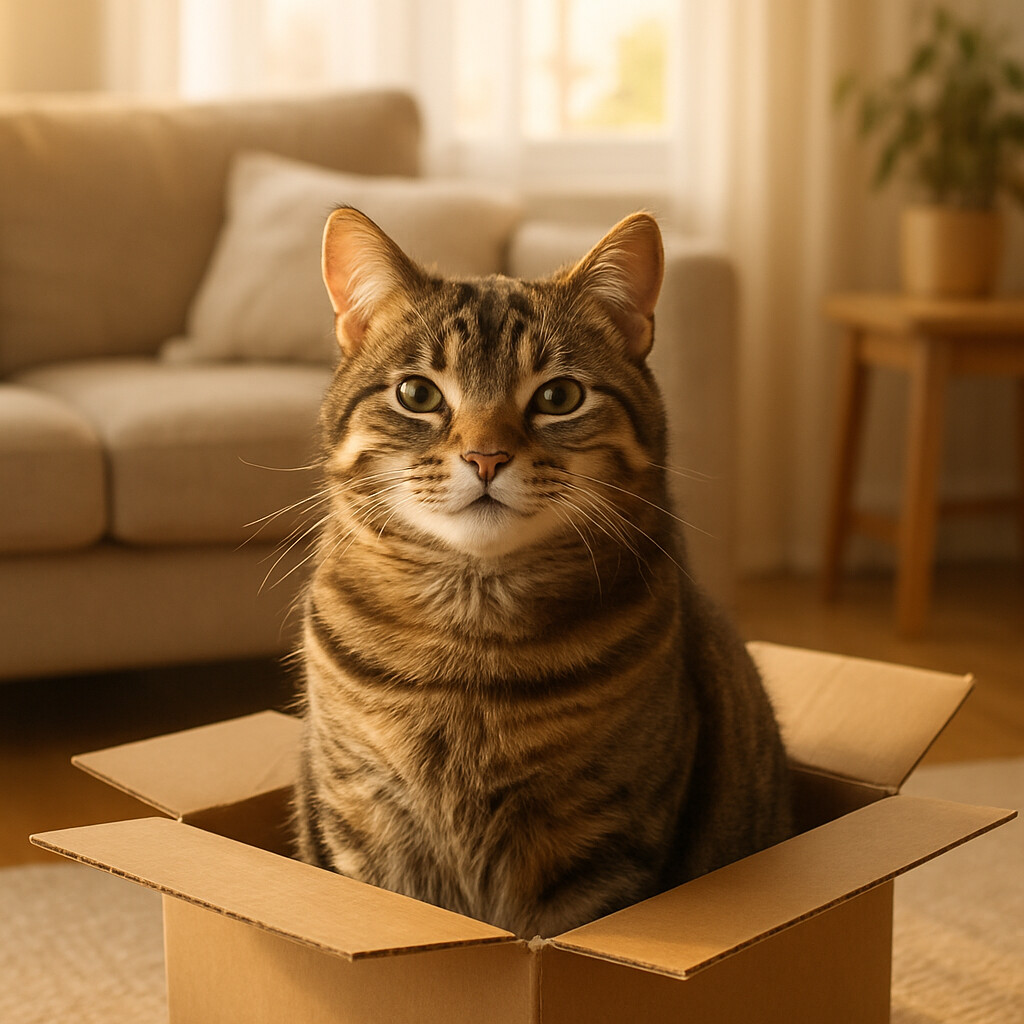
You bring home a new sofa. Your cat ignores it. You leave out the cardboard box it came in. Your cat moves in.
This scenario plays out in nearly every cat household in America — and it’s not a quirk. There’s real science behind why cats are magnetically drawn to boxes, and understanding it can actually help you manage your cat’s stress, improve their environment, and even catch early warning signs of anxiety.
Here’s everything you actually need to know.
The Core Reason: Boxes Trigger a Hardwired Stress Response
Cats are both predator and prey animals. In the wild, small wild cats rely on enclosed spaces to stay hidden from larger predators while also using them as ambush points for prey. That dual need — for concealment and for a launch point — is baked into their nervous system.
When a cat is in a box, their back and sides are protected. They have a clear sightline to what’s in front of them. Their threat perception drops, their heart rate slows, and cortisol levels (the stress hormone) decrease.
A landmark 2014 study published in the journal Applied Animal Behaviour Science placed shelter cats in two groups: one with boxes, one without. After two weeks, the cats with boxes adapted to shelter life significantly faster, showed fewer stress behaviors, and were more interested in interacting with humans. The box wasn’t a toy. It was a coping tool.
Why Enclosed Spaces Work Better Than Open “Safe Zones”
You might wonder: if a cat wants to feel safe, why doesn’t a cozy corner of the couch work the same way?
It comes down to tactile input. When a cat’s body is in contact with surfaces on multiple sides — the bottom, sides, and sometimes the top of a box — it activates something researchers call thigmotaxis, which is the instinct to seek comfort through touch with surrounding surfaces. This is the same instinct that makes cats love pressing themselves into tight spots, curling under blankets, or wedging themselves between the couch cushions.
Open spaces, even quiet ones, don’t provide the same sensory reassurance as enclosed contact. The box isn’t just about hiding — it’s about feeling the walls around them.
What Box Shape and Size Actually Matters
Not all boxes are equal. Cats have preferences, and ignoring them means your cat may be choosing the cardboard Amazon box over the expensive cat cave you bought because the dimensions are simply better.
Ideal box dimensions for most cats:
- Length: 16–20 inches (slightly longer than your cat’s body length)
- Width: 12–16 inches (enough to turn around comfortably)
- Height: At least 12 inches (so they’re not fully exposed above the rim)
Smaller cats (under 8 lbs) often prefer tighter fits — they feel more secure when the walls are close. Larger cats (over 12 lbs) need more room or they’ll simply avoid the box.
Entry point matters too. A box with one cut-out side is preferable to a box with the top flap open — cats prefer a single, defined entry point they can monitor, not an open top that exposes them from above.
Cardboard Specifically Has Extra Appeal
If you’ve wondered why cats often prefer a cheap cardboard box over a plush fabric cat bed, there are two reasons beyond shape:
-
Cardboard is a thermal insulator. It holds warmth. Cats have a thermoneutral zone of 86–97°F, meaning their body doesn’t have to work hard to stay warm when they’re in contact with cardboard. Fabric on a hard floor surface is cooler.
-
Cardboard absorbs scent. Cats use scent marking heavily to feel secure. A cardboard box absorbs their pheromones quickly, becoming “theirs” within a day or two. Fabric and plastic surfaces don’t absorb scent the same way.
This is also why your cat will often return to a broken-down box long after it’s ceased to be structurally useful — it smells like them.
When Box Obsession Is Actually a Stress Signal
A cat that occasionally naps in boxes is living their best life. But a cat that spends most of the day in a box, refuses to come out when the household is active, or seems to be using the box to hide from people or other pets is showing you something important: they’re overwhelmed.
Watch for these patterns:
- Hiding during normal household activity (not just during loud events or strangers visiting)
- Reluctance to leave the box for meals
- Running directly from the food bowl back to the box
- Hissing or swatting when approached in the box
These behaviors point to a chronic stress load that goes beyond “cats like boxes.” Common causes include conflict with another pet in the home, insufficient vertical space, a litter box that’s too close to their feeding area, or a recent change in routine.
If your cat is box-hiding excessively, the ASPCA’s guide on feline stress is a useful diagnostic starting point, and a vet visit to rule out pain (which mimics stress behavior) is worth doing.
How to Actually Use This Knowledge
Understanding the box instinct gives you practical tools:
Provide a permanent enclosed space. Don’t wait for the next Amazon delivery. Give your cat a dedicated box or cat cave placed in a quiet spot, away from foot traffic and other pets’ favorite areas. Replace it every few months when the scent starts to feel “stale” to them (cardboard absorbs too much and can also harbor bacteria).
Position matters. Elevated boxes — on a shelf, a cat tree platform with walls, or a bookcase — combine the box effect with the security cats get from height. This is especially valuable in multi-cat homes where a ground-level box can feel vulnerable.
Use boxes during transitions. Moving house, bringing home a new pet, having guests over? Set up a box in a quiet room for your cat before the event. The ASPCA recommends this as one of the simplest ways to reduce stress during major changes.
Don’t force interaction at the box. If your cat is in their box, that’s their “do not disturb” signal. Reaching in to pet them when they’ve retreated there can backfire — it teaches them the box isn’t actually safe, which defeats the whole purpose.
Multi-Cat Households: Box Politics Are Real
In homes with more than one cat, boxes become territory. If you have two cats, you need at least two boxes placed in different rooms or different areas of the same room — ideally at different heights if one cat dominates the other.
Cats who don’t have their own box may show increased tension with the resident cat, over-groom, or start eliminating outside the litter box. These behaviors are often misread as personality problems when they’re actually resource competition problems.
The rule of thumb: one box per cat, plus one extra. Same as litter boxes.
The cardboard box is one of the cheapest enrichment tools you have. Now that you know why it works, you can use it strategically — as a stress buffer, a diagnostic tool, and a permanent fixture your cat will thank you for (in their own silent, judgmental cat way).
— CatLady6