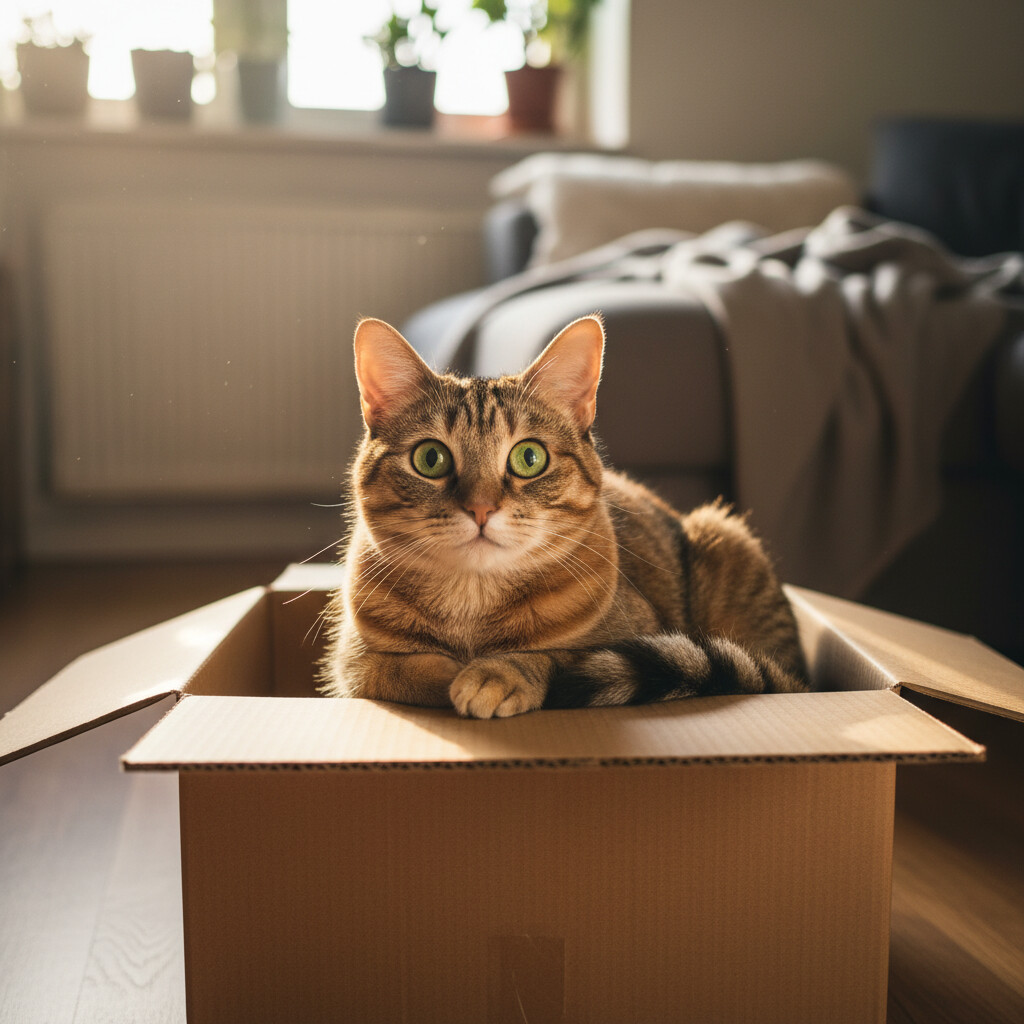
Cats seek out boxes because enclosed spaces make them feel secure, warm, and strategically positioned. It’s not quirky for quirky’s sake — it’s deeply wired into how cats process safety and territory. Here’s what’s actually going on.
The Science: Boxes Reduce Stress
The most compelling research on this comes from a 2014 study published in Applied Animal Behaviour Science by ethologist Claudia Vinke at Utrecht University. Shelter cats given cardboard boxes adapted to their new environment significantly faster than cats without them — they showed lower cortisol levels and approached human contact sooner.
The reason is simple: a box limits the number of directions a threat can come from. In the wild, a cat in an open field can be approached from 360 degrees. A cat in a hollow log can only be approached from one or two. Boxes replicate that geometry inside your home. Even if your cat’s biggest threat is your Roomba, the nervous system doesn’t know that.
Ambush Predators Need Cover
Cats are ambush predators — they evolved to hunt by waiting, watching, and striking from concealment rather than running prey down. A box satisfies that instinct even when there’s nothing to hunt. It’s the same reason cats are drawn to the gap behind the couch, the space under the bed, and any paper bag left on the floor.
This also explains why cats in boxes don’t just sleep — they watch. A cat sitting in a box with its head up is surveying its territory from a defensible position. They’re not hiding from the world; they’re observing it from cover.
Warmth: Cardboard Is a Surprisingly Good Insulator
Cats have a thermoneutral zone between 86°F and 100°F (30–38°C) — the temperature range where they don’t have to spend energy on heating or cooling themselves. Most homes run cooler than that. Cardboard is a decent insulator, and the enclosed space traps body heat. A box, especially a small one, becomes a self-warming den.
This is why cats often prefer boxes that are too small for them to fully stretch out in. A snug fit maximises heat retention. If your cat is draped halfway out of a box that’s objectively too small, that’s thermoregulation, not poor spatial reasoning.
New Box in the House? It’s Theirs Now.
Cats are drawn to novel objects in their environment — a behaviour called neophilia, which is part of their broader investigative instinct. A new box arriving in the house is an environmental event that demands investigation and, often, immediate occupation.
But it goes beyond curiosity. Cats also scent-mark objects they consider part of their territory. When a cat sits in your Amazon box, it’s rubbing its scent glands (located on the paws, cheeks, and chin) onto the surface and claiming it. The fact that you might need that box to return something is irrelevant from the cat’s perspective.
What This Tells You About What Your Cat Needs
If your cat spends a lot of time in boxes, it’s a good sign they’re doing what cats do — but it also tells you something about what they find satisfying:
- Enclosed spaces feel safe. Provide options: cat trees with enclosed cubbies, tunnel toys, igloo-style beds, or a cardboard box left out deliberately.
- Vertical + enclosed is the gold standard. A cubby at height gives cover and elevation — two different stress-reduction mechanisms in one.
- Don’t take the boxes away. If your cat has adopted a cardboard box, let them have it for a while. It costs nothing and provides genuine comfort.
For indoor cats especially, boxes and enclosed hiding spots are a form of environmental enrichment — they give the cat agency in their environment, which matters for stress reduction.
When Box Behaviour Becomes a Concern
Normal box behaviour: seeking out boxes occasionally, using them to rest or observe, investigating new boxes as they arrive.
Worth watching: a cat that suddenly starts hiding in boxes and doesn’t come out — especially if paired with other signs like changes in appetite, reduced grooming, or unusual quietness. This pattern can indicate illness, pain, or significant stress. Cats instinctively hide when they feel unwell.
If your cat’s box behaviour changes abruptly — particularly if they seem to be hiding rather than lounging — it’s worth a closer look. A vet visit to rule out physical causes is always the right call when a cat’s normal behaviour shifts suddenly.
The Short Version
Your cat sits in boxes because:
- Enclosed spaces are inherently calming — evolutionary wiring, not preference
- Boxes are warm and trap body heat
- A box is a great place to observe the world from a defensible position
- New boxes need to be investigated and claimed — it’s territorial instinct
Let them have the boxes. Provide more enclosed spaces if you can. And if the box behaviour shifts into something that looks more like hiding than lounging, pay attention — that distinction matters.