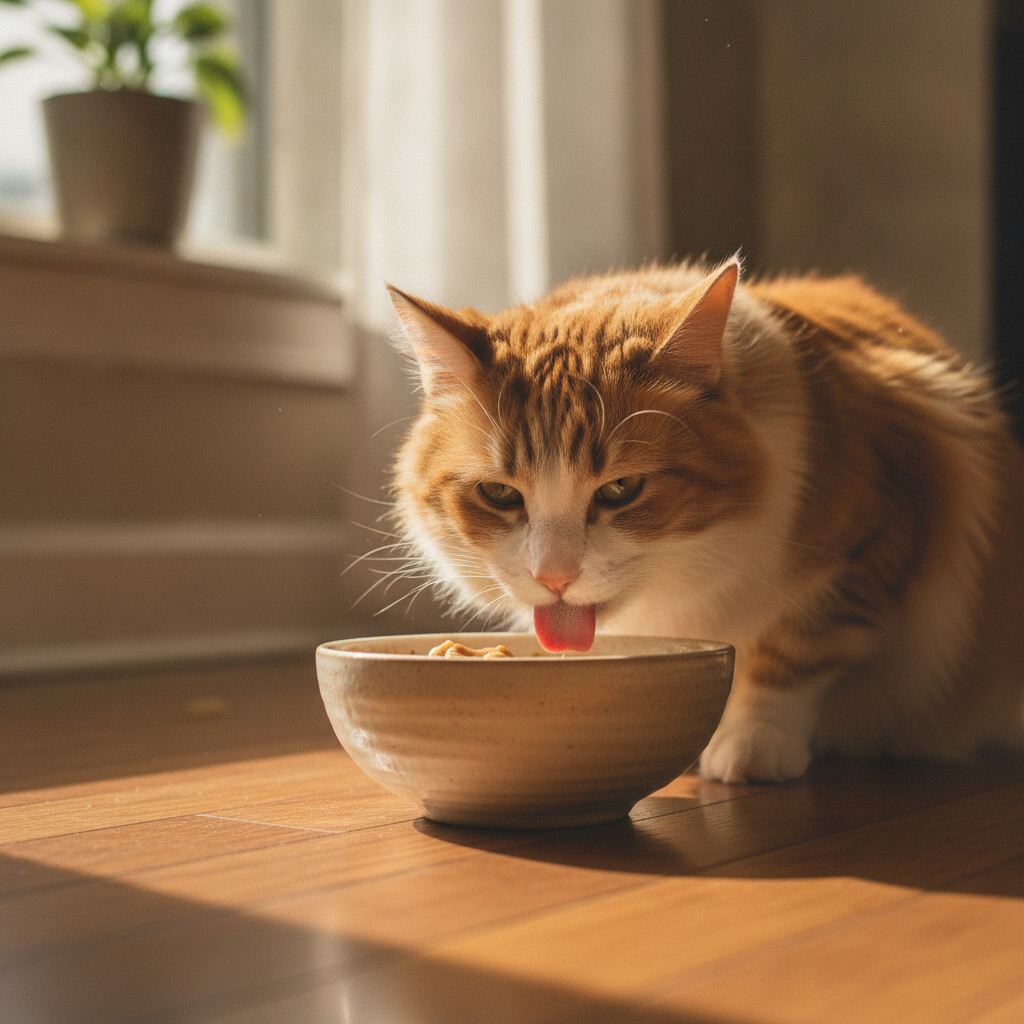
Most cats who lick the gravy and leave the chunks are going for the most flavourful, most aromatic part of the meal. That’s normal behaviour, not a quirk. The catch is that the gravy alone isn’t a full meal, so a cat who eats only the gravy can slowly lose weight. Here’s why they do it, when it’s worth worrying about, and how to get the chunks eaten too.
Why cats go for the gravy first
The gravy is where most of the flavour sits. Pet food manufacturers coat food in palatability enhancers to make it more appealing. Common ones are animal digests (meat broken down into a savoury liquid), hydrolysed proteins and fats. In a “chunks in gravy” product, a lot of that flavour ends up in the liquid. From your cat’s point of view, the gravy is the tastiest part of the bowl.
Cats are tuned to savoury, meaty tastes. Cats lack a working sweet-taste receptor, a finding first described by Li and colleagues in PLoS Genetics (2005). They are, however, highly sensitive to savoury “umami” compounds. A 2023 study in Chemical Senses (McGrane et al.) found that the cat umami receptor responds strongly to compounds that are abundant in meat and fish. A meaty, salty gravy hits exactly what a cat’s palate is built for.
Smell drives appetite more than taste does. Cats decide whether to eat largely by smell. Warm, wet gravy releases more aroma than a dense chunk does, so it’s the first thing they notice and the first thing they go for.
Texture matters. Some cats simply prefer licking to chewing. Cats develop strong texture preferences, often based on what they ate as kittens. A cat raised on pâté may never really accept chunks, and some cats prefer finely shredded food to either.
Is it a problem if my cat only eats the gravy?
Now and then, no. As a long-term habit, possibly.
When a wet food is labelled “complete and balanced”, that claim applies to the whole can, chunks and gravy together. The gravy is mostly water, held together with thickeners like starch or gums. Most of the protein, and a lot of the vitamins and minerals, are in the chunks. A cat who eats only the gravy is getting fewer calories and less protein than the label suggests, even when the bowl looks well licked.
Over weeks, that can lead to:
- Gradual weight and muscle loss, which is easy to miss under a fluffy coat
- Begging soon after meals, because they’re still hungry
- Owners topping up with more gravy food, making the problem worse
There’s one more risk. Cats should not go without proper food for long. A cat who eats very little for even a few days, especially an overweight cat, is at risk of hepatic lipidosis (fatty liver disease), a serious condition explained in our hepatic lipidosis guide.
The upside: gravy is a decent source of water, and many cats don’t drink enough. If hydration is a concern for your cat, see our article on why cats don’t drink enough water. Just don’t count on gravy to supply the nutrition as well.
When the gravy habit means something else
Sometimes a cat licks the gravy because chewing hurts. This is the reason vets most want to rule out, especially if the habit started suddenly in a cat who used to eat chunks without a problem.
Dental disease is extremely common in adult cats. Tooth resorption, a painful condition where the tooth structure breaks down, is reported in roughly a third or more of adult cats in several studies, and the proportion rises with age. Signs that point toward mouth pain include:
- Dropping food, or chewing on one side
- Drooling, or pawing at the mouth
- Bad breath or red gums
- Approaching the bowl eagerly, then backing away
Nausea, kidney disease and other conditions that blunt appetite can produce the same “lick a bit, walk away” pattern. A cat who has always licked the gravy is probably just being picky. A cat who has just started is worth a vet check.
How to get your cat to eat the whole meal
If your vet is happy that there’s no medical reason, these usually work, roughly from easiest to most effort:
- Mash the chunks into the gravy. A fork, thirty seconds, done. Many cats will eat the whole thing once there’s nothing to separate.
- Switch to pâté, mousse or finely minced textures. These have no separate gravy to pick out. If your cat likes a particular brand’s gravy flavour, try the same brand in a pâté first.
- Warm it slightly. Food served around body temperature smells stronger. A few seconds in the microwave, stirred well, is enough. Check for hot spots and don’t serve it hot.
- Add a spoon of warm water to pâté. This gives gravy-lovers the lickable texture they want without leaving solid food behind.
- Serve smaller portions, more often. A fresh small portion is more appealing than food that has been sitting in the bowl.
- Don’t top up the gravy. If you put down more gravy food every time the bowl is “empty”, your cat learns to wait for the good bit.
- Change food gradually. A sudden switch can backfire. Our guide on transitioning to a new food walks through how to do it over a week or so.
A word on leftovers: wet food shouldn’t sit at room temperature indefinitely. Many manufacturers and vets suggest throwing out uneaten wet food after a few hours, sooner in warm weather. Old chunks are also less appealing than fresh food, so a cleared bowl helps here too.
If your cat is fussy across the board, not just with gravy, our guide to helping a picky cat actually eat covers bowl choice, feeding location and other things that put cats off food.
Can I just feed gravy-only toppers?
Products sold as “toppers”, “broths” or “complements” are usually labelled for supplemental or intermittent feeding. That means they aren’t designed to be a whole diet. You’ll find the statement near the nutrition information on the label. Our guide to reading a cat food label shows where to look.
Used as a small add-on to a complete food, toppers are fine. As a replacement for the meal, they leave gaps.
When to see a vet
Book a vet visit if your cat:
- Started licking only the gravy recently, after previously eating chunks
- Shows any sign of mouth pain: drooling, dropping food, chewing on one side, pawing at the face
- Is losing weight, or you can feel their spine and hips more easily than before
- Is vomiting, drinking more than usual, or less active
Call the same day if your cat has eaten little or nothing for 24 hours, or for any length of time if they are overweight, older or already unwell.
The bottom line: a gravy-licker is usually just a cat with strong opinions about flavour and texture. Mash the food, try a pâté, and keep an eye on their weight. If the habit is new, or comes with any of the signs above, let a vet look at their mouth before you blame the food.